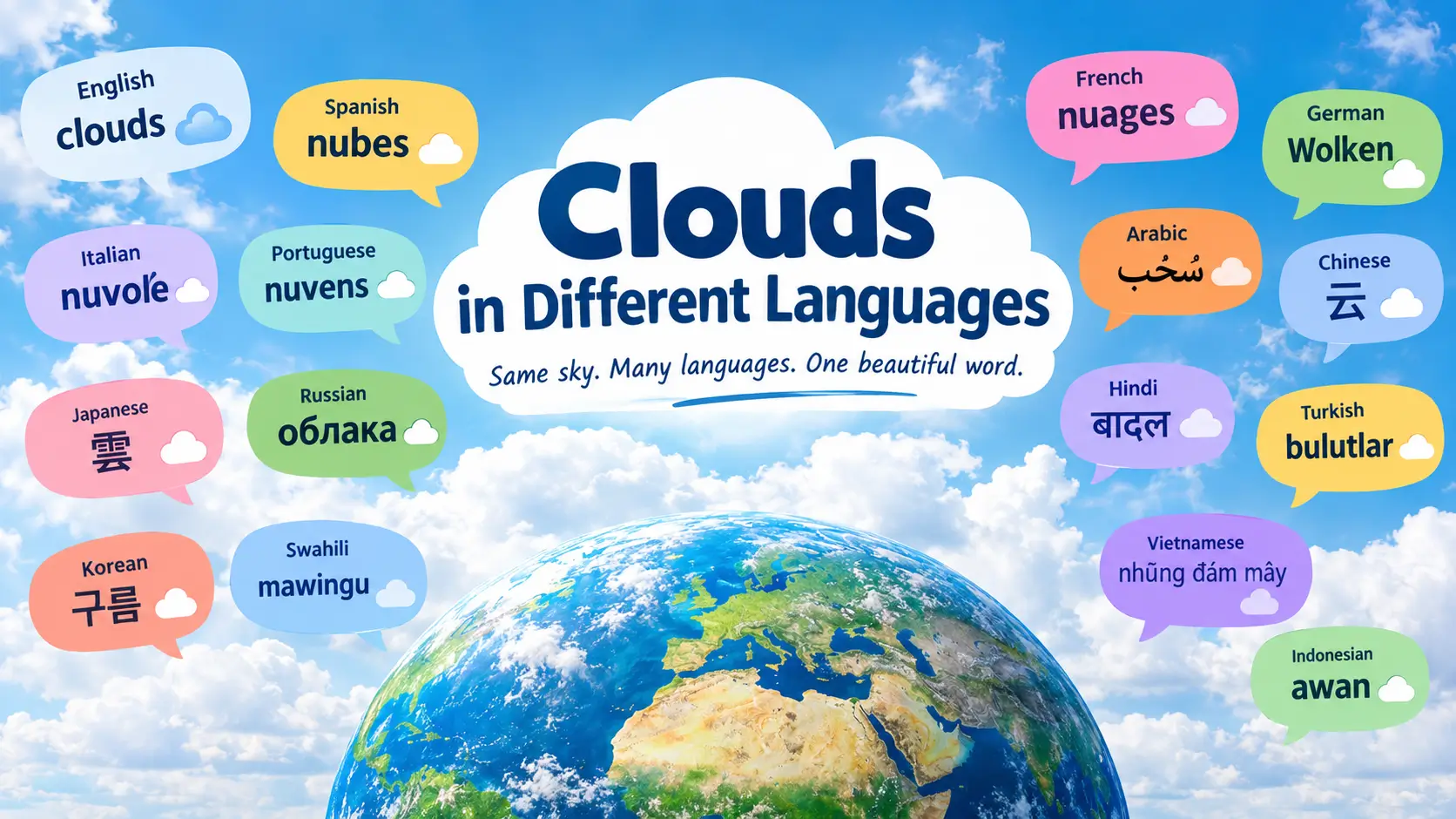
Clouds are one of the most familiar sights in nature, but the word “clouds” sounds very different from one language to another. Learning how to say clouds in different languages is useful for travelers, language learners, writers, students, and anyone interested in world languages.
In this guide, you’ll discover clouds translations in 70 languages, along with easy English pronunciations and short real-life examples. Whether you are searching for clouds in all languages, wondering how to say clouds in different languages, or simply exploring how the word is expressed around the world, this list provides a practical reference.
Clouds in Different Languages
The following table gives the common word or phrase for “clouds” in 70 languages. Pronunciations are simplified for English speakers and are intended as learning aids rather than exact phonetic transcriptions.
| # | Language | Native Phrase | Easy English Pronunciation | Example Sentence | English Meaning |
|---|---|---|---|---|---|
| 1 | English | clouds | klowdz | The clouds are moving quickly. | The clouds are moving quickly. |
| 2 | Spanish | nubes | NOO-bes | Las nubes cubren el cielo. | The clouds cover the sky. |
| 3 | French | nuages | nwee-AHZH | Les nuages sont gris. | The clouds are gray. |
| 4 | German | Wolken | VOL-ken | Die Wolken sind dunkel. | The clouds are dark. |
| 5 | Italian | nuvole | NOO-vo-leh | Le nuvole sono bianche. | The clouds are white. |
| 6 | Portuguese | nuvens | NOO-vens | As nuvens estão baixas. | The clouds are low. |
| 7 | Dutch | wolken | VOL-ken | De wolken zijn dik. | The clouds are thick. |
| 8 | Afrikaans | wolke | VOL-kuh | Die wolke bedek die son. | The clouds cover the sun. |
| 9 | Swedish | moln | moln | Molnen är mörka. | The clouds are dark. |
| 10 | Norwegian | skyer | SHOO-er | Skyene dekker himmelen. | The clouds cover the sky. |
| 11 | Danish | skyer | SKOO-er | Skyerne er grå. | The clouds are gray. |
| 12 | Icelandic | ský | skwee | Skýin eru hvít. | The clouds are white. |
| 13 | Finnish | pilvet | PEEL-vet | Pilvet ovat harmaita. | The clouds are gray. |
| 14 | Estonian | pilved | PEEL-ved | Pilved liiguvad kiiresti. | The clouds are moving quickly. |
| 15 | Latvian | mākoņi | MAH-konyi | Mākoņi ir tumši. | The clouds are dark. |
| 16 | Lithuanian | debesys | deh-BEH-sis | Debesys dengia saulę. | The clouds cover the sun. |
| 17 | Polish | chmury | HMOO-ri | Chmury są niskie. | The clouds are low. |
| 18 | Czech | mraky | MRAH-kee | Mraky jsou šedé. | The clouds are gray. |
| 19 | Slovak | oblaky | OH-bla-kee | Oblaky sú biele. | The clouds are white. |
| 20 | Slovenian | oblaki | oh-BLAH-kee | Oblaki pokrivajo nebo. | The clouds cover the sky. |
| 21 | Croatian | oblaci | oh-BLAH-tsee | Oblaci su tamni. | The clouds are dark. |
| 22 | Serbian | облаци | OH-bla-tsee | Облаци су густи. | The clouds are thick. |
| 23 | Bosnian | oblaci | oh-BLAH-tsee | Oblaci prekrivaju nebo. | The clouds cover the sky. |
| 24 | Macedonian | облаци | OH-bla-tsee | Облаците се движат. | The clouds are moving. |
| 25 | Bulgarian | облаци | OH-bla-tsee | Облаците са сиви. | The clouds are gray. |
| 26 | Russian | облака | ah-bla-KAH | Облака закрыли солнце. | The clouds covered the sun. |
| 27 | Ukrainian | хмари | KHMA-ri | Хмари закрили сонце. | The clouds covered the sun. |
| 28 | Belarusian | аблокі | ah-bloh-KEE | Аблокі цёмныя. | The clouds are dark. |
| 29 | Greek | σύννεφα | SEE-ne-fa | Τα σύννεφα είναι λευκά. | The clouds are white. |
| 30 | Albanian | retë | REH-tuh | Retë mbulojnë qiellin. | The clouds cover the sky. |
| 31 | Romanian | nori | NOR-ee | Norii sunt gri. | The clouds are gray. |
| 32 | Hungarian | felhők | FEL-hurk | A felhők sötétek. | The clouds are dark. |
| 33 | Turkish | bulutlar | boo-LOOT-lar | Bulutlar gökyüzünü kaplıyor. | The clouds are covering the sky. |
| 34 | Azerbaijani | buludlar | boo-LOOD-lar | Buludlar göyü örtür. | The clouds cover the sky. |
| 35 | Georgian | ღრუბლები | GHROOB-leh-bee | ღრუბლები ცას ფარავენ. | The clouds cover the sky. |
| 36 | Armenian | ամպեր | am-PER | Ամպերը մուգ են։ | The clouds are dark. |
| 37 | Persian | ابرها | abr-HAA | ابرها آسمان را پوشاندند. | The clouds covered the sky. |
| 38 | Arabic | سُحُب | SOO-hoob | السحب تغطي السماء. | The clouds cover the sky. |
| 39 | Hebrew | עננים | ah-na-NEEM | העננים כהים. | The clouds are dark. |
| 40 | Hindi | बादल | BAA-dal | बादल आसमान में हैं। | The clouds are in the sky. |
| 41 | Urdu | بادل | BAA-dal | بادل آسمان پر چھائے ہیں۔ | The clouds cover the sky. |
| 42 | Bengali | মেঘ | megh | মেঘ আকাশ ঢেকে দিয়েছে। | The clouds have covered the sky. |
| 43 | Punjabi | ਬੱਦਲ | BAD-dal | ਬੱਦਲ ਅਸਮਾਨ ਨੂੰ ਢੱਕ ਰਹੇ ਹਨ। | The clouds are covering the sky. |
| 44 | Gujarati | વાદળો | VAA-dah-lo | વાદળો આકાશમાં છે. | The clouds are in the sky. |
| 45 | Marathi | ढग | DHUG | ढग आकाशात आहेत. | The clouds are in the sky. |
| 46 | Nepali | बादलहरू | BAA-dal-ha-roo | बादलहरूले आकाश ढाकेका छन्। | The clouds have covered the sky. |
| 47 | Sinhala | වලාකුළු | va-LAA-ku-loo | වලාකුළු අහස වසා ඇත. | The clouds cover the sky. |
| 48 | Tamil | மேகங்கள் | MAY-gang-gal | மேகங்கள் வானத்தை மூடியுள்ளன. | The clouds cover the sky. |
| 49 | Telugu | మేఘాలు | MAY-ghaa-loo | మేఘాలు ఆకాశాన్ని కప్పాయి. | The clouds covered the sky. |
| 50 | Kannada | ಮೋಡಗಳು | MO-da-ga-loo | ಮೋಡಗಳು ಆಕಾಶವನ್ನು ಮುಚ್ಚಿವೆ. | The clouds cover the sky. |
| 51 | Malayalam | മേഘങ്ങൾ | MAY-ghang-gal | മേഘങ്ങൾ ആകാശം മൂടി. | The clouds covered the sky. |
| 52 | Thai | เมฆ | MAYK | เมฆปกคลุมท้องฟ้า | The clouds cover the sky. |
| 53 | Vietnamese | những đám mây | noong dam may | Những đám mây che bầu trời. | The clouds cover the sky. |
| 54 | Indonesian | awan | AH-wan | Awan menutupi langit. | The clouds cover the sky. |
| 55 | Malay | awan | AH-wan | Awan menutupi langit. | The clouds cover the sky. |
| 56 | Filipino | mga ulap | mga oo-LAP | Ang mga ulap ay makapal. | The clouds are thick. |
| 57 | Javanese | mega | MEH-gah | Mega nutupi langit. | The clouds cover the sky. |
| 58 | Chinese (Mandarin) | 云 | yún | 云遮住了太阳。 | The clouds covered the sun. |
| 59 | Japanese | 雲 | kumo | 雲が空を覆っています。 | The clouds are covering the sky. |
| 60 | Korean | 구름 | gureum | 구름이 하늘을 덮고 있어요. | The clouds are covering the sky. |
| 61 | Mongolian | үүлс | ools | Үүлс тэнгэрийг бүрхэв. | The clouds covered the sky. |
| 62 | Kazakh | бұлттар | boolt-TAR | Бұлттар аспанды жауып тұр. | The clouds cover the sky. |
| 63 | Uzbek | bulutlar | boo-LOOT-lar | Bulutlar osmonni qoplagan. | The clouds cover the sky. |
| 64 | Swahili | mawingu | mah-WEEN-goo | Mawingu yamefunika anga. | The clouds cover the sky. |
| 65 | Zulu | amafu | ah-MAH-foo | Amafu amboze isibhakabhaka. | The clouds cover the sky. |
| 66 | Xhosa | amafu | ah-MAH-foo | Amafu agubungele isibhakabhaka. | The clouds cover the sky. |
| 67 | Yoruba | awọsanma | ah-WAW-shan-mah | Awọsanma bo ọrun. | The clouds cover the sky. |
| 68 | Hausa | gajimare | gah-jee-MAH-reh | Gajimare ya rufe sama. | The clouds cover the sky. |
| 69 | Somali | daruuraha | dah-OO-rah-ha | Daruuraha ayaa cirka daboolaya. | The clouds cover the sky. |
| 70 | Amharic | ደመናዎች | de-me-na-woch | ደመናዎች ሰማዩን ሸፍነዋል። | The clouds have covered the sky. |
What Does “Clouds” Mean?
A cloud is a visible collection of tiny water droplets or ice crystals suspended in the atmosphere. The plural “clouds” refers to two or more clouds or to clouds considered collectively.
The word can also have figurative meanings. For example, “clouds of smoke” describes a large amount of smoke, while “clouded judgment” describes unclear thinking.
When learning clouds in different languages, it is important to remember that some languages use a plural form while others may use a collective or context-dependent form.
How to Say “Clouds” in Different Languages
The simplest way to learn the word is to connect it with a familiar sentence. Instead of memorizing a translation alone, practice phrases such as:
- The clouds are gray.
- The clouds cover the sky.
- I can see clouds.
- Dark clouds are coming.
- The clouds are moving quickly.
This approach makes clouds translations easier to remember because you learn the word in a realistic context.
Clouds Around the World
The concept of clouds is universal, but languages organize and describe them differently. European languages often have words that resemble one another because of shared linguistic history, while Asian, African, and Middle Eastern languages can have very different vocabulary.
For example, Spanish uses nubes, French uses nuages, German uses Wolken, and Italian uses nuvole. In South Asian languages, you can find forms such as बादल in Hindi and Urdu, while Mandarin Chinese uses 云 and Japanese uses 雲.
These differences make vocabulary about nature particularly interesting for language learners.
Singular and Plural Forms of “Cloud”
English clearly distinguishes between cloud and clouds. Other languages may handle number differently.
For example, some languages have a specific plural form, while others can use a collective noun or a form whose exact interpretation depends on the sentence. This is why a direct word-for-word translation is not always the best way to understand how to say clouds in different languages.
The table above focuses on natural, commonly understood expressions rather than forcing every language into an identical grammatical structure.
Why Learn “Clouds” in Different Languages?
Learning everyday nature words can improve vocabulary quickly. “Clouds” is especially useful because it appears in conversations about weather, travel, photography, nature, seasons, and outdoor activities.
Knowing this word can also help you understand weather forecasts and simple descriptions when visiting another country.
For students, comparing clouds in all languages is also a useful way to see how different writing systems and grammatical structures work.
Easy Ways to Remember the Word “Clouds”
Try these simple techniques:
- Connect the word with an image. Imagine a sky filled with clouds whenever you study the vocabulary.
- Use a short sentence. Context makes new words easier to remember.
- Practice aloud. Repeating the native phrase helps build familiarity.
- Compare related languages. Similar words can reveal useful vocabulary patterns.
- Review regularly. Short daily practice is usually more effective than one long study session.
Common Uses of “Clouds”
The word clouds can describe several things in everyday English:
- Weather: “Dark clouds are approaching.”
- Nature: “The clouds look beautiful at sunset.”
- Photography: “The clouds made the picture more dramatic.”
- Travel: “We flew above the clouds.”
- Figurative language: “Clouds of dust filled the road.”
The exact equivalent in another language may change depending on the context, so sentences are often more useful than isolated vocabulary.
Clouds in All Languages: A Quick Comparison
If you only need a few popular translations, here is a quick reference:
- Spanish: nubes
- French: nuages
- German: Wolken
- Italian: nuvole
- Portuguese: nuvens
- Arabic: سُحُب
- Hindi: बादल
- Urdu: بادل
- Bengali: মেঘ
- Turkish: bulutlar
- Chinese: 云
- Japanese: 雲
- Korean: 구름
- Russian: облака
- Greek: σύννεφα
- Swahili: mawingu
These examples show just how much the word changes across languages.
Frequently Asked Questions About Clouds in Different Languages
1. How do you say “clouds” in different languages?
“Clouds” has different translations depending on the language. For example, it is nubes in Spanish, nuages in French, Wolken in German, nuvole in Italian, 雲 in Japanese, and 구름 in Korean.
2. What is the word for clouds in 70 languages?
This article provides clouds translations in 70 languages, including European, Asian, African, and Middle Eastern languages. Each entry includes the native expression, an easy pronunciation guide, and a practical example sentence.
3. How do you say “clouds” in Spanish?
In Spanish, “clouds” is nubes. A common sentence is “Las nubes cubren el cielo,” meaning “The clouds cover the sky.”
4. How do you say “clouds” in Japanese?
In Japanese, “cloud” or “clouds” is commonly expressed with 雲 (kumo). The surrounding sentence and context can indicate whether the reference is singular or plural.
5. Why are translations for “clouds” different across languages?
Languages developed independently or through different historical influences, so they use different sounds, writing systems, and grammatical rules. Some languages mark plural nouns clearly, while others may rely more on context.
Conclusion
Learning clouds in different languages is a simple but interesting way to expand your vocabulary and explore how people around the world describe nature. From nubes in Spanish and nuages in French to 云 in Chinese and 雲 in Japanese, each language offers its own expression.
Whether you are studying languages, preparing for travel, writing, or simply curious about clouds around the world, these 70 translations give you a useful starting point for understanding and remembering this everyday word.

I am Ricardo Hunter, Administrator at LingoBuz, passionate about languages, translations, and global communication. I help create useful, clear content that makes exploring different languages simple, enjoyable, and accessible.