The word “clean” is useful in everyday conversations, travel, work, housekeeping, and many other situations. Whether you mean something that is free from dirt, a tidy place, or the act of making something clean, learning this simple word in other languages can make communication easier.
In this guide, you’ll discover clean in different languages, including the native translation, an easy English pronunciation, and a short real-life example for each language. If you are looking for clean in all languages or wondering how to say clean in different languages, this list provides a practical starting point.
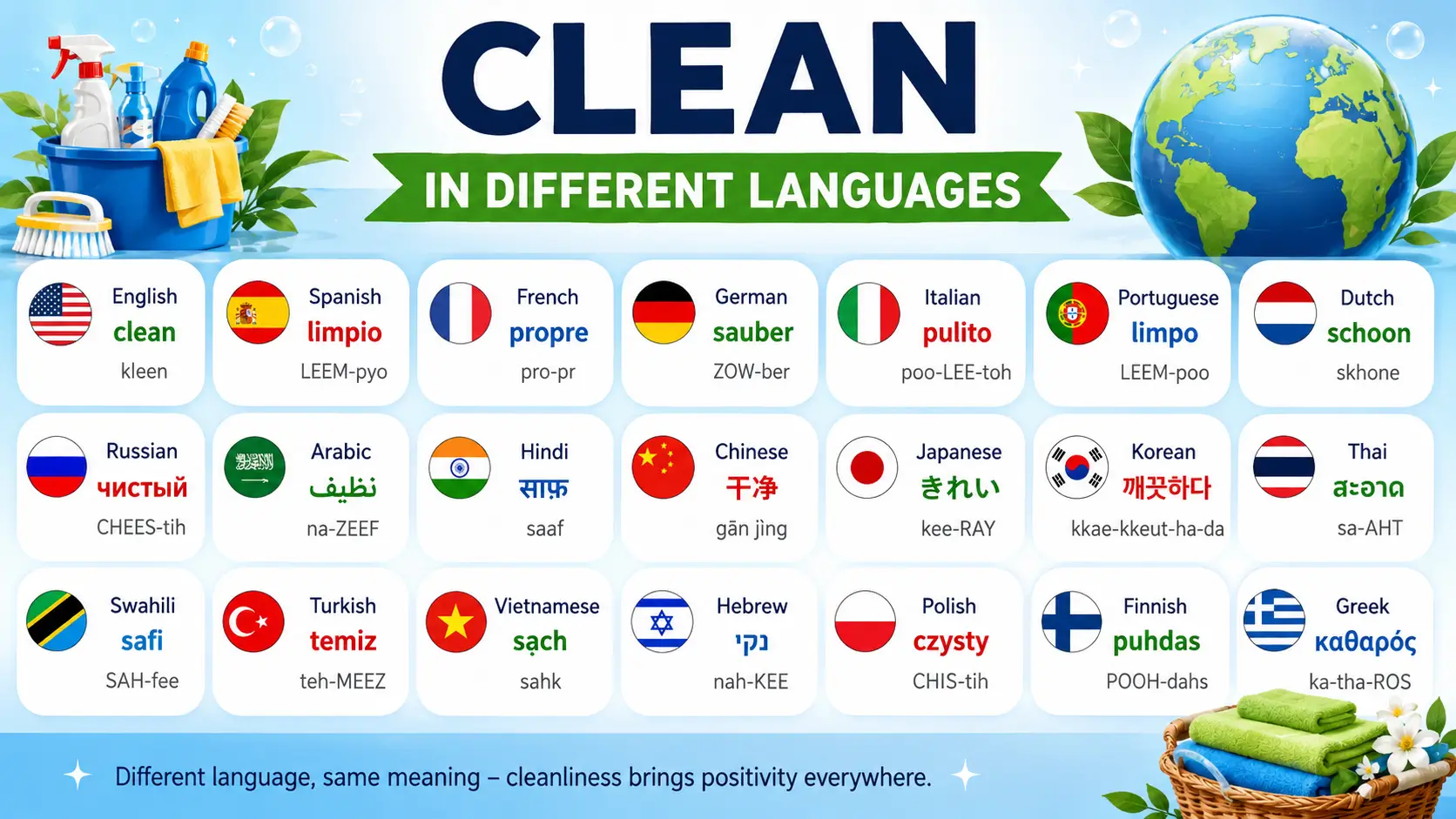
Clean in Different Languages
The exact translation of “clean” can change depending on grammar and context. In some languages, adjectives change according to gender, number, or the noun being described. The forms below use a common, practical form of the word.
| # | Language | Native Phrase | Easy English Pronunciation | Example Sentence | English Meaning |
|---|---|---|---|---|---|
| 1 | English | clean | kleen | The room is clean. | The room is clean. |
| 2 | Spanish | limpio | LEEM-pyo | El cuarto está limpio. | The room is clean. |
| 3 | French | propre | pro-pr | La chambre est propre. | The room is clean. |
| 4 | German | sauber | ZOW-ber | Das Zimmer ist sauber. | The room is clean. |
| 5 | Italian | pulito | poo-LEE-toh | Il tavolo è pulito. | The table is clean. |
| 6 | Portuguese | limpo | LEEM-poo | O quarto está limpo. | The room is clean. |
| 7 | Dutch | schoon | skhone | De kamer is schoon. | The room is clean. |
| 8 | Swedish | ren | rayn | Rummet är rent. | The room is clean. |
| 9 | Norwegian | ren | rayn | Rommet er rent. | The room is clean. |
| 10 | Danish | ren | rayn | Værelset er rent. | The room is clean. |
| 11 | Finnish | puhdas | POOH-dahs | Huone on puhdas. | The room is clean. |
| 12 | Icelandic | hreinn | raytn | Herbergið er hreint. | The room is clean. |
| 13 | Irish | glan | glahn | Tá an seomra glan. | The room is clean. |
| 14 | Welsh | glân | glahn | Mae’r ystafell yn lân. | The room is clean. |
| 15 | Scottish Gaelic | glan | glahn | Tha an seòmar glan. | The room is clean. |
| 16 | Polish | czysty | CHIS-tih | Pokój jest czysty. | The room is clean. |
| 17 | Czech | čistý | CHIS-tee | Pokoj je čistý. | The room is clean. |
| 18 | Slovak | čistý | CHIS-tee | Izba je čistá. | The room is clean. |
| 19 | Slovenian | čist | cheest | Soba je čista. | The room is clean. |
| 20 | Croatian | čist | cheest | Soba je čista. | The room is clean. |
| 21 | Serbian | чист | cheest | Soba je čista. | The room is clean. |
| 22 | Bulgarian | чист | cheest | Стаята е чиста. | The room is clean. |
| 23 | Macedonian | чист | cheest | Собата е чиста. | The room is clean. |
| 24 | Russian | чистый | CHEES-tih | Комната чистая. | The room is clean. |
| 25 | Ukrainian | чистий | CHYS-tiy | Кімната чиста. | The room is clean. |
| 26 | Belarusian | чысты | CHIS-tih | Пакой чысты. | The room is clean. |
| 27 | Lithuanian | švarus | SHVAH-roos | Kambarys švarus. | The room is clean. |
| 28 | Latvian | tīrs | teers | Istaba ir tīra. | The room is clean. |
| 29 | Estonian | puhas | POO-hahs | Tuba on puhas. | The room is clean. |
| 30 | Hungarian | tiszta | TEES-taw | A szoba tiszta. | The room is clean. |
| 31 | Romanian | curat | koo-RAHT | Camera este curată. | The room is clean. |
| 32 | Albanian | pastër | PAH-stur | Dhoma është e pastër. | The room is clean. |
| 33 | Greek | καθαρός | ka-tha-ROS | Το δωμάτιο είναι καθαρό. | The room is clean. |
| 34 | Turkish | temiz | teh-MEEZ | Oda temiz. | The room is clean. |
| 35 | Azerbaijani | təmiz | teh-MEEZ | Otaq təmizdir. | The room is clean. |
| 36 | Armenian | մաքուր | mah-KOOR | Սենյակը մաքուր է։ | The room is clean. |
| 37 | Georgian | სუფთა | SOOP-tah | ოთახი სუფთაა. | The room is clean. |
| 38 | Persian | تمیز | teh-MEEZ | اتاق تمیز است. | The room is clean. |
| 39 | Arabic | نظيف | na-ZEEF | الغرفة نظيفة. | The room is clean. |
| 40 | Hebrew | נקי | nah-KEE | החדר נקי. | The room is clean. |
| 41 | Hindi | साफ़ | saaf | कमरा साफ़ है। | The room is clean. |
| 42 | Urdu | صاف | saaf | کمرہ صاف ہے۔ | The room is clean. |
| 43 | Bengali | পরিষ্কার | po-REE-shkar | ঘরটি পরিষ্কার। | The room is clean. |
| 44 | Punjabi | ਸਾਫ਼ | saaf | ਕਮਰਾ ਸਾਫ਼ ਹੈ। | The room is clean. |
| 45 | Gujarati | સ્વચ્છ | svach-chh | ઓરડો સ્વચ્છ છે. | The room is clean. |
| 46 | Marathi | स्वच्छ | svach-chh | खोली स्वच्छ आहे. | The room is clean. |
| 47 | Nepali | सफा | SAH-fah | कोठा सफा छ। | The room is clean. |
| 48 | Sinhala | පිරිසිදු | pee-ree-see-DOO | කාමරය පිරිසිදුයි. | The room is clean. |
| 49 | Tamil | சுத்தமான | SOOTH-tha-maa-na | அறை சுத்தமாக உள்ளது. | The room is clean. |
| 50 | Telugu | శుభ్రమైన | SHOOBH-ra-may-na | గది శుభ్రంగా ఉంది. | The room is clean. |
| 51 | Kannada | ಸ್ವಚ್ಛ | svach-chha | ಕೊಠಡಿ ಸ್ವಚ್ಛವಾಗಿದೆ. | The room is clean. |
| 52 | Malayalam | വൃത്തിയുള്ള | VRIT-tee-yoo-la | മുറി വൃത്തിയുള്ളതാണ്. | The room is clean. |
| 53 | Thai | สะอาด | sa-AHT | ห้องสะอาด | The room is clean. |
| 54 | Vietnamese | sạch | sahk | Phòng sạch. | The room is clean. |
| 55 | Indonesian | bersih | ber-SEEH | Kamarnya bersih. | The room is clean. |
| 56 | Malay | bersih | ber-SEEH | Bilik itu bersih. | The room is clean. |
| 57 | Filipino | malinis | mah-LEE-nees | Malinis ang kuwarto. | The room is clean. |
| 58 | Chinese (Mandarin) | 干净 | gān jìng | 房间很干净。 | The room is very clean. |
| 59 | Japanese | きれい | kee-RAY | 部屋はきれいです。 | The room is clean. |
| 60 | Korean | 깨끗하다 | kkae-kkeut-ha-da | 방이 깨끗해요. | The room is clean. |
| 61 | Mongolian | цэвэр | tseh-VER | Өрөө цэвэр байна. | The room is clean. |
| 62 | Swahili | safi | SAH-fee | Chumba ni safi. | The room is clean. |
| 63 | Afrikaans | skoon | skhone | Die kamer is skoon. | The room is clean. |
| 64 | Zulu | hlanzekile | hlan-ZEH-kee-leh | Igumbi lihlanzekile. | The room is clean. |
| 65 | Xhosa | icocekile | ee-koh-TSEH-kee-leh | Igumbi licocekile. | The room is clean. |
| 66 | Amharic | ንጹህ | nits-OOH | ክፍሉ ንጹህ ነው። | The room is clean. |
| 67 | Somali | nadiif | nah-DEEF | Qolku waa nadiif. | The room is clean. |
| 68 | Yoruba | mọ́ | maw | Yara naa mọ́. | The room is clean. |
| 69 | Hausa | tsabta | TSAHB-tah | Dakin yana da tsabta. | The room is clean. |
| 70 | Malagasy | madio | mah-DEE-oo | Madio ny efitra. | The room is clean. |
What Does “Clean” Mean?
The English word clean has several common uses.
As an adjective, it can describe something without dirt, dust, stains, or unwanted material. For example, “The kitchen is clean.”
It can also describe something that is neat or hygienic. In some contexts, “clean” may refer to something pure, harmless, or free from contamination.
As a verb, clean means to remove dirt or unwanted material. For example, “I need to clean the bathroom.”
Because of these different uses, the best translation can depend on the sentence and the language.
How to Say “Clean” in Different Languages
If you want to know how to say clean in different languages, start with the adjective used to describe a person, object, room, or place.
For example:
- Spanish: limpio
- French: propre
- German: sauber
- Italian: pulito
- Arabic: نظيف
- Hindi: साफ़
- Urdu: صاف
- Chinese: 干净
- Japanese: きれい
- Korean: 깨끗하다
Remember that many languages change adjectives based on gender, number, or grammatical structure. The form used in a dictionary may not always be the exact form needed in a sentence.
Clean Translations Around the World
The clean translations around the world show how different languages express the same everyday idea.
European languages often have forms that look or sound quite different from English. For instance, French uses propre, German uses sauber, and Italian uses pulito.
South Asian languages also have several interesting equivalents. Hindi and Urdu commonly use the word meaning “clean” in everyday speech, while Bengali, Punjabi, Marathi, Gujarati, Tamil, Telugu, Kannada, Malayalam, and Sinhala use their own native forms.
In East and Southeast Asia, languages such as Mandarin, Japanese, Korean, Thai, Vietnamese, Indonesian, and Filipino also have distinct expressions.
Clean in All Languages: Important Usage Tips
Learning a single translation is useful, but learning how the word works in a sentence is even better.
1. Adjective forms can change
In languages such as Spanish, Italian, French, Russian, and many others, adjectives may change depending on the noun.
2. “Clean” can have several meanings
A word for physical cleanliness may not always be the best choice when “clean” means morally acceptable, environmentally friendly, or free from something unwanted.
3. Context matters
For example, “clean water,” “clean room,” “clean clothes,” and “clean your shoes” may require different grammatical structures in another language.
4. Use the example sentence
The examples in the table help you see how each translation works naturally rather than memorizing isolated vocabulary.
Why Learn “Clean” in Different Languages?
Knowing everyday vocabulary can be especially useful when traveling, studying a foreign language, communicating with international friends, or working with people from different countries.
“Clean” is also a practical word because it appears in conversations about homes, hotels, restaurants, clothing, workplaces, personal hygiene, and public spaces.
Learning clean in all languages can therefore be a simple way to expand your vocabulary while understanding how different cultures express everyday ideas.
Related Words for “Clean”
Once you know the word for clean, learning related vocabulary can make your language skills more useful.
Common English words connected with clean include:
- Cleaning
- Cleaner
- Cleanliness
- Cleaned
- Cleaning supplies
- Wash
- Washable
- Tidy
- Neat
- Fresh
- Hygienic
- Dirt
- Dust
- Stain
These words can help you create more natural sentences instead of relying on one vocabulary item.
Frequently Asked Questions About Clean in Different Languages
1. What is “clean” in Spanish?
“Clean” in Spanish is commonly limpio. The form can change depending on the gender and number of the noun being described.
2. How do you say “clean” in French?
“Clean” in French is commonly propre. It can describe something that is clean or tidy depending on the context.
3. What is “clean” in Hindi and Urdu?
In Hindi, “clean” is commonly साफ़, while in Urdu it is صاف. Both are widely used in everyday speech.
4. How do you say “clean” in Japanese?
A common Japanese expression for “clean” is きれい. Depending on context, it can also convey the idea of something being neat or beautiful.
5. What is the word for “clean” in Chinese?
In Mandarin Chinese, a common word for “clean” is 干净 (gānjìng). It is frequently used to describe rooms, clothes, places, and other things that are free from dirt.
Conclusion
Learning clean in different languages is a useful way to build practical vocabulary for everyday communication. From limpio in Spanish and propre in French to صاف in Urdu, 干净 in Mandarin, and きれい in Japanese, the word takes many forms around the world.
Use the 70-language table to practice pronunciation, understand sentence structure, and discover how the idea of cleanliness is expressed across different languages. For the best results, learn each translation together with its example sentence rather than memorizing the word alone.

I’m Jesse Crawford, a language enthusiast and writer passionate about exploring different languages. I create helpful content that makes words, meanings, translations, and language learning simple, useful, and enjoyable for everyone.