The word “angel” carries a beautiful meaning across cultures. It is commonly associated with a divine messenger, a spiritual being, or someone who is exceptionally kind and helpful. Because angels appear in religions, literature, art, names, and everyday expressions, the word has fascinating equivalents in languages around the world.
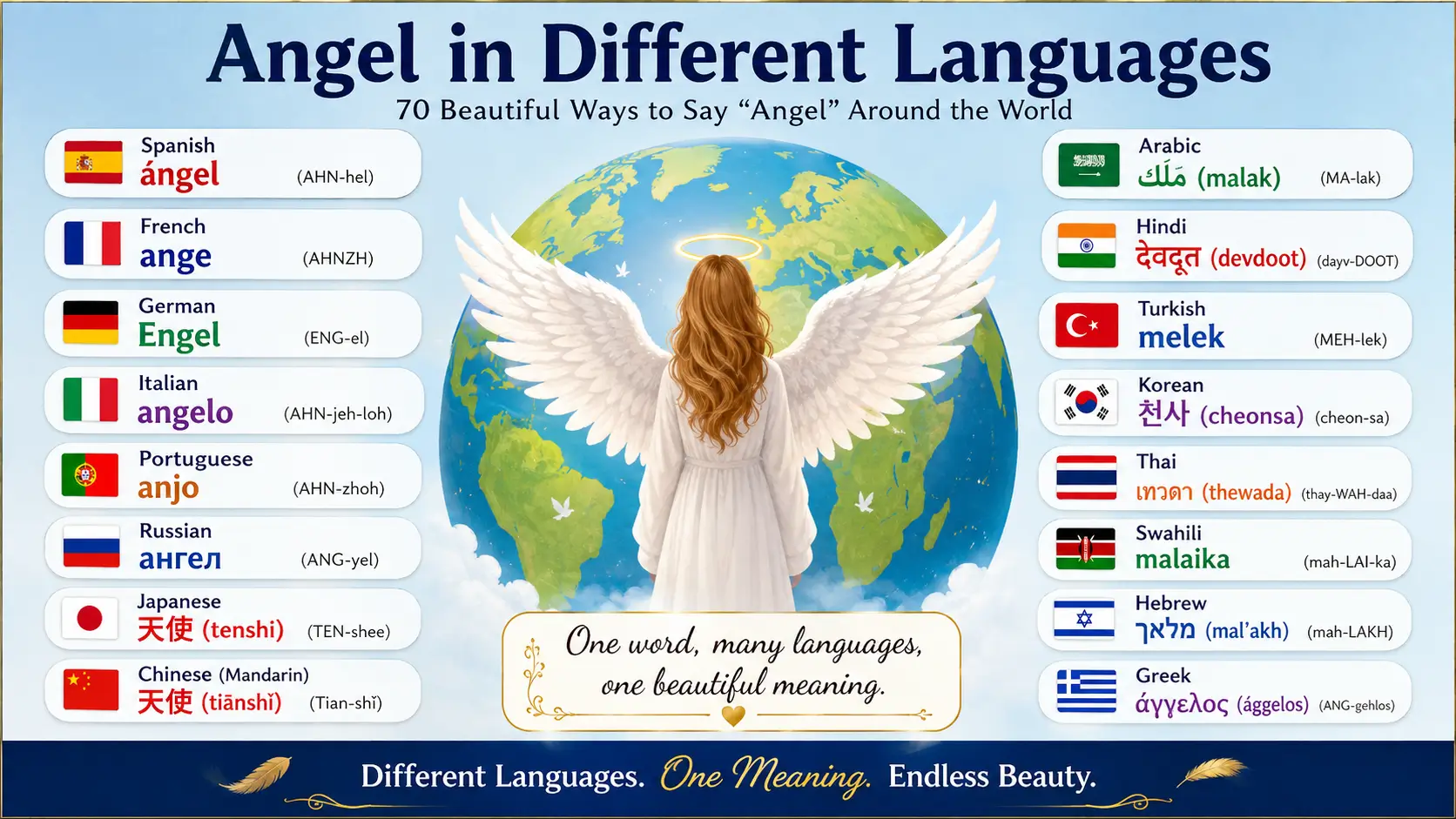
If you are searching for angel in different languages, this guide gives you 70 translations with native spellings, easy English pronunciations, and practical example sentences. Whether you are learning languages, writing creatively, choosing a meaningful name, or simply curious about angel translations, this list makes it easy to compare them.
Angel in Different Languages at a Glance
The English word angel comes through Old French and Latin angelus, ultimately connected to the Greek word angelos, meaning “messenger.” Many European languages have related forms because of this shared historical influence, while other languages use completely different native terms.
Here is how to say angel in all languages covered in this guide:
| # | Language | Native Phrase | Easy English Pronunciation | Example Sentence | English Meaning |
|---|---|---|---|---|---|
| 1 | Spanish | ángel | AHN-hel | Mi hermana es un ángel. | My sister is an angel. |
| 2 | French | ange | AHNZH | Elle est un ange. | She is an angel. |
| 3 | German | Engel | ENG-el | Sie ist ein Engel. | She is an angel. |
| 4 | Italian | angelo | AHN-jeh-loh | Lui è un angelo. | He is an angel. |
| 5 | Portuguese | anjo | AHN-zhoh | Ela é um anjo. | She is an angel. |
| 6 | Dutch | engel | ENG-uhl | Zij is een engel. | She is an angel. |
| 7 | Swedish | ängel | EN-yel | Hon är en ängel. | She is an angel. |
| 8 | Norwegian | engel | ENG-el | Hun er en engel. | She is an angel. |
| 9 | Danish | engel | ENG-el | Hun er en engel. | She is an angel. |
| 10 | Finnish | enkeli | EN-keh-lee | Hän on enkeli. | He/She is an angel. |
| 11 | Icelandic | engill | ENG-il | Hún er engill. | She is an angel. |
| 12 | Irish | aingeal | ANG-yuhl | Is aingeal í. | She is an angel. |
| 13 | Scottish Gaelic | aingeal | ANG-yuhl | Tha i na h-aingeal. | She is an angel. |
| 14 | Welsh | angel | AN-gel | Mae hi’n angel. | She is an angel. |
| 15 | Latin | angelus | AHN-jeh-loos | Angelus adest. | The angel is present. |
| 16 | Greek | άγγελος | ANG-geh-los | Είναι ένας άγγελος. | He is an angel. |
| 17 | Russian | ангел | ANG-yel | Она ангел. | She is an angel. |
| 18 | Ukrainian | янгол | YAN-hol | Вона янгол. | She is an angel. |
| 19 | Polish | anioł | AH-nyow | Ona jest aniołem. | She is an angel. |
| 20 | Czech | anděl | AHN-dyel | Ona je anděl. | She is an angel. |
| 21 | Slovak | anjel | AHN-yel | Ona je anjel. | She is an angel. |
| 22 | Slovenian | angel | AHN-gel | Ona je angel. | She is an angel. |
| 23 | Croatian | anđeo | AHN-djeh-oh | Ona je anđeo. | She is an angel. |
| 24 | Serbian | anđeo / анђео | AHN-djeh-oh | Ona je anđeo. | She is an angel. |
| 25 | Bosnian | anđeo | AHN-djeh-oh | Ona je anđeo. | She is an angel. |
| 26 | Macedonian | ангел | ANG-el | Таа е ангел. | She is an angel. |
| 27 | Bulgarian | ангел | ANG-el | Тя е ангел. | She is an angel. |
| 28 | Romanian | înger | IN-jer | Ea este un înger. | She is an angel. |
| 29 | Hungarian | angyal | AHN-yahl | Ő egy angyal. | He/She is an angel. |
| 30 | Albanian | engjëll | ENG-yuhl | Ajo është një engjëll. | She is an angel. |
| 31 | Estonian | ingel | ING-el | Ta on ingel. | He/She is an angel. |
| 32 | Latvian | eņģelis | EN-jyeh-lis | Viņa ir eņģelis. | She is an angel. |
| 33 | Lithuanian | angelas | AHN-geh-lahs | Ji yra angelas. | She is an angel. |
| 34 | Armenian | հրեշտակ | hreh-SHTAHK | Նա հրեշտակ է։ | He/She is an angel. |
| 35 | Georgian | ანგელოზი | an-geh-LOH-zee | ის ანგელოზია. | He/She is an angel. |
| 36 | Turkish | melek | MEH-lek | O bir melek. | He/She is an angel. |
| 37 | Azerbaijani | mələk | muh-LEK | O, mələkdir. | He/She is an angel. |
| 38 | Persian | فرشته | feh-RESH-teh | او یک فرشته است. | He/She is an angel. |
| 39 | Arabic | مَلَك | MA-lak | هي مَلَك. | She is an angel. |
| 40 | Hebrew | מלאך | ma-LAKH | היא מלאך. | She is an angel. |
| 41 | Hindi | देवदूत | dayv-DOOT | वह एक देवदूत है। | He/She is an angel. |
| 42 | Urdu | فرشتہ | feh-RISH-tah | وہ ایک فرشتہ ہے۔ | He/She is an angel. |
| 43 | Bengali | দেবদূত | day-boo-DHOOT | সে একজন দেবদূত। | He/She is an angel. |
| 44 | Punjabi | ਦੂਤ | DOOT | ਉਹ ਇੱਕ ਦੂਤ ਹੈ। | He/She is a messenger/angel. |
| 45 | Gujarati | દેવદૂત | dayv-DOOT | તે એક દેવદૂત છે. | He/She is an angel. |
| 46 | Marathi | देवदूत | dayv-DOOT | तो देवदूत आहे. | He is an angel. |
| 47 | Nepali | स्वर्गदूत | swor-guh-DOOT | उनी स्वर्गदूत हुन्। | They are an angel. |
| 48 | Sanskrit | देवदूत | day-vah-DOOT | सः देवदूतः अस्ति। | He is an angel. |
| 49 | Tamil | தேவதை | thay-vuh-THAI | அவள் ஒரு தேவதை. | She is an angel. |
| 50 | Telugu | దేవదూత | day-vah-DOO-tah | ఆమె దేవదూత. | She is an angel. |
| 51 | Kannada | ದೇವದೂತ | day-vah-DOO-tah | ಅವಳು ದೇವದೂತಳು. | She is an angel. |
| 52 | Malayalam | മാലാഖ | maa-LAA-kha | അവൾ ഒരു മാലാഖയാണ്. | She is an angel. |
| 53 | Sinhala | දේවදූතයා | day-vah-DOO-tah-yah | ඇය දේවදූතයෙකි. | She is an angel. |
| 54 | Chinese (Mandarin) | 天使 | tiānshǐ | 她是天使。 | She is an angel. |
| 55 | Japanese | 天使 | tenshi | 彼女は天使です。 | She is an angel. |
| 56 | Korean | 천사 | cheon-sa | 그녀는 천사예요. | She is an angel. |
| 57 | Vietnamese | thiên thần | tyen-than | Cô ấy là thiên thần. | She is an angel. |
| 58 | Thai | เทวดา | thay-WAH-daa | เธอเป็นเทวดา | She is an angel. |
| 59 | Indonesian | malaikat | mah-LAI-kaht | Dia seperti malaikat. | He/She is like an angel. |
| 60 | Malay | malaikat | mah-LAI-kaht | Dia seperti malaikat. | He/She is like an angel. |
| 61 | Filipino | anghel | ANG-hel | Isa siyang anghel. | He/She is an angel. |
| 62 | Mongolian | тэнгэрэлч | teng-ger-ELCH | Тэр тэнгэрэлч юм. | He/She is an angel. |
| 63 | Swahili | malaika | mah-LAI-ka | Yeye ni malaika. | He/She is an angel. |
| 64 | Amharic | መልአክ | mel-AHK | እሷ መልአክ ናት። | She is an angel. |
| 65 | Zulu | ingelosi | in-geh-LOH-see | Ungelosi. | He/She is an angel. |
| 66 | Xhosa | ingelosi | in-geh-LOH-see | Ungumngelosi. | He/She is an angel. |
| 67 | Afrikaans | engel | ENG-uhl | Sy is ‘n engel. | She is an angel. |
| 68 | Malagasy | anjely | an-JEH-lee | Izy dia anjely. | He/She is an angel. |
| 69 | Hawaiian | ʻānela | ah-NEH-lah | He ʻānela ʻo ia. | He/She is an angel. |
| 70 | Māori | anahera | ah-nah-HEH-rah | He anahera ia. | He/She is an angel. |
How to Say Angel in Different Languages
Learning how to say angel in different languages is more than memorizing translations. The word can have slightly different cultural meanings depending on the language and context.
For example, Spanish ángel, Italian angelo, French ange, German Engel, and Portuguese anjo are all closely connected historically. In contrast, Turkish melek, Japanese 天使, and Mandarin 天使 come from different linguistic traditions.
Some languages also use a word closer to messenger, heavenly messenger, or divine being rather than a direct equivalent of the English word.
Angel Translations in European Languages
European languages provide many familiar forms of the word.
Romance languages often have forms related to Latin angelus. This is why you can see similarities between ángel, ange, angelo, and anjo.
Germanic languages also have recognizable forms such as Engel in German and Dutch and engel in several Scandinavian languages.
Eastern and Central European languages show more variation. Polish uses anioł, Romanian uses înger, Hungarian uses angyal, and Croatian uses anđeo.
These differences make angel around the world an interesting example of how languages adapt religious and cultural vocabulary.
Angel in Asian Languages
Asian languages offer some especially interesting translations.
In Mandarin Chinese, 天使 literally relates to a heavenly messenger. Japanese also uses 天使, read as tenshi. Korean uses 천사, while Vietnamese uses thiên thần.
In South Asian languages, terms such as Hindi देवदूत, Urdu فرشتہ, Bengali দেবদূত, and Gujarati દેવદૂત reflect concepts associated with divine or heavenly messengers.
Arabic مَلَك, Persian فرشته, and Hebrew מלאך are also important terms in the religious vocabulary of their respective languages.
Angel in African Languages
The concept of an angel is also expressed in many African languages.
Swahili uses malaika, while Zulu and Xhosa use forms based on ingelosi. Amharic uses መልአክ, and Afrikaans uses engel.
Because languages develop through contact, migration, religion, and cultural exchange, some African angel translations resemble European forms while others have distinct linguistic histories.
Angel in Pacific and Indigenous Languages
Languages from the Pacific also have their own expressions.
Hawaiian uses ʻānela, while Māori uses anahera. These forms reflect the influence of Christian vocabulary while adapting words to the sound systems of the languages.
This is a useful reminder that translation is not always a simple word-for-word process. A borrowed concept can take on a distinctive local form over time.
What Does “Angel” Mean?
An angel is generally understood as a supernatural or spiritual being associated with divine service, guidance, protection, or communication.
The word can also be used figuratively. In everyday English, calling someone an “angel” often means that the person is extremely kind, helpful, caring, or generous.
For example:
- “You helped me when I needed you—you’re an angel.”
- “My grandmother was an angel to our family.”
- “That nurse was an absolute angel.”
So, the intended meaning depends heavily on context.
Why Do Angel Translations Differ?
Angel translations differ because languages have their own histories, writing systems, religious traditions, and cultural influences.
There is no single universal translation method. One language may use a direct loanword, while another may use a phrase meaning heavenly messenger or divine messenger.
Pronunciation can also vary considerably. Even when two languages use historically related words, their modern pronunciation may be completely different.
Angel as a Symbol Across Cultures
Angels are commonly associated with several ideas:
- Protection
- Guidance
- Goodness
- Hope
- Spirituality
- Divine messages
- Compassion
- Peace
The exact symbolism varies between cultures and religious traditions. In some contexts, angels are primarily viewed as divine messengers. In others, they are commonly associated with guardianship or protection.
The figurative use is broader. A person who performs an exceptionally kind act may be called an “angel” regardless of religious context.
Common Uses of the Word Angel
The word angel can appear in several contexts:
Religious Context
An angel may refer to a spiritual being serving or communicating a divine purpose.
Personal Names
Angel is used as a personal name in several cultures and languages. Related forms include names derived from words such as Ángel, Angelo, and Anđelo.
Literature and Poetry
Writers often use angels as symbols of innocence, beauty, protection, or hope.
Everyday Speech
Calling someone an angel can be a warm way of expressing gratitude.
Art and Popular Culture
Angels frequently appear in paintings, sculptures, films, books, music, and other forms of creative expression.
Tips for Using Angel Translations Correctly
If you plan to use an angel translation in a tattoo, name, artwork, greeting, story, or other permanent project, check the exact context first.
A dictionary translation may represent the general concept, but grammatical forms can change depending on whether you mean an angel, the angel, my angel, or angels.
It is also important to distinguish between a literal religious meaning and a figurative meaning such as “a very kind person.”
For formal, religious, or permanent uses, native-speaker verification is especially valuable.
Angel in All Languages: Key Takeaway
There are many ways to express angel in all languages, and each translation reflects a particular linguistic and cultural history.
Some forms are clearly related to the Latin and Greek traditions, while others use independent words for heavenly or divine messengers. Learning these differences can make language study more interesting and help you understand how cultures express similar ideas in different ways.
Frequently Asked Questions
1. How do you say “angel” in different languages?
The word “angel” has many translations. Examples include ángel in Spanish, ange in French, Engel in German, angelo in Italian, anjo in Portuguese, melek in Turkish, 天使 in Chinese and Japanese, and 천사 in Korean.
2. What is the most common translation of angel?
There is no single translation that is most common worldwide. The appropriate word depends on the language and context. Many European languages have forms historically related to the Latin angelus.
3. What is “angel” in Japanese?
In Japanese, angel is 天使, pronounced tenshi. The term is commonly used for an angel or heavenly spiritual being.
4. What is “angel” in Arabic?
In Arabic, angel is مَلَك. The word is used for an angel or divine messenger and has an important place in Arabic religious vocabulary.
5. Can “angel” mean a kind person?
Yes. In English and many other languages, an angel can be used figuratively to describe someone who is exceptionally kind, helpful, caring, or generous. The intended meaning depends on the sentence and cultural context.
Conclusion
Learning angel in different languages reveals how one powerful idea can take many linguistic forms. From Spanish ángel and Italian angelo to Turkish melek, Mandarin 天使, Japanese 天使, Arabic مَلَك, and Māori anahera, these translations show the diversity of languages around the world.
Whether you are researching angel translations, studying vocabulary, exploring cultural expressions, or looking for the right word for a creative project, this 70-language guide provides a useful starting point for understanding how people express the idea of an angel around the world.

I am Ava Jones, a language enthusiast and author passionate about exploring different languages, sharing useful phrases, explaining meanings, and helping readers communicate confidently across cultures and countries.