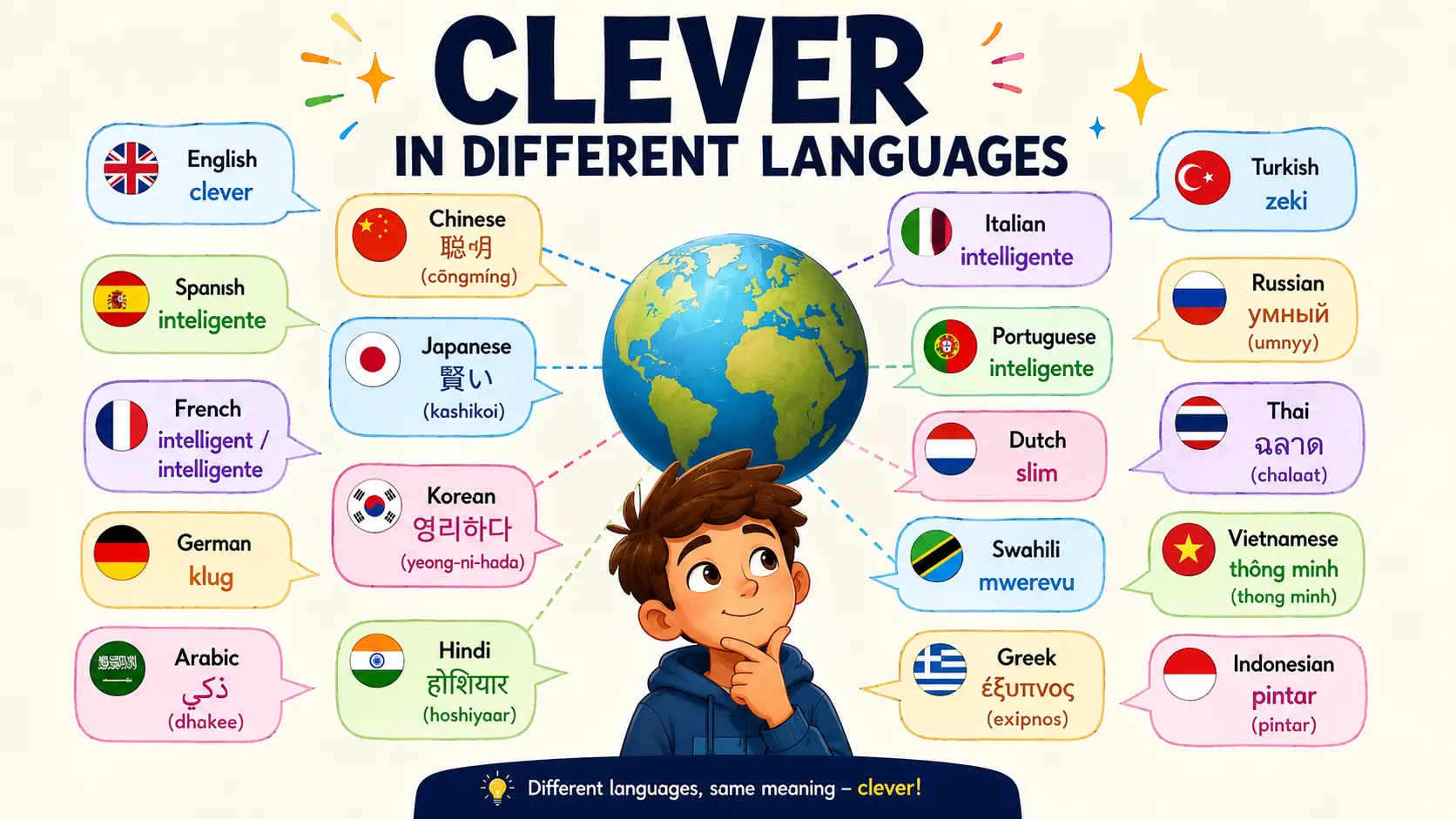
The word “clever” describes someone who is intelligent, quick-thinking, skillful, or good at finding smart solutions. Its meaning can vary slightly between languages: in some cultures, the closest word means intelligent, while in others it can mean skillful, sharp, bright, or ingenious.
If you are learning languages, traveling, writing, studying vocabulary, or simply curious about clever in different languages, this guide gives you 70 useful translations with easy pronunciation and practical examples.
Whether you want to know how to say clever in different languages or are looking for clever translations from around the world, the table below provides a quick reference.
Clever in Different Languages
The following table shows clever in all languages with a commonly used translation, an easy English pronunciation, and a short example sentence.
| # | Language | Native Phrase | Easy English Pronunciation | Example Sentence | English Meaning |
|---|---|---|---|---|---|
| 1 | English | clever | KLEV-er | She is very clever. | She is very intelligent. |
| 2 | Spanish | inteligente | een-teh-lee-HEN-teh | Ella es muy inteligente. | She is very clever. |
| 3 | French | intelligent / intelligente | an-tay-lee-ZHON / an-tay-lee-ZHONT | Elle est très intelligente. | She is very clever. |
| 4 | German | klug | kloog | Er ist sehr klug. | He is very clever. |
| 5 | Italian | intelligente | een-tel-lee-JEN-teh | Lei è molto intelligente. | She is very clever. |
| 6 | Portuguese | inteligente | een-teh-lee-ZHEN-chee | Ela é muito inteligente. | She is very clever. |
| 7 | Dutch | slim | slim | Zij is erg slim. | She is very clever. |
| 8 | Afrikaans | slim | slim | Sy is baie slim. | She is very clever. |
| 9 | Swedish | smart | smahrt | Hon är väldigt smart. | She is very clever. |
| 10 | Danish | klog | kloh | Hun er meget klog. | She is very clever. |
| 11 | Norwegian | smart | smahrt | Hun er veldig smart. | She is very clever. |
| 12 | Finnish | älykäs | AEL-y-kaes | Hän on hyvin älykäs. | He/She is very clever. |
| 13 | Icelandic | klár | klaur | Hún er mjög klár. | She is very clever. |
| 14 | Irish | cliste | KLISH-teh | Tá sí an-chliste. | She is very clever. |
| 15 | Welsh | clyfar | KLUH-var | Mae hi’n glyfar iawn. | She is very clever. |
| 16 | Scottish Gaelic | glic | gleek | Tha i glic. | She is clever. |
| 17 | Polish | mądry | MON-dri | On jest bardzo mądry. | He is very clever. |
| 18 | Czech | chytrý | KHIT-ri | On je velmi chytrý. | He is very clever. |
| 19 | Slovak | múdry | MOO-dri | On je veľmi múdry. | He is very clever. |
| 20 | Slovenian | pameten | pah-MEH-ten | On je zelo pameten. | He is very clever. |
| 21 | Croatian | pametan | PAH-meh-tan | On je vrlo pametan. | He is very clever. |
| 22 | Serbian | pametan | PAH-meh-tan | On je veoma pametan. | He is very clever. |
| 23 | Bosnian | pametan | PAH-meh-tan | On je veoma pametan. | He is very clever. |
| 24 | Bulgarian | умен | OO-men | Той е много умен. | He is very clever. |
| 25 | Macedonian | паметен | PAH-meh-ten | Тој е многу паметен. | He is very clever. |
| 26 | Russian | умный | OOM-niy | Он очень умный. | He is very clever. |
| 27 | Ukrainian | розумний | roh-ZOOM-niy | Він дуже розумний. | He is very clever. |
| 28 | Belarusian | разумны | rah-ZOOM-ni | Ён вельмі разумны. | He is very clever. |
| 29 | Lithuanian | protingas | proh-TEEN-gas | Jis labai protingas. | He is very clever. |
| 30 | Latvian | gudrs | GOODRS | Viņš ir ļoti gudrs. | He is very clever. |
| 31 | Estonian | tark | tark | Ta on väga tark. | He is very clever. |
| 32 | Hungarian | okos | OH-kosh | Ő nagyon okos. | He is very clever. |
| 33 | Romanian | inteligent | een-teh-lee-ZHENT | El este foarte inteligent. | He is very clever. |
| 34 | Greek | έξυπνος | EX-ip-nos | Είναι πολύ έξυπνος. | He is very clever. |
| 35 | Albanian | i zgjuar | ee ZHOO-ar | Ai është shumë i zgjuar. | He is very clever. |
| 36 | Armenian | խելացի | kheh-LAH-tsee | Նա շատ խելացի է։ | He is very clever. |
| 37 | Georgian | ჭკვიანი | chkvee-AH-nee | ის ძალიან ჭკვიანია. | He is very clever. |
| 38 | Turkish | zeki | ZEH-kee | O çok zeki. | He/She is very clever. |
| 39 | Azerbaijani | ağıllı | ah-UHL-luh | O çox ağıllıdır. | He/She is very clever. |
| 40 | Persian | باهوش | baa-HOOSH | او خیلی باهوش است. | He/She is very clever. |
| 41 | Arabic | ذكي | dha-KEE | هو ذكي جدًا. | He is very clever. |
| 42 | Hebrew | חכם | kha-KHAM | הוא מאוד חכם. | He is very clever. |
| 43 | Hindi | होशियार | ho-shi-YAAR | वह बहुत होशियार है। | He/She is very clever. |
| 44 | Urdu | ہوشیار | ho-shi-YAAR | وہ بہت ہوشیار ہے۔ | He/She is very clever. |
| 45 | Bengali | বুদ্ধিমান | bud-dhi-MAAN | সে খুব বুদ্ধিমান। | He/She is very clever. |
| 46 | Punjabi | ਹੁਸ਼ਿਆਰ | ho-shi-YAAR | ਉਹ ਬਹੁਤ ਹੁਸ਼ਿਆਰ ਹੈ। | He/She is very clever. |
| 47 | Gujarati | હોશિયાર | ho-shi-YAAR | તે ખૂબ હોશિયાર છે. | He/She is very clever. |
| 48 | Marathi | हुशार | hoo-SHAAR | ती खूप हुशार आहे. | She is very clever. |
| 49 | Nepali | चलाख | cha-LAAKH | ऊ धेरै चलाख छ। | He/She is very clever. |
| 50 | Sinhala | දක්ෂ | DAK-sha | ඔහු ඉතා දක්ෂයි. | He is very clever. |
| 51 | Tamil | புத்திசாலி | poot-ti-SAA-lee | அவன் மிகவும் புத்திசாலி. | He is very clever. |
| 52 | Telugu | తెలివైన | teh-lee-vai-na | అతను చాలా తెలివైనవాడు. | He is very clever. |
| 53 | Kannada | ಬುದ್ಧಿವಂತ | bud-dhi-VAN-ta | ಅವನು ತುಂಬಾ ಬುದ್ಧಿವಂತ. | He is very clever. |
| 54 | Malayalam | ബുദ്ധിമാൻ | bud-dhi-MAAN | അവൻ വളരെ ബുദ്ധിമാനാണ്. | He is very clever. |
| 55 | Thai | ฉลาด | cha-LAAT | เขาฉลาดมาก | He is very clever. |
| 56 | Vietnamese | thông minh | tong MINH | Cô ấy rất thông minh. | She is very clever. |
| 57 | Indonesian | pintar | PIN-tar | Dia sangat pintar. | He/She is very clever. |
| 58 | Malay | bijak | BEE-jak | Dia sangat bijak. | He/She is very clever. |
| 59 | Filipino | matalino | ma-ta-LEE-no | Napakatalino niya. | He/She is very clever. |
| 60 | Javanese | pinter | PIN-ter | Dheweke pinter banget. | He/She is very clever. |
| 61 | Chinese (Mandarin) | 聪明 | cōngmíng | 她很聪明。 | She is very clever. |
| 62 | Japanese | 賢い | kashikoi | 彼はとても賢いです。 | He is very clever. |
| 63 | Korean | 영리하다 | yeong-ni-ha-da | 그는 매우 영리합니다. | He is very clever. |
| 64 | Mongolian | ухаалаг | oo-khaa-lag | Тэр маш ухаалаг. | He/She is very clever. |
| 65 | Swahili | mwerevu | mweh-REH-voo | Yeye ni mwerevu sana. | He/She is very clever. |
| 66 | Zulu | hlakaniphile | hla-ka-NEE-pee-leh | Uhlakaniphile kakhulu. | He/She is very clever. |
| 67 | Xhosa | krelekrele | kreh-leh-KREH-leh | Unengqondo ekrelekrele. | He/She is very clever. |
| 68 | Somali | caqli badan | ak-lee BA-dan | Wuu caqli badan yahay. | He is very clever. |
| 69 | Amharic | ብልህ | bil-LUH | እሱ በጣም ብልህ ነው። | He is very clever. |
| 70 | Malagasy | hendry | HEN-dree | Tena hendry izy. | He/She is very clever. |
What Does “Clever” Mean?
Clever generally describes a person who can understand things quickly, solve problems effectively, or use their knowledge in a smart way.
Depending on context, “clever” can refer to:
- Intelligence — someone who learns quickly.
- Quick thinking — someone who reacts intelligently.
- Ingenuity — someone who creates smart solutions.
- Skillfulness — someone who handles a task particularly well.
- Wit — someone who uses intelligence in a humorous or sharp way.
For example, saying “She is clever” usually means that she is intelligent or quick to understand things.
Clever vs. Intelligent: Are They the Same?
The words clever and intelligent are closely related, but they are not always identical.
Intelligent often describes a person’s general mental ability, knowledge, or capacity for learning. Clever can have a more practical meaning, suggesting that someone is good at solving problems or finding effective ways to accomplish something.
For example:
- He is intelligent — emphasizes his mental ability.
- He is clever — may emphasize his ability to find a smart solution.
In some languages, the same word may naturally cover both meanings.
How to Say “Clever” in Different Languages
If you are searching for how to say clever in different languages, the translation depends on the language and context.
Some especially common equivalents include:
- Spanish: inteligente
- French: intelligent / intelligente
- German: klug
- Italian: intelligente
- Portuguese: inteligente
- Dutch: slim
- Russian: умный
- Arabic: ذكي
- Hindi: होशियार
- Urdu: ہوشیار
- Chinese: 聪明
- Japanese: 賢い
- Korean: 영리하다
- Turkish: zeki
- Swahili: mwerevu
Remember that a dictionary translation may not capture every shade of meaning. Context matters, especially when “clever” means witty, crafty, or skillful rather than simply intelligent.
Clever Translations Around the World
The idea of being clever is expressed in many different ways around the world. European languages often use words connected with intelligence or wisdom, while other languages may emphasize being skillful, sharp-minded, or resourceful.
For language learners, learning the surrounding context is just as important as memorizing the translation. A word that sounds like the direct equivalent of “clever” may sometimes be more naturally translated as smart, bright, wise, or intelligent.
This is why example sentences are useful: they show how the word works in everyday communication.
When to Use “Clever”
You can use “clever” in several everyday situations.
Describing a Person
You can call someone clever when they understand things quickly or solve problems well.
Example: “My sister is very clever.”
Describing an Idea
“Clever” can describe an idea that is creative or effective.
Example: “That was a clever solution.”
Describing a Trick
The word can sometimes describe a smart or skillful trick.
Example: “That was a clever way to fix the problem.”
Describing Humor
A joke or comment can also be clever when it shows quick thinking or originality.
Example: “He made a clever joke.”
Is “Clever” Always a Compliment?
Usually, clever is positive. It can be a compliment when you want to say that someone is intelligent, creative, or good at solving problems.
However, context can change its meaning. In some situations, “clever” can suggest that someone is being too crafty or manipulative.
For example, “He is a clever businessman” may be positive, while “That was a clever trick” could be either complimentary or slightly suspicious depending on the situation.
Tips for Learning “Clever” in Other Languages
When learning clever in all languages, do more than memorize isolated words.
- Learn the native spelling so you recognize the word when reading.
- Practice the pronunciation with native speakers or reliable language-learning resources.
- Study an example sentence to understand how the word works naturally.
- Check gender and grammar where the language requires it.
- Pay attention to context, because “clever” can overlap with “smart,” “intelligent,” “wise,” or “skillful.”
- Use the word in conversation to make it easier to remember.
Frequently Asked Questions
1. What is “clever” in different languages?
“Clever” has different equivalents depending on the language. Common translations include inteligente in Spanish, klug in German, intelligente in Italian, 聪明 in Mandarin Chinese, 賢い in Japanese, and 영리하다 in Korean.
2. How do you say “clever” in Spanish?
In Spanish, “clever” is commonly translated as inteligente. For example, “Ella es muy inteligente” means “She is very clever.”
3. What is the difference between clever and intelligent?
Both words describe mental ability, but clever can emphasize quick thinking, practical problem-solving, or ingenuity, while intelligent often refers more broadly to a person’s intellectual ability.
4. What is “clever” in Japanese?
A common Japanese translation is 賢い (kashikoi). It can describe someone who is smart, wise, or clever depending on the context.
5. What is the most common translation of “clever”?
There is no single translation that works perfectly in every language. Words meaning smart, intelligent, bright, skillful, wise, or quick-thinking may be used depending on the language and situation.
Conclusion
Learning clever in different languages is a useful way to expand your vocabulary while discovering how different cultures express intelligence and quick thinking. Although many languages have a direct equivalent, the exact meaning can change with context.
From inteligente in Spanish and klug in German to 聪明 in Chinese and 賢い in Japanese, these 70 translations give you a practical starting point for understanding clever around the world.

I am Scarlett Wilson, a passionate language writer who loves exploring different languages, words, meanings, translations, and useful phrases. I enjoy making language learning simple, clear, and interesting for everyone.