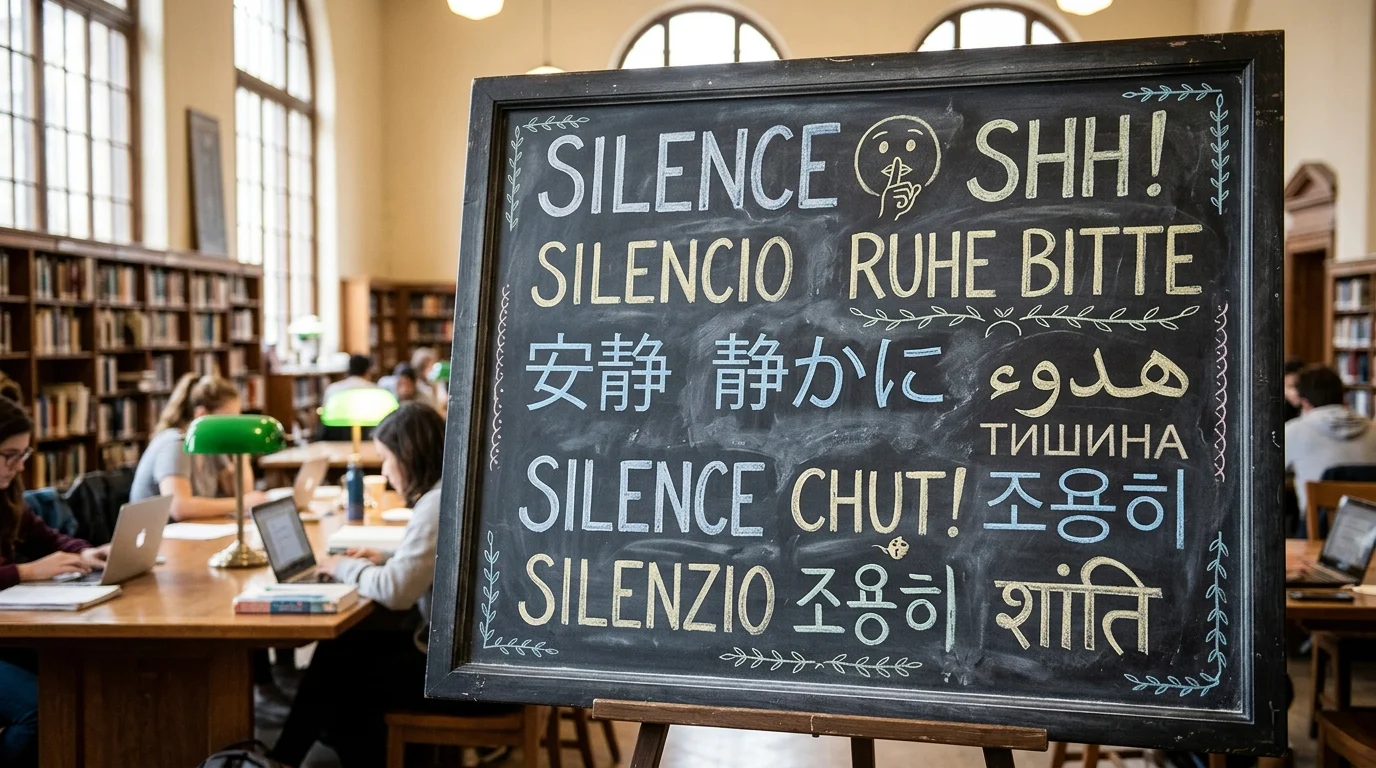
Learning how to say “quiet” in different languages can help you communicate while traveling, studying, or speaking with people from different cultures. Whether you want to ask someone to be quiet, describe a peaceful place, or explain that a room is silent, knowing the right word makes communication easier.
The word “quiet” can mean silent, calm, peaceful, or not making much noise. Its translation changes depending on the situation, so this guide includes 70 languages, easy pronunciations, and example sentences to help you understand how the word is used.
How to Say Quiet in Different Languages
Here are 10 common languages and their translations for “quiet.” These words are useful when describing a peaceful environment or asking someone to lower their voice.
| # | Language | Quiet | Easy Pronunciation | Example Sentence |
|---|---|---|---|---|
| 1 | English | Quiet | KWY-uht | Please be quiet. |
| 2 | Spanish | Silencioso / Callado | see-len-see-OH-soh / kah-YAH-doh | Por favor, guarda silencio. |
| 3 | French | Calme / Silencieux | kahm / see-lahn-SYUH | S’il te plaît, reste calme. |
| 4 | German | Ruhig | ROO-ikh | Bitte sei ruhig. |
| 5 | Italian | Silenzioso / Tranquillo | see-len-TSYOH-zoh / tran-KWEE-loh | Per favore, fai silenzio. |
| 6 | Portuguese | Quieto / Silencioso | kee-EH-too / see-len-see-OH-zoo | Por favor, fique quieto. |
| 7 | Dutch | Stil / Rustig | stil / RUS-tikh | Wees alsjeblieft stil. |
| 8 | Swedish | Tyst | tist | Var tyst, tack. |
| 9 | Norwegian | Stille | STEEL-leh | Vær stille, takk. |
| 10 | Danish | Stille | STEEL-leh | Vær stille, tak. |
Quiet in European Countries
European languages offer several ways to describe silence, calmness, or a peaceful atmosphere. The correct word depends on whether you are describing a place or asking someone to stop making noise.
| # | Language | Quiet | Easy Pronunciation | Example Sentence |
|---|---|---|---|---|
| 11 | Finnish | Hiljainen | HIL-yah-nen | Ole hiljaa, kiitos. |
| 12 | Icelandic | Kyrr | kir | Vinsamlegast vertu hljóð. |
| 13 | Irish | Ciúin | KYOO-in | Bí ciúin, le do thoil. |
| 14 | Welsh | Tawel | TAH-wel | Bydd yn dawel, os gweli di’n dda. |
| 15 | Scottish Gaelic | Sàmhach | SAA-vakh | Bi sàmhach, mas e do thoil e. |
| 16 | Polish | Cichy | TSIH-khih | Proszę, bądź cicho. |
| 17 | Czech | Tichý | TEE-khee | Prosím, buď potichu. |
| 18 | Slovak | Tichý | TEE-khee | Prosím, buď ticho. |
| 19 | Ukrainian | Тихий (Tykhyi) | TIH-khiy | Будь ласка, тихо. |
| 20 | Russian | Тихий (Tikhiy) | TEE-khiy | Пожалуйста, потише. |
Quiet in Eastern and Southern European Languages
These languages use different words for being quiet, staying silent, and feeling calm. Some examples below are natural requests rather than literal adjective translations.
| # | Language | Quiet | Easy Pronunciation | Example Sentence |
|---|---|---|---|---|
| 21 | Bulgarian | Тих (Tih) | teekh | Моля, пази тишина. |
| 22 | Serbian | Тих (Tih) | teekh | Молим те, буди тих. |
| 23 | Croatian | Tih | teekh | Molim te, budi tih. |
| 24 | Slovenian | Tih | teekh | Prosim, bodi tiho. |
| 25 | Greek | Ήσυχος (Ísychos) | EE-see-khos | Σε παρακαλώ, κάνε ησυχία. |
| 26 | Romanian | Liniștit | lee-neesh-TEET | Te rog, fă liniște. |
| 27 | Hungarian | Csendes | CHEN-dehsh | Kérlek, maradj csendben. |
| 28 | Albanian | I qetë | ee cheh-TUH | Të lutem, rri i qetë. |
| 29 | Turkish | Sessiz | ses-SEEZ | Lütfen sessiz ol. |
| 30 | Basque | Isil | EE-seel | Mesedez, isilik egon. |
Quiet in Middle Eastern and South Asian Languages
In Middle Eastern and South Asian languages, the words for “quiet” may change depending on grammar, politeness, and whether you mean silence or calmness.
| # | Language | Quiet | Easy Pronunciation | Example Sentence |
|---|---|---|---|---|
| 31 | Arabic | هادئ (Hādiʾ) | HAA-dee | من فضلك، التزم الهدوء. |
| 32 | Hebrew | שקט (Sheket / Shaket) | SHEH-ket / SHAH-ket | בבקשה, תהיה בשקט. |
| 33 | Persian (Farsi) | ساکت (Sāket) | SAA-ket | لطفاً ساکت باش. |
| 34 | Urdu | خاموش (Khamosh) | kha-MOSH | براہِ کرم خاموش رہیں۔ |
| 35 | Hindi | शांत (Shaant) | shaant | कृपया शांत रहें। |
| 36 | Bengali | শান্ত (Shanto) | SHAN-toh | দয়া করে চুপ থাকুন। |
| 37 | Punjabi | ਚੁੱਪ (Chupp) | choop | ਕਿਰਪਾ ਕਰਕੇ ਚੁੱਪ ਰਹੋ। |
| 38 | Gujarati | શાંત (Shaant) | shaant | કૃપા કરીને શાંત રહો. |
| 39 | Marathi | शांत (Shaant) | shaant | कृपया शांत राहा. |
| 40 | Nepali | शान्त (Shanta) | SHAN-tah | कृपया शान्त बस्नुहोस्। |
Quiet in East and Southeast Asian Languages
In East and Southeast Asia, a word meaning “quiet” may describe a silent room, a calm person, or a peaceful setting. The examples show common ways to request quiet or silence.
| # | Language | Quiet | Easy Pronunciation | Example Sentence |
|---|---|---|---|---|
| 41 | Sinhala | නිහඬ (Nihanda) | nee-HUN-dah | කරුණාකර නිහඬව සිටින්න. |
| 42 | Tamil | அமைதியான (Amaithiyaana) | ah-my-thee-YAA-nah | தயவுசெய்து அமைதியாக இருங்கள். |
| 43 | Telugu | నిశ్శబ్దమైన (Nishshabdamaina) | nish-shab-dah-MY-nah | దయచేసి నిశ్శబ్దంగా ఉండండి. |
| 44 | Kannada | ಶಾಂತ (Shaanta) | SHAAN-tah | ದಯವಿಟ್ಟು ಶಾಂತವಾಗಿರಿ. |
| 45 | Malayalam | ശാന്തമായ (Shaanthamaaya) | SHAAN-tha-maa-yah | ദയവായി നിശ്ശബ്ദമായിരിക്കുക. |
| 46 | Mandarin Chinese | 安静 (Ānjìng) | an-JING | 请安静。 |
| 47 | Cantonese | 靜 (Zing6) | jing | 請保持安靜。 |
| 48 | Japanese | 静か (Shizuka) | shee-ZOO-kah | 静かにしてください。 |
| 49 | Korean | 조용한 (Joyonghan) | jo-yong-han | 조용히 해 주세요. |
| 50 | Vietnamese | Yên tĩnh | yen TING | Xin hãy giữ yên lặng. |
Quiet in Southeast Asian and African Languages
The following words are used in Southeast Asian and African languages. Depending on the sentence, the translation may refer to silence, calmness, or being peaceful.
| # | Language | Quiet | Easy Pronunciation | Example Sentence |
|---|---|---|---|---|
| 51 | Thai | เงียบ (Ngîap) | ngee-ap | กรุณาเงียบหน่อย |
| 52 | Lao | ງຽບ (Ngïap) | ngee-ap | ກະລຸນາງຽບ. |
| 53 | Khmer | ស្ងាត់ (Sngat) | sngat | សូមស្ងាត់បន្តិច។ |
| 54 | Burmese | တိတ်ဆိတ် (Teik-sate) | tayk-sate | ကျေးဇူးပြု၍ တိတ်တိတ်နေပါ။ |
| 55 | Indonesian | Tenang | tuh-NAHNG | Tolong diam sebentar. |
| 56 | Malay | Senyap / Tenang | suh-NYAP / tuh-NAHNG | Tolong senyap sebentar. |
| 57 | Filipino (Tagalog) | Tahimik | tah-HEE-mik | Pakiusap, tumahimik ka. |
| 58 | Javanese | Meneng | muh-NENG | Tulung meneng dhisik. |
| 59 | Swahili | Kimya / Tulivu | KEEM-yah / too-LEE-voo | Tafadhali kaa kimya. |
| 60 | Amharic | ጸጥታ (Tsetta) | TSEHT-tah | እባክህ ጸጥ በል። |
Quiet in African and Other Languages
These languages add more examples from Africa and other language communities around the world.
| # | Language | Quiet | Easy Pronunciation | Example Sentence |
|---|---|---|---|---|
| 61 | Somali | Aamusnaan | ah-mooz-NAAN | Fadlan aamus. |
| 62 | Yoruba | Idákẹ́jẹ́ | ee-dah-keh-JEH | Jọ̀wọ́, dákẹ́. |
| 63 | Igbo | Ịgbachi nkịtị | ee-gbah-chee n-KEE-tee | Biko, gbachi nkịtị. |
| 64 | Zulu | Thula | TOO-lah | Ngicela uthule. |
| 65 | Xhosa | Thula | TOO-lah | Ndicela uthule. |
| 66 | Afrikaans | Stil | stil | Wees asseblief stil. |
| 67 | Haitian Creole | Trankil / An silans | trahn-KEEL / ahn see-LAHNS | Tanpri, rete trankil. |
| 68 | Esperanto | Silenta / Kvieta | see-LEN-tah / kvee-EH-tah | Bonvolu esti silenta. |
| 69 | Latin | Tacitus / Quietus | tah-KEE-toos / kwee-EH-toos | Quaeso, tace. |
| 70 | Catalan | Silenciós / Tranquil | see-len-see-OHS / trahn-KEEL | Si us plau, feu silenci. |
Different Meanings of Quiet
The word “quiet” can describe different situations in English. Understanding these differences helps you choose the most appropriate translation.
| Meaning | Example | Explanation |
|---|---|---|
| Making little noise | The library is quiet. | There is very little sound. |
| Asking for silence | Please be quiet. | A request to stop talking or making noise. |
| Peaceful or calm | We had a quiet afternoon. | A relaxed time without much activity. |
| A reserved person | He is a quiet person. | Someone who does not speak very much. |
| A quiet place | We found a quiet beach. | A place with little noise or activity. |
Why Learn “Quiet” in Different Languages?
Learning this word can be useful in everyday life and across different cultures.
- Travel: Ask for a quieter environment in hotels, libraries, or public places.
- Education: Understand instructions in classrooms and language-learning settings.
- Communication: Politely ask people to lower their voices.
- Writing: Describe peaceful places, calm moods, and silent moments.
- Cultural understanding: Learn how different languages express silence and tranquility.
Frequently Asked Questions
1. How do you say “quiet” in Spanish?
“Quiet” can be translated as silencioso when describing something silent, or callado when describing a person who is not speaking. To ask someone to be quiet, you can say, “Por favor, guarda silencio.”
2. What is “quiet” in French?
In French, calme means calm or quiet, while silencieux means silent or making little noise. The best choice depends on the context.
3. How do you say “quiet” in Urdu?
The Urdu word for “quiet” is خاموش (khamosh). For example, “Please be quiet” can be expressed as “براہِ کرم خاموش رہیں۔”
4. What is the difference between quiet and silent?
“Quiet” usually means making little noise, while “silent” means making no sound or not speaking. In everyday conversation, the words sometimes overlap.
5. What is the most common word for quiet around the world?
There is no single word used worldwide. Common translations include silencioso in Spanish, calme in French, ruhig in German, 安静 (ānjìng) in Mandarin Chinese, and خاموش (khamosh) in Urdu.
Conclusion
Learning how to say quiet in 70 different languages gives you useful vocabulary for travel, conversations, education, and writing. Words such as silencioso, ruhig, khamosh, shizuka, and tahimik can describe silence or calmness, depending on the language and context.
Remember that translations may change depending on whether you are describing a peaceful place, a quiet person, or asking someone to stop making noise. Using the full sentence as a guide will help you choose the most natural expression.

I’m Jesse Crawford, a language enthusiast and writer passionate about exploring different languages. I create helpful content that makes words, meanings, translations, and language learning simple, useful, and enjoyable for everyone.