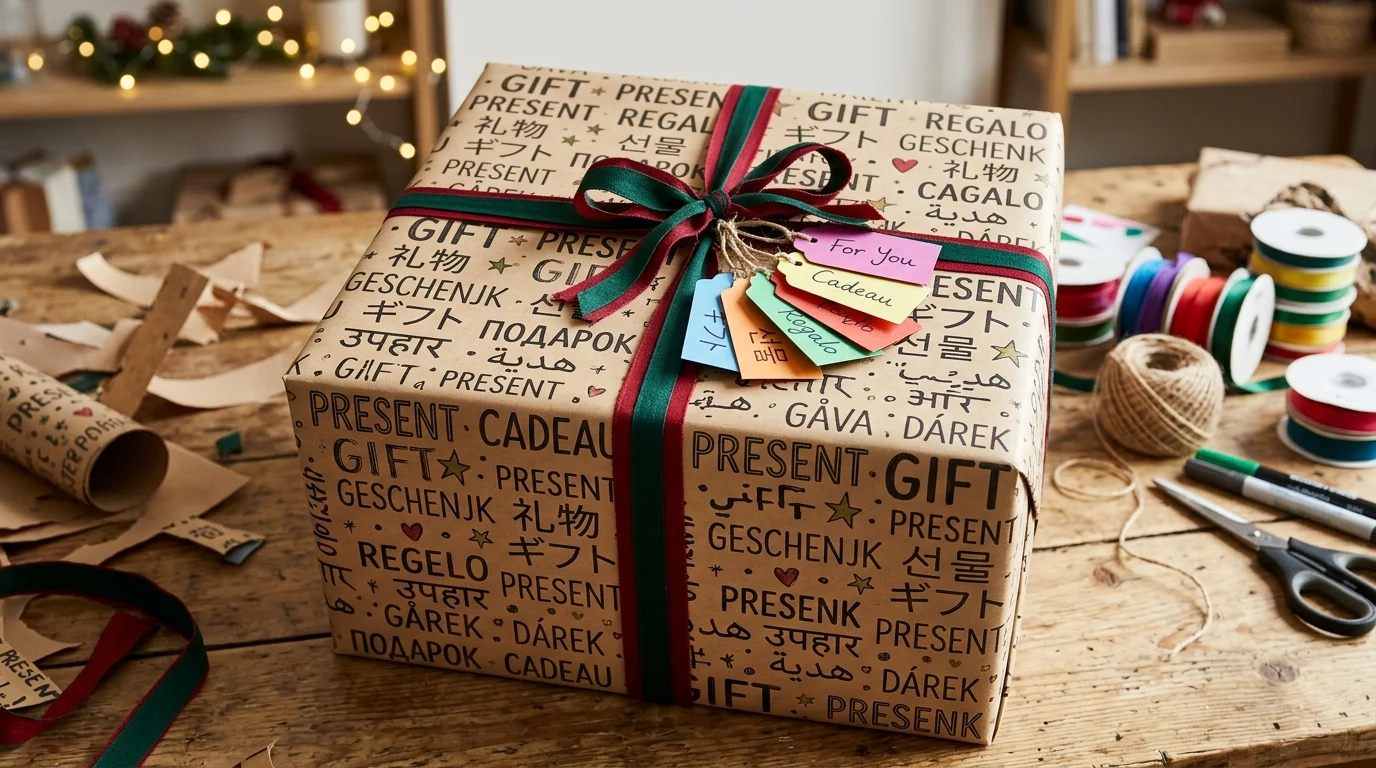
Learning how to say “present” in different languages is useful for students, travelers, language learners, and anyone curious about words from around the world. However, “present” has several meanings in English. It can refer to a gift, being in a particular place, or the current time.
This guide focuses mainly on “present” meaning a gift, while also explaining how to express the other meanings when needed. Explore 70 languages, their translations, easy pronunciations, and example sentences.
How to Say Present in Different Languages
The word “present” does not have one universal translation. In many languages, the word for a gift differs from the word used to describe someone who is physically present.
| # | Language | Present (Gift) | Easy Pronunciation | English Example |
|---|---|---|---|---|
| 1 | English | Present / Gift | PREZ-uhnt / gift | I bought you a present. |
| 2 | Spanish | Regalo | reh-GAH-loh | Te compré un regalo. |
| 3 | French | Cadeau | kah-DOH | J’ai acheté un cadeau. |
| 4 | German | Geschenk | geh-SHENK | Ich habe ein Geschenk gekauft. |
| 5 | Italian | Regalo | reh-GAH-loh | Ho comprato un regalo. |
| 6 | Portuguese | Presente | preh-ZEN-chee | Comprei um presente. |
| 7 | Dutch | Cadeau | kah-DOH | Ik heb een cadeau gekocht. |
| 8 | Swedish | Present | preh-SENT | Jag köpte en present. |
| 9 | Norwegian | Gave | GAH-veh | Jeg kjøpte en gave. |
| 10 | Danish | Gave | GAH-veh | Jeg købte en gave. |
Present in European Countries
These languages are spoken in different European countries. Some are also widely used outside Europe.
| # | Language | Present (Gift) | Easy Pronunciation | English Example |
|---|---|---|---|---|
| 11 | Finnish | Lahja | LAH-yah | Ostin sinulle lahjan. |
| 12 | Icelandic | Gjöf | gyurf | Ég keypti gjöf. |
| 13 | Irish | Bronntanas | BRUN-tuh-nus | Cheannaigh mé bronntanas. |
| 14 | Welsh | Anrheg | AN-rheg | Prynais anrheg. |
| 15 | Scottish Gaelic | Tiodhlac | CHEE-lak | Cheannaich mi tiodhlac. |
| 16 | Polish | Prezent | PREH-zent | Kupiłem prezent. |
| 17 | Czech | Dárek | DAA-rek | Koupil jsem dárek. |
| 18 | Slovak | Darček | DAR-chek | Kúpil som darček. |
| 19 | Ukrainian | Подарунок (Podarunok) | poh-dah-ROO-nok | Я купив подарунок. |
| 20 | Russian | Подарок (Podarok) | pah-dah-ROK | Я купил подарок. |
Present in Eastern and Southern European Languages
The following translations show how several other European languages express the idea of a gift.
| # | Language | Present (Gift) | Easy Pronunciation | English Example |
|---|---|---|---|---|
| 21 | Bulgarian | Подарък (Podarak) | poh-dah-RUK | Купих подарък. |
| 22 | Serbian | Поклон (Poklon) | POHK-lohn | Купио сам поклон. |
| 23 | Croatian | Poklon | POHK-lohn | Kupio sam poklon. |
| 24 | Slovenian | Darilo | dah-REE-loh | Kupil sem darilo. |
| 25 | Greek | Δώρο (Dóro) | THOH-roh | Αγόρασα ένα δώρο. |
| 26 | Romanian | Cadou | kah-DOW | Am cumpărat un cadou. |
| 27 | Hungarian | Ajándék | AH-yaan-dayk | Vettem egy ajándékot. |
| 28 | Albanian | Dhuratë | thoo-RAH-tuh | Bleva një dhuratë. |
| 29 | Turkish | Hediye | heh-dee-YEH | Sana bir hediye aldım. |
| 30 | Basque | Opari | oh-PAH-ree | Opari bat erosi dut. |
Present in Middle Eastern and South Asian Languages
In these languages, gift-related words are often used for birthdays, weddings, holidays, and other special occasions.
| # | Language | Present (Gift) | Easy Pronunciation | English Example |
|---|---|---|---|---|
| 31 | Arabic | هدية (Hadiyya) | hah-DEE-yah | اشتريت لك هدية. |
| 32 | Hebrew | מתנה (Matana) | mah-tah-NAH | קניתי לך מתנה. |
| 33 | Persian (Farsi) | هدیه (Hediyeh) | heh-dee-YEH | برایت هدیه خریدم. |
| 34 | Urdu | تحفہ (Tohfa) | TOHF-ah | میں نے تمہارے لیے تحفہ خریدا۔ |
| 35 | Hindi | उपहार (Upahaar) | oo-pah-HAAR | मैंने तुम्हारे लिए उपहार खरीदा। |
| 36 | Bengali | উপহার (Upohar) | oo-poh-HAAR | আমি তোমার জন্য উপহার কিনেছি। |
| 37 | Punjabi | ਤੋਹਫ਼ਾ (Tohfa) | TOHF-ah | ਮੈਂ ਤੇਰੇ ਲਈ ਤੋਹਫ਼ਾ ਖਰੀਦਿਆ। |
| 38 | Gujarati | ભેટ (Bhet) | BHEHT | મેં તમારા માટે ભેટ ખરીદી. |
| 39 | Marathi | भेट (Bhet) | BHEHT | मी तुझ्यासाठी भेट घेतली. |
| 40 | Nepali | उपहार (Upahār) | oo-pah-HAAR | मैले तिम्रो लागि उपहार किनेँ। |
Present in East and Southeast Asian Languages
Explore gift-related words used across China, Japan, Korea, and several Southeast Asian countries.
| # | Language | Present (Gift) | Easy Pronunciation | English Example |
|---|---|---|---|---|
| 41 | Sinhala | තෑග්ග (Thægga) | THAEG-gah | මම තෑග්ගක් ගත්තා. |
| 42 | Tamil | பரிசு (Parisu) | pah-ree-soo | நான் உனக்குப் பரிசு வாங்கினேன். |
| 43 | Telugu | బహుమతి (Bahumati) | bah-hoo-mah-tee | నేను నీకు బహుమతి కొన్నాను. |
| 44 | Kannada | ಉಡುಗೊರೆ (Udugore) | oo-doo-GOH-reh | ನಾನು ನಿನಗೆ ಉಡುಗೊರೆ ಖರೀದಿಸಿದೆ. |
| 45 | Malayalam | സമ്മാനം (Sammanam) | sam-MAA-nam | ഞാൻ നിനക്കൊരു സമ്മാനം വാങ്ങി. |
| 46 | Mandarin Chinese | 礼物 (Lǐwù) | lee-WOO | 我给你买了一份礼物。 |
| 47 | Cantonese | 禮物 (Lai5 mat6) | lai maht | 我買咗份禮物畀你。 |
| 48 | Japanese | プレゼント (Purezento) | poo-reh-ZEN-toh | あなたにプレゼントを買いました。 |
| 49 | Korean | 선물 (Seonmul) | SUN-mool | 너에게 선물을 샀어. |
| 50 | Vietnamese | Quà tặng | gwah TAHNG | Tôi đã mua một món quà. |
Present in Southeast Asian and African Languages
The next group includes languages used in Southeast Asia and Africa. Gift-giving traditions vary across communities and occasions.
| # | Language | Present (Gift) | Easy Pronunciation | English Example |
|---|---|---|---|---|
| 51 | Thai | ของขวัญ (Khong khwan) | khawng-KWUN | ฉันซื้อของขวัญให้คุณ |
| 52 | Lao | ຂອງຂວັນ (Khong khwan) | khawng-KWUN | ຂ້ອຍຊື້ຂອງຂວັນໃຫ້ເຈົ້າ |
| 53 | Khmer | អំណោយ (Amnoy) | am-NOY | ខ្ញុំបានទិញអំណោយមួយ។ |
| 54 | Burmese | လက်ဆောင် (Let-saung) | let-SOWN | မင်းအတွက် လက်ဆောင်ဝယ်ခဲ့တယ်။ |
| 55 | Indonesian | Hadiah | hah-DEE-ah | Saya membeli hadiah untukmu. |
| 56 | Malay | Hadiah | hah-DEE-ah | Saya membeli hadiah untuk awak. |
| 57 | Filipino (Tagalog) | Regalo | reh-GAH-loh | Bumili ako ng regalo para sa iyo. |
| 58 | Javanese | Bebungah | beh-BOO-ngah | Aku tuku bebungah kanggo kowe. |
| 59 | Swahili | Zawadi | zah-WAH-dee | Nimekununulia zawadi. |
| 60 | Amharic | ስጦታ (Sitota) | see-TOH-tah | ስጦታ ገዛሁልህ። |
Present in African and Other Languages
These translations represent additional languages from Africa and other parts of the world.
| # | Language | Present (Gift) | Easy Pronunciation | English Example |
|---|---|---|---|---|
| 61 | Somali | Hadiyad | hah-DEE-yad | Waxaan kuu iibsaday hadiyad. |
| 62 | Yoruba | Ẹ̀bùn | eh-BOON | Mo ra ẹ̀bùn fún ọ. |
| 63 | Igbo | Onyinye | oh-NYIN-yeh | Azụtara m gị onyinye. |
| 64 | Zulu | Isipho | ee-SEE-poh | Ngikuthengele isipho. |
| 65 | Xhosa | Isipho | ee-SEE-poh | Ndikuthengele isipho. |
| 66 | Afrikaans | Geskenk | khuh-SHENK | Ek het vir jou ’n geskenk gekoop. |
| 67 | Haitian Creole | Kado | kah-DOH | Mwen achte yon kado pou ou. |
| 68 | Esperanto | Donaco | doh-NAH-tsoh | Mi aĉetis donacon por vi. |
| 69 | Latin | Donum | DOH-num | Tibi donum emi. |
| 70 | Catalan | Regal | reh-GAHL | He comprat un regal per a tu. |
What Does “Present” Mean in Different Contexts?
The English word “present” has three common meanings. Choosing the right translation depends on the sentence.
| Meaning | Example | Explanation |
|---|---|---|
| A gift | She gave me a present. | Something given to another person, often for a celebration. |
| Being here | All students are present. | Someone is attending or physically in a place. |
| Current time | Live in the present. | The time happening now, rather than the past or future. |
For example, Spanish uses regalo for a gift, but presente can describe someone who is attending. French uses cadeau for a gift and présent for being present or for the current time, depending on context.
Why Learn the Word “Present” in Different Languages?
Learning this word can help in several everyday situations:
- Travel: Understand gift-related words when visiting another country.
- Celebrations: Talk about birthday, wedding, and holiday gifts.
- Language learning: Build vocabulary through practical examples.
- Cultural understanding: Discover how different languages express the idea of giving.
- Communication: Choose the right word for a gift, attendance, or the current moment.
Frequently Asked Questions
1. How do you say “present” in Spanish?
“Present” meaning a gift is regalo in Spanish. For example, “I bought you a present” translates to “Te compré un regalo.”
2. What is “present” in French?
The French word for a gift is cadeau. The word présent can mean being present or the current time, depending on the sentence.
3. What is “present” in Urdu?
In Urdu, “present” meaning a gift is تحفہ (tohfa). If you mean someone is physically present, the wording changes according to the sentence.
4. Is “present” the same in every language?
No. Each language has its own vocabulary, and some languages use different words for a gift, attendance, and the current time.
5. What is the difference between a present and a gift?
In everyday English, “present” and “gift” generally mean the same thing when referring to something given to someone. “Gift” is also common in formal and professional contexts.
Conclusion
Knowing how to say present in different languages makes it easier to talk about gifts, celebrations, and everyday experiences across cultures. From regalo in Spanish to cadeau in French, tohfa in Urdu, and zawadi in Swahili, each language offers its own expression for the idea of giving.
Remember that “present” can also mean being in a place or the time happening now. Always consider the context before choosing a translation.

I am Scarlett Wilson, a passionate language writer who loves exploring different languages, words, meanings, translations, and useful phrases. I enjoy making language learning simple, clear, and interesting for everyone.