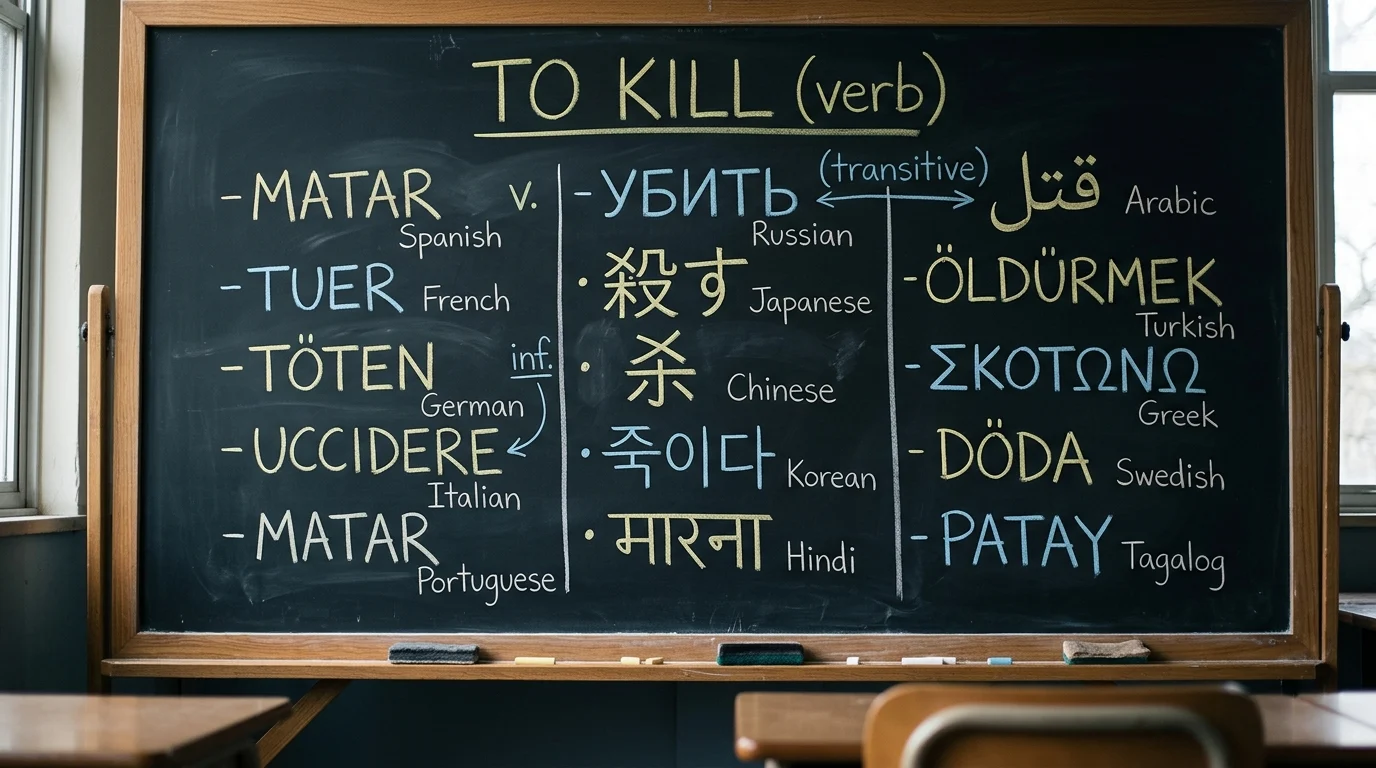
The word kill has a serious meaning, but it appears in different contexts across languages, from news reports and books to everyday expressions and figurative phrases. Learning how to say kill in different languages can help you understand translations, explore vocabulary, and recognize how different cultures express the same idea.
In English, kill usually means to cause the death of a person, animal, or living thing. Depending on the context, it can also be used figuratively, as in “kill time,” “kill a conversation,” or “that joke killed me.”
If you are searching for kill in different languages, this guide includes 70 translations organized into regional tables. Each entry provides the native word or phrase, an easy pronunciation guide, and an English example to explain how the word may be used. Some languages use different words depending on whether the context is literal, figurative, formal, or informal.
Quick Reference: Kill in Different Languages
| Language | Translation | Easy Pronunciation |
|---|---|---|
| Spanish | Matar | mah-TAR |
| French | Tuer | tweh |
| German | Töten | TUH-ten |
| Italian | Uccidere | oot-chee-DEH-reh |
| Portuguese | Matar | mah-TAR |
| Russian | Убивать | oo-bee-VAT |
| Chinese | 杀死 | shah-sz |
| Japanese | 殺す | koh-roo-soo |
| Korean | 죽이다 | joo-gee-da |
| Arabic | قتل | qa-tal |
| Hindi | मारना | maar-naa |
| Urdu | قتل کرنا | qatl karna |
| Turkish | Öldürmek | ul-dur-mek |
| Swahili | Kuua | koo-oo-ah |
| Filipino | Pumatay | poo-mah-tie |
European Languages
European languages have different words for kill, and some distinguish between causing death, murdering someone, and killing an animal.
Western and Northern European Languages
| Language | Native Translation | Easy Pronunciation | Example in English | English Meaning |
|---|---|---|---|---|
| Spanish | Matar | mah-TAR | The word means to kill. | To cause death |
| French | Tuer | tweh | The verb means to kill. | To cause death |
| German | Töten | TUH-ten | The German word means to kill. | To cause death |
| Italian | Uccidere | oot-chee-DEH-reh | The verb means to kill. | To cause death |
| Portuguese | Matar | mah-TAR | The word means to kill. | To cause death |
| Dutch | Doden | DOH-den | The Dutch verb means to kill. | To cause death |
| Swedish | Döda | DUH-da | The word means to kill. | To cause death |
| Norwegian | Drepe | DREH-peh | The Norwegian verb means to kill. | To cause death |
| Danish | Dræbe | DREH-beh | The word means to kill. | To cause death |
| Finnish | Tappaa | TAP-paa | The Finnish verb means to kill. | To cause death |
Central, Eastern, and Other European Languages
| Language | Native Translation | Easy Pronunciation | Example in English | English Meaning |
|---|---|---|---|---|
| Polish | Zabijać | zah-BEE-yatch | The word can mean to kill. | To cause death |
| Czech | Zabít | ZAH-beet | The Czech verb means to kill. | To cause death |
| Slovak | Zabiť | ZAH-beet | The word means to kill. | To cause death |
| Romanian | A ucide | ah oo-CHEE-deh | The Romanian phrase means to kill. | To cause death |
| Greek | Σκοτώνω | sko-TOH-no | The Greek verb means to kill. | To cause death |
| Russian | Убивать | oo-bee-VAT | The Russian word means to kill. | To cause death |
| Ukrainian | Вбивати | vbee-VAH-ty | The Ukrainian verb means to kill. | To cause death |
| Bulgarian | Убивам | oo-BEE-vam | The Bulgarian word means to kill. | To cause death |
| Croatian | Ubiti | OO-bee-tee | The Croatian verb means to kill. | To cause death |
| Hungarian | Megölni | MEG-uhl-nee | The Hungarian word means to kill. | To cause death |
South Asian Languages
South Asian languages often have several expressions for kill, depending on whether the speaker means killing, murdering, or causing someone’s death.
| Language | Native Translation | Easy Pronunciation | Example in English | English Meaning |
|---|---|---|---|---|
| Hindi | मारना | maar-naa | The Hindi word can mean to kill. | To cause death |
| Urdu | قتل کرنا | qatl karna | The Urdu phrase means to kill. | To cause death |
| Bengali | হত্যা করা | hot-ta ko-ra | The Bengali phrase means to kill. | To cause death |
| Punjabi | ਮਾਰਨਾ | maar-naa | The Punjabi word can mean to kill. | To cause death |
| Tamil | கொல்லுதல் | kol-lu-thal | The Tamil word means to kill. | To cause death |
| Telugu | చంపడం | cham-pa-dam | The Telugu word means to kill. | To cause death |
| Kannada | ಕೊಲ್ಲು | kol-lu | The Kannada word means to kill. | To cause death |
| Malayalam | കൊല്ലുക | kol-lu-ka | The Malayalam word means to kill. | To cause death |
| Marathi | मारणे | maa-ra-ne | The Marathi word can mean to kill. | To cause death |
| Gujarati | મારવું | maar-vu | The Gujarati word can mean to kill. | To cause death |
East and Southeast Asian Languages
These languages use different writing systems and grammatical structures. The English verb kill may translate into a short word or a longer expression.
| Language | Native Translation | Easy Pronunciation | Example in English | English Meaning |
|---|---|---|---|---|
| Chinese (Mandarin) | 杀死 | shā-sǐ | The Mandarin expression means to kill. | To cause death |
| Japanese | 殺す | ko-ro-su | The Japanese verb means to kill. | To cause death |
| Korean | 죽이다 | ju-gi-da | The Korean verb means to kill. | To cause death |
| Thai | ฆ่า | khâa | The Thai word means to kill. | To cause death |
| Vietnamese | Giết | zyət, approximately | The Vietnamese word means to kill. | To cause death |
| Indonesian | Membunuh | mem-boo-nooh | The Indonesian word means to kill. | To cause death |
| Malay | Membunuh | mem-boo-nooh | The Malay word means to kill. | To cause death |
| Filipino (Tagalog) | Pumatay | poo-mah-tie | The Tagalog word means to kill. | To cause death |
| Burmese | သတ်သည် | that-thi | The Burmese expression means to kill. | To cause death |
| Khmer | សម្លាប់ | som-lap | The Khmer word means to kill. | To cause death |
Middle Eastern and Central Asian Languages
Words related to killing can have different levels of formality and seriousness. In some languages, the most natural translation depends strongly on the sentence.
| Language | Native Translation | Easy Pronunciation | Example in English | English Meaning |
|---|---|---|---|---|
| Arabic | قتل | qa-tal | The Arabic verb can mean to kill. | To cause death |
| Persian (Farsi) | کشتن | kosh-tan | The Persian verb means to kill. | To cause death |
| Hebrew | להרוג | la-ha-rog | The Hebrew verb means to kill. | To cause death |
| Turkish | Öldürmek | ul-dur-mek | The Turkish verb means to kill. | To cause death |
| Armenian | Սպանել | spa-nel | The Armenian verb means to kill. | To cause death |
| Georgian | მოკვლა | mok-vla | The Georgian word means to kill. | To cause death |
| Kazakh | Өлтіру | ul-ti-ru | The Kazakh word means to kill. | To cause death |
| Uzbek | O‘ldirmoq | ul-dir-moq | The Uzbek verb means to kill. | To cause death |
| Mongolian | Алах | a-lakh | The Mongolian word means to kill. | To cause death |
| Pashto | وژل | wa-jal | The Pashto word can mean to kill. | To cause death |
African Languages
African languages include many distinct linguistic traditions. These examples show how the idea of kill is expressed in several languages from different parts of the continent.
| Language | Native Translation | Easy Pronunciation | Example in English | English Meaning |
|---|---|---|---|---|
| Swahili | Kuua | koo-oo-ah | The Swahili word means to kill. | To cause death |
| Amharic | መግደል | meg-dehl | The Amharic verb means to kill. | To cause death |
| Hausa | Kashe | kah-sheh | The Hausa word can mean to kill. | To cause death |
| Yoruba | Pa | pah | The Yoruba word can mean to kill. | To cause death |
| Igbo | Igbu | eeg-boo | The Igbo word can mean to kill. | To cause death |
| Zulu | Bulala | boo-LAH-lah | The Zulu word can mean to kill. | To cause death |
| Xhosa | Bulala | boo-LAH-lah | The Xhosa word can mean to kill. | To cause death |
| Afrikaans | Doodmaak | DOHT-mahk | The Afrikaans word means to kill. | To cause death |
| Somali | Dil | dil | The Somali word can mean to kill. | To cause death |
| Kinyarwanda | Kwica | kwee-cha | The Kinyarwanda word means to kill. | To cause death |
Other Languages Around the World
The following languages come from the Atlantic, Pacific, and other language communities. Some entries are less commonly encountered in translation lists, so the pronunciation guides are approximate.
| Language | Native Translation | Easy Pronunciation | Example in English | English Meaning |
|---|---|---|---|---|
| Haitian Creole | Touye | too-yeh | The Haitian Creole word means to kill. | To cause death |
| Māori | Patu | pah-too | The Māori word can mean to strike or kill, depending on context. | To cause death or strike |
| Samoan | Fasioti | fah-see-oh-tee | The Samoan word can refer to killing. | To cause death |
| Hawaiian | Pepehi | peh-peh-hee | The Hawaiian word can mean to kill. | To cause death |
| Irish | Marú | mah-ROO | The Irish word means killing or to kill, depending on grammar. | To cause death |
| Welsh | Lladd | hlath, approximately | The Welsh word can mean to kill. | To cause death |
| Icelandic | Drepa | DREH-pa | The Icelandic verb means to kill. | To cause death |
| Esperanto | Mortigi | mor-TEE-gee | The Esperanto word means to kill. | To cause death |
| Basque | Hil | heel | The Basque word is associated with killing or death, depending on its grammatical use. | To kill or die, depending on form |
| Catalan | Matar | mah-TAR | The Catalan verb means to kill. | To cause death |
How to Use the Word Kill in English
The word kill can have a literal meaning or a figurative meaning. Understanding the context helps you choose the correct translation.
Literal Meaning
In its literal sense, kill means to cause the death of a living being.
Examples:
- The news reported that the animal was killed in an accident.
- The story describes a character who wants to kill the villain.
- The law distinguishes between different circumstances involving a person’s death.
Figurative Meaning
In informal English, kill can be used without referring to a literal death.
Examples:
- Kill time: Do something while waiting.
- Kill a conversation: Make a conversation stop or become awkward.
- Kill the mood: Spoil a pleasant atmosphere.
- You killed it: You performed extremely well.
- That joke killed me: The joke was extremely funny.
These expressions usually need to be translated by meaning rather than word for word. A direct translation may sound unnatural or may suggest literal harm in another language.
Kill vs. Murder: What Is the Difference?
Although kill and murder are related, they are not interchangeable in every situation.
- Kill: A broad verb meaning to cause death. It does not, by itself, explain whether the act was intentional or unlawful.
- Murder: A legal and everyday term generally referring to the unlawful and intentional killing of another person, subject to the relevant jurisdiction’s definition.
- Die: To stop living. This describes what happens to the person or living thing, rather than identifying someone who caused the death.
- Death: The noun describing the end of life.
For example, “The character killed the creature” describes an action. “The character died” describes the end of the character’s life. “Murder” carries a more specific meaning and should not be substituted for kill in every translation.
Common Mistakes When Translating Kill
When learning kill in different languages, keep these points in mind:
- Do not assume every translation is interchangeable. Some words refer specifically to murder, while others can refer to killing animals or causing death more generally.
- Check the grammar. A dictionary may list an infinitive, a root, or a conjugated form. These forms cannot always replace one another in a sentence.
- Consider the context. A word used in a crime report may not be suitable for a joke or casual expression.
- Avoid translating idioms literally. Expressions such as “kill time” usually need a natural equivalent in the target language.
- Use pronunciation guides as a starting point. English spelling cannot represent every sound in another language perfectly.
- Check regional variation. Words and expressions may differ between countries and communities that share a language.
How to Learn Vocabulary in Different Languages
If you are building your multilingual vocabulary, try these simple methods:
- Learn words in context: Study a short sentence rather than memorizing a translation alone.
- Listen to native speakers: Audio pronunciation can help you recognize sounds that written guides cannot explain.
- Compare related words: Learn the difference between kill, murder, die, and death.
- Review regularly: Revisit a few words each day instead of trying to memorize every translation at once.
- Check reliable dictionaries: For sensitive or serious words, confirm the intended meaning and grammatical form before using them.
Frequently Asked Questions
How do you say kill in different languages?
The word has different translations around the world. Examples include matar in Spanish, tuer in French, töten in German, убивать in Russian, 殺す in Japanese, قتل کرنا in Urdu, and kuua in Swahili.
What is the Spanish word for kill?
The common Spanish verb is matar. The best translation can depend on the sentence and whether the intended meaning is literal or figurative.
What is the difference between kill and murder?
Kill is a broad word for causing death. Murder usually refers to an unlawful and intentional killing of another person, although its exact legal definition varies by jurisdiction.
Can kill have a figurative meaning?
Yes. English expressions such as “kill time,” “kill the mood,” and “you killed it” are figurative. Their intended meanings are not usually about causing death.
Are these translations suitable for every sentence?
No. These entries are general vocabulary equivalents, not universal substitutions. Grammar, formality, context, and regional usage can change which expression sounds natural. For an important translation, consult a reliable dictionary or a fluent speaker.
Conclusion
Learning kill in different languages is a way to explore vocabulary, pronunciation, and cultural differences. This guide brings together 70 language entries from Europe, Asia, the Middle East, Africa, and other regions, with native forms and simple pronunciation guides.
Remember that a word’s meaning depends on context. Literal uses, legal terminology, and figurative expressions may require different translations. When accuracy matters, check how the word works in a complete sentence rather than relying on a single-word equivalent.

I am Scarlett Wilson, a passionate language writer who loves exploring different languages, words, meanings, translations, and useful phrases. I enjoy making language learning simple, clear, and interesting for everyone.