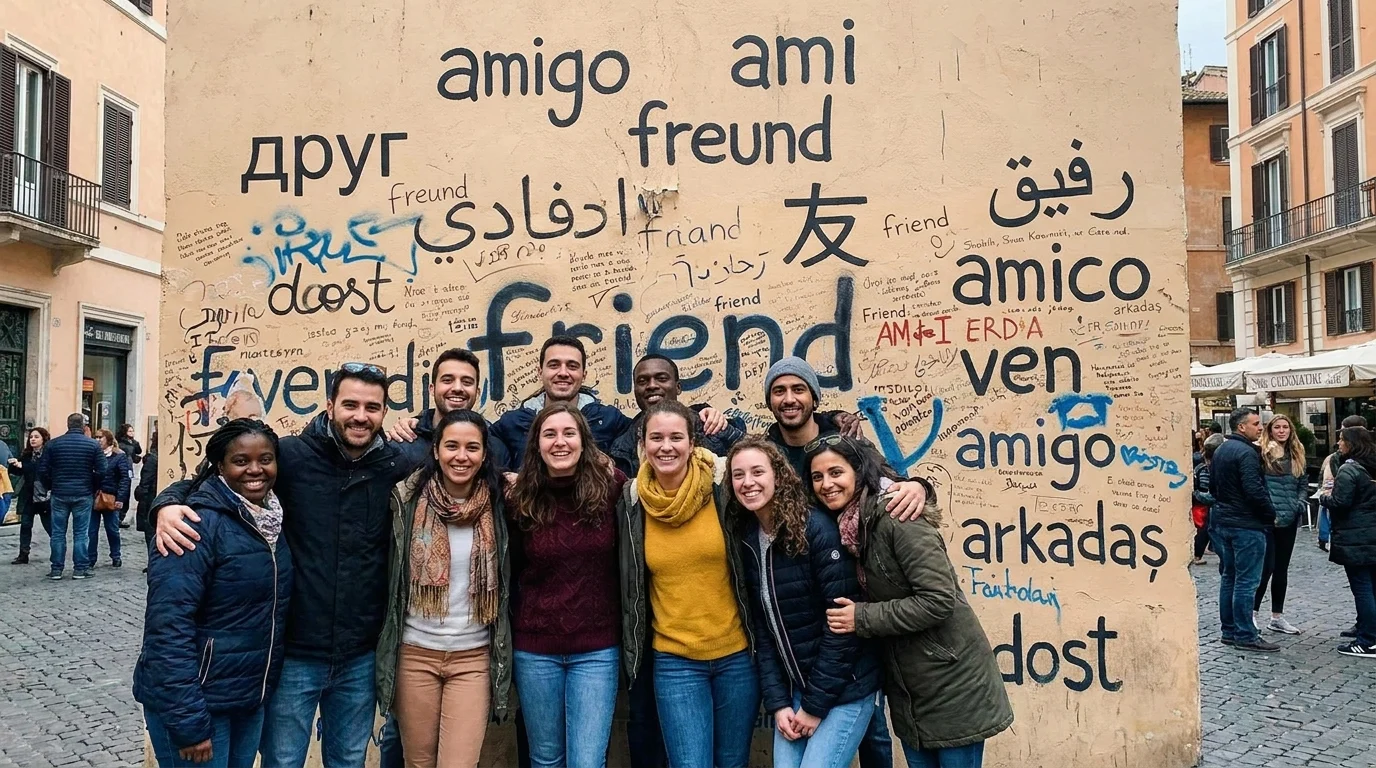
Friendship is one of the most meaningful connections people share, bringing trust, kindness, support, and happiness into everyday life. Learning how to say friend in different languages is a wonderful way to connect with people from other cultures, learn new vocabulary, and express appreciation for the people who matter to you.
The word friend has different translations around the world. It is amigo in Spanish, ami in French, Freund in German, दोस्त (dost) in Hindi, and 朋友 (péngyou) in Mandarin Chinese. Some languages also use different words depending on gender, closeness, or the type of relationship.
In this guide, you will discover 70 language translations, native spellings, easy pronunciation guides, and practical example sentences with English meanings. You will also learn how to use these words naturally when talking about friendship.
How Do You Say Friend in Different Languages?
The English word friend can be translated in several ways depending on the language and context. Here are eight common translations to help you get started.
| Language | Native Word for Friend | Easy Pronunciation |
|---|---|---|
| Spanish | Amigo / Amiga | Ah-mee-go / Ah-mee-ga |
| French | Ami / Amie | Ah-mee |
| German | Freund / Freundin | Froynt / FROYND-in |
| Italian | Amico / Amica | Ah-mee-ko / Ah-mee-ka |
| Portuguese | Amigo / Amiga | Ah-mee-go / Ah-mee-ga |
| Hindi | दोस्त | Dost |
| Urdu | دوست | Dost |
| Japanese | 友達 | Tomo-dachi |
Helpful tip: Some languages distinguish between male and female friends, while others use one common word for everyone. The best translation depends on the language and the sentence you want to say.
Friend in South Asian Languages
South Asian languages have several words for friend, including terms used in everyday conversations, school, work, and close relationships.
| Language | Native Word | Easy Pronunciation | Example Sentence | English Meaning |
|---|---|---|---|---|
| Hindi | दोस्त | Dost | मेरा दोस्त बहुत अच्छा है। | My friend is very nice. |
| Urdu | دوست | Dost | میرا دوست بہت اچھا ہے۔ | My friend is very nice. |
| Bengali | বন্ধু | Bondhu | আমার বন্ধু খুব ভালো। | My friend is very nice. |
| Punjabi | ਦੋਸਤ | Dost | ਮੇਰਾ ਦੋਸਤ ਬਹੁਤ ਚੰਗਾ ਹੈ। | My friend is very nice. |
| Gujarati | મિત્ર | Mitra | મારો મિત્ર ખૂબ સારો છે. | My friend is very nice. |
| Marathi | मित्र | Mitra | माझा मित्र खूप चांगला आहे. | My friend is very nice. |
| Nepali | साथी | Saathi | मेरो साथी धेरै राम्रो छ। | My friend is very nice. |
Friend in East Asian Languages
In East Asian languages, words for friend may also express companionship or a close personal relationship. Context often determines how formal or casual the expression feels.
| Language | Native Word | Easy Pronunciation | Example Sentence | English Meaning |
|---|---|---|---|---|
| Chinese (Mandarin) | 朋友 | Péng-you | 我的朋友很好。 | My friend is very nice. |
| Japanese | 友達 | Tomodachi | 私の友達はとても親切です。 | My friend is very kind. |
| Korean | 친구 | Chin-gu | 제 친구는 정말 친절해요. | My friend is really kind. |
| Mongolian | Найз | Naiz | Миний найз их сайхан сэтгэлтэй. | My friend is very kind. |
| Tibetan | གྲོགས་པོ | Dro-poh | ངའི་གྲོགས་པོ་བཟང་པོ་རེད། | My friend is good. |
Friend in Southeast Asian Languages
These languages offer different ways to talk about friends, companions, and people you enjoy spending time with.
| Language | Native Word | Easy Pronunciation | Example Sentence | English Meaning |
|---|---|---|---|---|
| Indonesian | Teman | Tuh-man | Teman saya sangat baik. | My friend is very kind. |
| Malay | Kawan | Kah-wan | Kawan saya sangat baik. | My friend is very kind. |
| Filipino (Tagalog) | Kaibigan | Kai-bee-gan | Mabait ang kaibigan ko. | My friend is kind. |
| Javanese | Kanca | Kan-cha | Kancaku apik banget. | My friend is very nice. |
| Burmese | သူငယ်ချင်း | Thu-ngè-chin | ကျွန်တော့်သူငယ်ချင်းက သဘောကောင်းတယ်။ | My friend is kind. |
| Khmer | មិត្តភក្តិ | Mit-pheak | មិត្តភក្តិរបស់ខ្ញុំល្អណាស់។ | My friend is very nice. |
| Lao | ໝູ່ | Moo | ໝູ່ຂອງຂ້ອຍໃຈດີຫຼາຍ. | My friend is very kind. |
Friend in Middle Eastern Languages
Words for friend in the Middle East vary by language, dialect, and level of familiarity. Some terms are common in everyday speech, while others are more formal.
| Language | Native Word | Easy Pronunciation | Example Sentence | English Meaning |
|---|---|---|---|---|
| Arabic | صديق / صديقة | Sadeeq / Sadeeqa | صديقي لطيف جدًا. | My male friend is very kind. |
| Persian | دوست | Doost | دوست من خیلی مهربان است. | My friend is very kind. |
| Hebrew | חבר / חברה | Khaver / Khavera | החבר שלי נחמד מאוד. | My male friend is very nice. |
| Turkish | Arkadaş | Ar-ka-dash | Arkadaşım çok iyi biri. | My friend is a very good person. |
| Kurdish (Kurmanji) | Heval | Heh-val | Hevalê min pir baş e. | My friend is very good. |
| Armenian | Ընկեր | Un-ker | Իմ ընկերը շատ բարի է։ | My friend is very kind. |
| Georgian | მეგობარი | Me-go-ba-ri | ჩემი მეგობარი ძალიან კეთილია. | My friend is very kind. |
Friend in Western European Languages
Many Western European languages have words for friend that change according to gender or grammatical structure.
| Language | Native Word | Easy Pronunciation | Example Sentence | English Meaning |
|---|---|---|---|---|
| French | Ami / Amie | Ah-mee | Mon ami est très gentil. | My friend is very kind. |
| Spanish | Amigo / Amiga | Ah-mee-go / Ah-mee-ga | Mi amigo es muy amable. | My friend is very kind. |
| Portuguese | Amigo / Amiga | Ah-mee-go / Ah-mee-ga | Meu amigo é muito gentil. | My friend is very kind. |
| Italian | Amico / Amica | Ah-mee-ko / Ah-mee-ka | Il mio amico è molto gentile. | My friend is very kind. |
| German | Freund / Freundin | Froynt / FROYND-in | Mein Freund ist sehr nett. | My male friend is very nice. |
| Dutch | Vriend / Vriendin | Vreent / VREEN-din | Mijn vriend is erg aardig. | My male friend is very nice. |
| Catalan | Amic / Amiga | Ah-meek / Ah-mee-ga | El meu amic és molt amable. | My male friend is very kind. |
Friend in Northern European Languages
Northern European languages include several Germanic languages as well as Finnish and Estonian. The words below are useful for everyday conversations about friends.
| Language | Native Word | Easy Pronunciation | Example Sentence | English Meaning |
|---|---|---|---|---|
| Swedish | Vän | Ven | Min vän är mycket snäll. | My friend is very kind. |
| Norwegian | Venn | Ven | Vennen min er veldig snill. | My friend is very kind. |
| Danish | Ven | Ven | Min ven er meget sød. | My friend is very kind. |
| Icelandic | Vinur / Vinkona | Vee-nur / Veen-ko-na | Vinur minn er mjög góður. | My male friend is very good. |
| Finnish | Ystävä | Oos-tä-vä | Ystäväni on todella ystävällinen. | My friend is really kind. |
| Estonian | Sõber | Suh-ber | Mu sõber on väga lahke. | My friend is very kind. |
Friend in Southern European and Balkan Languages
These languages have their own expressions for friendship, companionship, and close personal relationships.
| Language | Native Word | Easy Pronunciation | Example Sentence | English Meaning |
|---|---|---|---|---|
| Greek | Φίλος / Φίλη | Fee-los / Fee-lee | Ο φίλος μου είναι πολύ καλός. | My male friend is very nice. |
| Albanian | Mik / Mikesha | Meek / Mee-keh-sha | Miku im është shumë i sjellshëm. | My male friend is very kind. |
| Romanian | Prieten / Prietenă | Pree-eh-ten / Pree-eh-teh-nuh | Prietenul meu este foarte amabil. | My male friend is very kind. |
| Serbian | Пријатељ / Пријатељица | Pree-ya-tel / Pree-ya-te-lyee-tsa | Мој пријатељ је веома добар. | My male friend is very good. |
| Croatian | Prijatelj / Prijateljica | Pree-ya-tely / Pree-ya-te-lyee-tsa | Moj prijatelj je vrlo ljubazan. | My male friend is very kind. |
| Bulgarian | Приятел / Приятелка | Pree-ya-tel / Pree-ya-tel-ka | Моят приятел е много мил. | My male friend is very nice. |
| Macedonian | Пријател / Пријателка | Pree-ya-tel / Pree-ya-tel-ka | Мојот пријател е многу добар. | My male friend is very good. |
Friend in Slavic and Eastern European Languages
Slavic languages share some historical connections, but their words for friend differ in spelling, pronunciation, and grammatical gender.
| Language | Native Word | Easy Pronunciation | Example Sentence | English Meaning |
|---|---|---|---|---|
| Russian | Друг / Подруга | Droog / Pa-droo-ga | Мой друг очень добрый. | My male friend is very kind. |
| Ukrainian | Друг / Подруга | Drooh / Pod-roo-ha | Мій друг дуже добрий. | My male friend is very kind. |
| Polish | Przyjaciel / Przyjaciółka | Psheh-ya-chel / Psheh-ya-choow-ka | Mój przyjaciel jest bardzo miły. | My male friend is very nice. |
| Czech | Kamarád / Kamarádka | Ka-ma-raat / Ka-ma-raat-ka | Můj kamarád je moc milý. | My male friend is very nice. |
| Slovak | Kamarát / Kamarátka | Ka-ma-raat / Ka-ma-raat-ka | Môj kamarát je veľmi milý. | My male friend is very nice. |
| Slovenian | Prijatelj / Prijateljica | Pree-ya-tely / Pree-ya-te-lyee-tsa | Moj prijatelj je zelo prijazen. | My male friend is very kind. |
| Belarusian | Сябар / Сяброўка | Sya-bar / Sya-brow-ka | Мой сябар вельмі добры. | My male friend is very kind. |
Friend in Central Asian Languages
Central Asian languages include Turkic and Iranian languages, each with its own vocabulary for friendship and companionship.
| Language | Native Word | Easy Pronunciation | Example Sentence | English Meaning |
|---|---|---|---|---|
| Kazakh | Дос | Dos | Менің досым өте мейірімді. | My friend is very kind. |
| Uzbek | Doʻst | Dost | Mening doʻstim juda mehribon. | My friend is very kind. |
| Kyrgyz | Дос | Dos | Менин досум абдан боорукер. | My friend is very kind. |
| Turkmen | Dost | Dost | Meniň dostum örän mähirli. | My friend is very kind. |
| Tajik | Дӯст | Doost | Дӯсти ман хеле меҳрубон аст. | My friend is very kind. |
Friend in African Languages
Africa has thousands of languages, and these examples show a small part of its linguistic diversity. The words below are useful for learning how to talk about friends across different communities.
| Language | Native Word | Easy Pronunciation | Example Sentence | English Meaning |
|---|---|---|---|---|
| Swahili | Rafiki | Rah-fee-kee | Rafiki yangu ni mwema sana. | My friend is very kind. |
| Yoruba | Ọ̀rẹ́ | Aw-reh | Ọ̀rẹ́ mi jẹ́ ẹni rere. | My friend is a good person. |
| Igbo | Enyi | Eh-nyee | Enyi m dị ezigbo mma. | My friend is very good. |
| Zulu | Umngane | Oom-ngah-neh | Umngane wami unomusa kakhulu. | My friend is very kind. |
| Xhosa | Umhlobo | Oom-hloh-boh | Umhlobo wam unobubele kakhulu. | My friend is very kind. |
| Afrikaans | Vriend / Vriendin | Freent / VREEN-din | My vriend is baie gaaf. | My male friend is very nice. |
| Amharic | ጓደኛ | Gwa-den-ya | ጓደኛዬ በጣም ደግ ነው። | My friend is very kind. |
Friend in Other World Languages
These additional languages offer more ways to express friendship, including Celtic languages, Lithuanian, Basque, and Esperanto.
| Language | Native Word | Easy Pronunciation | Example Sentence | English Meaning |
|---|---|---|---|---|
| Irish | Cara | Kah-rah | Tá mo chara an-chineálta. | My friend is very kind. |
| Welsh | Ffrind | Freend | Mae fy ffrind yn garedig iawn. | My friend is very kind. |
| Lithuanian | Draugas / Draugė | DROW-gas / DROW-geh | Mano draugas yra labai malonus. | My male friend is very kind. |
| Basque | Lagun | Lah-goon | Nire laguna oso atsegina da. | My friend is very nice. |
| Esperanto | Amiko / Amikino | Ah-mee-ko / Ah-mee-kee-no | Mia amiko estas tre afabla. | My friend is very kind. |
How to Use the Word Friend in Everyday Conversations
Knowing a translation is helpful, but using it in a complete sentence makes it easier to remember. Here are some useful expressions to learn.
- My friend: Use this when introducing or talking about someone you know well.
- Best friend: Refers to a particularly close friend.
- A good friend: Describes someone who is supportive, caring, or trustworthy.
- Old friend: Refers to someone you have known for a long time.
- Make friends: Means to develop new friendships.
- Friendship: Describes the relationship between friends.
For example, Spanish speakers use mi amigo for “my male friend” and mi amiga for “my female friend.” In French, mon ami and mon amie follow different grammatical patterns. The correct expression depends on the language.
What Is the Difference Between Friend and Best Friend?
A friend is someone you know and have a friendly relationship with. A best friend is usually someone with whom you share a particularly close bond, trust, and personal experiences.
Here are some useful examples:
- My friend helps me with my homework.
- My best friend knows me very well.
- I met a new friend at school.
- My childhood friend lives in another city.
Not every language uses a direct word-for-word equivalent of best friend. Some use expressions meaning “closest friend” or “very close friend.”
How to Say My Friend in Different Languages
If you want to talk about your own friends, these expressions are useful starting points.
| Language | Translation of My Friend |
|---|---|
| Spanish | Mi amigo / Mi amiga |
| French | Mon ami / Mon amie |
| German | Mein Freund / Meine Freundin |
| Italian | Il mio amico / La mia amica |
| Portuguese | Meu amigo / Minha amiga |
| Hindi | मेरा दोस्त / मेरी दोस्त |
| Urdu | میرا دوست / میری دوست |
| Japanese | 私の友達 (Watashi no tomodachi) |
| Korean | 내 친구 (Nae chingu) |
| Arabic | صديقي / صديقتي (Sadeeqi / Sadeeqati) |
In some languages, the form changes according to the speaker, the friend’s gender, or the grammatical structure of the sentence. In others, one expression works for friends of any gender.
Tips for Learning Friendship Words in Other Languages
Learning vocabulary becomes easier when you connect words with real situations.
- Start with familiar languages: Learn words such as dost, amigo, and ami first.
- Practice aloud: Say each word several times to become familiar with its sounds.
- Learn complete phrases: Remembering “My friend is kind” gives you more practical knowledge than memorizing a single word.
- Compare related languages: Spanish amigo, Portuguese amigo, and Italian amico have related histories.
- Check the context: A word used for a casual friend may not always be appropriate for a close companion or a romantic partner.
Frequently Asked Questions
What is the word for friend in 70 languages?
Friend has different translations around the world. Examples include amigo in Spanish, ami in French, dost in Hindi and Urdu, tomodachi in Japanese, and rafiki in Swahili. The tables above cover 70 languages with native words, pronunciation guides, and example sentences.
How do you say friend in Japanese?
The Japanese word for friend is 友達 (tomodachi). It is commonly used when talking about friends in everyday situations. For example, 私の友達 means “my friend.”
How do you say friend in Arabic?
A common Arabic word for a male friend is صديق (sadeeq), while صديقة (sadeeqa) is commonly used for a female friend. Arabic also has other expressions depending on dialect and context.
What is the difference between a friend and a companion?
A friend is someone with whom you have a friendly personal relationship. A companion is someone who accompanies you or spends time with you. A companion can also be a friend, but the two words do not always mean exactly the same thing.
Which languages have similar words for friend?
Spanish amigo, Portuguese amigo, and Italian amico are similar because these languages developed from Latin. Other languages, such as Hindi and Urdu, use the shared word dost, which has Persian origins. Similar words can reflect historical connections between languages.
Conclusion
Learning how to say friend in different languages is a simple way to explore vocabulary and express appreciation for people around the world. From amigo in Spanish to dost in Hindi and Urdu and rafiki in Swahili, each word offers another way to talk about friendship. Practice the translations in short sentences to build your vocabulary and communicate more confidently.

I am Ricardo Hunter, Administrator at LingoBuz, passionate about languages, translations, and global communication. I help create useful, clear content that makes exploring different languages simple, enjoyable, and accessible.