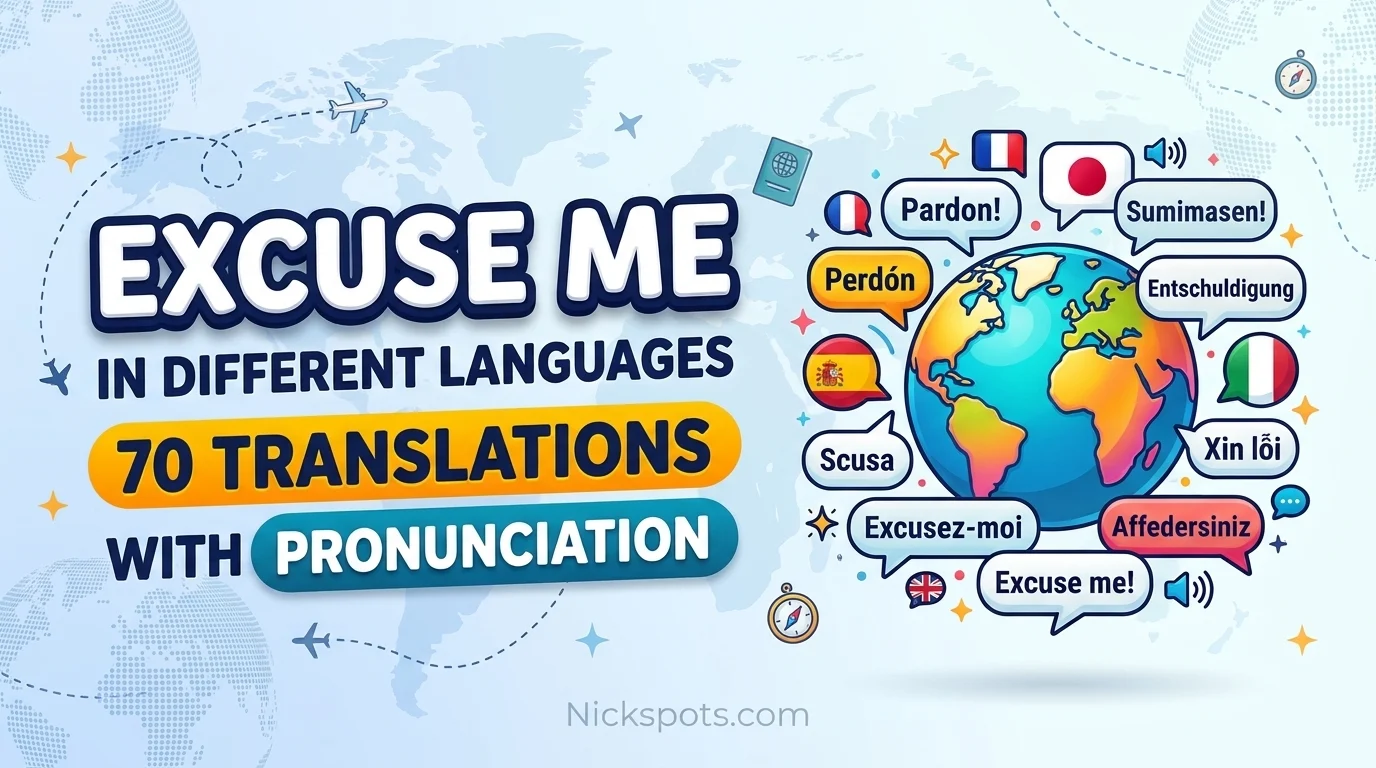
Learning how to say excuse me in different languages helps you communicate politely when traveling, meeting new people, or asking for assistance. You might need to get someone’s attention, pass through a crowded place, interrupt a conversation, or apologize for a small mistake. Although English uses the same phrase for several situations, other languages often have different expressions depending on the context. From perdón in Spanish to excusez-moi in French and sumimasen in Japanese, this guide covers 70 languages with native phrases, easy pronunciation guides, and practical example sentences to help you speak more naturally around the world.
How Do You Say Excuse Me in Different Languages?
The translation of excuse me depends on what you want to say. Some expressions are used to apologize, while others help you get attention or politely ask someone to move.
Here are eight common examples.
| Language | Native Phrase | Easy Pronunciation | Example Sentence | English Meaning |
|---|---|---|---|---|
| Spanish | Disculpe | dees-KOOL-peh | Disculpe, ¿dónde está el banco? | Excuse me, where is the bank? |
| French | Excusez-moi | ek-skew-zay MWAH | Excusez-moi, où est la gare ? | Excuse me, where is the station? |
| German | Entschuldigung | ent-SHOOL-dee-goong | Entschuldigung, wo ist der Bahnhof? | Excuse me, where is the train station? |
| Italian | Mi scusi | mee SKOO-zee | Mi scusi, dov’è la stazione? | Excuse me, where is the station? |
| Portuguese | Com licença | kong lee-SEN-sa | Com licença, posso passar? | Excuse me, may I pass? |
| Urdu | معاف کیجیے | maaf kee-JEE-ye | معاف کیجیے، کیا آپ میری مدد کر سکتے ہیں؟ | Excuse me, can you help me? |
| Hindi | माफ़ कीजिए | maaf kee-JEE-ye | माफ़ कीजिए, स्टेशन कहाँ है? | Excuse me, where is the station? |
| Japanese | すみません | soo-mee-mah-sen | すみません、駅はどこですか。 | Excuse me, where is the station? |
Excuse Me in South Asian Languages
South Asian languages have several polite expressions for asking questions, getting attention, and apologizing. Some expressions are appropriate in formal situations, while others are more common in everyday conversation.
| Language | Native Phrase | Easy Pronunciation | Example Sentence | English Meaning |
|---|---|---|---|---|
| Urdu | معاف کیجیے | maaf kee-JEE-ye | معاف کیجیے، راستہ کہاں ہے؟ | Excuse me, where is the way? |
| Hindi | माफ़ कीजिए | maaf kee-JEE-ye | माफ़ कीजिए, क्या आप मेरी मदद करेंगे? | Excuse me, will you help me? |
| Bengali | মাফ করবেন | maf kor-ben | মাফ করবেন, স্টেশন কোথায়? | Excuse me, where is the station? |
| Punjabi | ਮਾਫ਼ ਕਰਨਾ | maaf kar-naa | ਮਾਫ਼ ਕਰਨਾ, ਸਟੇਸ਼ਨ ਕਿੱਥੇ ਹੈ? | Excuse me, where is the station? |
| Gujarati | માફ કરશો | maaf kar-sho | માફ કરશો, સ્ટેશન ક્યાં છે? | Excuse me, where is the station? |
| Marathi | माफ करा | maaf ka-raa | माफ करा, स्टेशन कुठे आहे? | Excuse me, where is the station? |
| Nepali | माफ गर्नुहोस् | maaf gar-nu-hos | माफ गर्नुहोस्, स्टेशन कहाँ छ? | Excuse me, where is the station? |
| Sinhala | සමාවෙන්න | sa-maa-ven-na | සමාවෙන්න, දුම්රිය ස්ථානය කොහෙද? | Excuse me, where is the railway station? |
Excuse Me in East Asian Languages
In East Asian languages, polite expressions often depend on the situation and the relationship between speakers. A phrase used to apologize may also be useful when asking a stranger for help.
| Language | Native Phrase | Easy Pronunciation | Example Sentence | English Meaning |
|---|---|---|---|---|
| Chinese (Mandarin) | 不好意思 | boo how ee suh | 不好意思,请问地铁站在哪里? | Excuse me, where is the subway station? |
| Japanese | すみません | soo-mee-mah-sen | すみません、少し質問があります。 | Excuse me, I have a quick question. |
| Korean | 실례합니다 | shil-lye-ham-ni-da | 실례합니다, 화장실이 어디예요? | Excuse me, where is the restroom? |
| Mongolian | Уучлаарай | oo-chlaa-rai | Уучлаарай, буудал хаана вэ? | Excuse me, where is the station? |
| Tibetan | དགོངས་དག་ | gong-dak | དགོངས་དག་ ལམ་ག་ནས་ཡིན། | Excuse me, where is the road? |
Excuse Me in Southeast Asian Languages
Across Southeast Asia, expressions for excuse me are useful when asking for directions, requesting permission to pass, or politely starting a conversation.
| Language | Native Phrase | Easy Pronunciation | Example Sentence | English Meaning |
|---|---|---|---|---|
| Indonesian | Permisi | per-MEE-see | Permisi, boleh saya lewat? | Excuse me, may I pass? |
| Malay | Maafkan saya | ma-AF-kan SA-ya | Maafkan saya, boleh saya bertanya? | Excuse me, may I ask something? |
| Filipino (Tagalog) | Makikiraan po | ma-kee-kee-RA-an po | Makikiraan po, salamat. | Excuse me, may I pass? Thank you. |
| Vietnamese | Xin lỗi | sin loy | Xin lỗi, nhà ga ở đâu? | Excuse me, where is the station? |
| Thai | ขอโทษ | kho-thot | ขอโทษครับ สถานีอยู่ที่ไหน | Excuse me, where is the station? |
| Burmese | တစ်ဆိတ်လောက် | ta-seik-lout | တစ်ဆိတ်လောက်၊ ဘူတာရုံ ဘယ်မှာလဲ။ | Excuse me, where is the station? |
| Khmer | សុំទោស | som-toh | សុំទោស ស្ថានីយ៍នៅឯណា? | Excuse me, where is the station? |
| Lao | ຂໍໂທດ | kho-thot | ຂໍໂທດ ສະຖານີຢູ່ໃສ? | Excuse me, where is the station? |
Excuse Me in Middle Eastern Languages
Middle Eastern languages have expressions for apologies and polite interruptions. Choosing the right phrase helps you communicate respectfully with strangers and acquaintances.
| Language | Native Phrase | Easy Pronunciation | Example Sentence | English Meaning |
|---|---|---|---|---|
| Arabic | عذرًا | udh-ran | عذرًا، أين المحطة؟ | Excuse me, where is the station? |
| Hebrew | סליחה | slee-KHA | סליחה, איפה התחנה? | Excuse me, where is the station? |
| Persian (Farsi) | ببخشید | be-bakh-SHEED | ببخشید، ایستگاه کجاست؟ | Excuse me, where is the station? |
| Turkish | Affedersiniz | af-fe-der-see-niz | Affedersiniz, istasyon nerede? | Excuse me, where is the station? |
| Kurdish (Kurmanji) | Bibore | bee-BO-reh | Bibore, rawestgeh li ku ye? | Excuse me, where is the station? |
| Azerbaijani | Bağışlayın | baa-ghish-la-yin | Bağışlayın, stansiya haradadır? | Excuse me, where is the station? |
Excuse Me in Western European Languages
Western European languages use a variety of expressions to get attention, apologize, and ask someone to make room. Some languages also have different formal and informal forms.
| Language | Native Phrase | Easy Pronunciation | Example Sentence | English Meaning |
|---|---|---|---|---|
| English | Excuse me | ik-SKYOOZ mee | Excuse me, may I ask a question? | Excuse me, may I ask a question? |
| French | Excusez-moi | ek-skew-zay MWAH | Excusez-moi, puis-je passer ? | Excuse me, may I pass? |
| German | Entschuldigung | ent-SHOOL-dee-goong | Entschuldigung, darf ich vorbei? | Excuse me, may I get past? |
| Dutch | Pardon | par-DON | Pardon, mag ik erlangs? | Excuse me, may I get past? |
| Irish | Gabh mo leithscéal | gow muh leh-SHKALE | Gabh mo leithscéal, le do thoil. | Excuse me, please. |
| Welsh | Esgusodwch fi | es-gee-SOD-ookh vee | Esgusodwch fi, ble mae’r orsaf? | Excuse me, where is the station? |
| Basque | Barkatu | bar-KA-too | Barkatu, non dago geltokia? | Excuse me, where is the station? |
Excuse Me in Northern European Languages
Northern European languages have their own ways to express an apology or politely interrupt someone. These phrases are useful for asking questions and requesting directions.
| Language | Native Phrase | Easy Pronunciation | Example Sentence | English Meaning |
|---|---|---|---|---|
| Swedish | Ursäkta | oor-SHEK-ta | Ursäkta, var ligger stationen? | Excuse me, where is the station? |
| Norwegian | Unnskyld | OON-shill | Unnskyld, hvor er stasjonen? | Excuse me, where is the station? |
| Danish | Undskyld | OON-skul | Undskyld, hvor er stationen? | Excuse me, where is the station? |
| Finnish | Anteeksi | AN-teek-see | Anteeksi, missä asema on? | Excuse me, where is the station? |
| Icelandic | Afsakið | AF-sa-kith | Afsakið, hvar er stöðin? | Excuse me, where is the station? |
| Estonian | Vabandage | va-ban-DA-geh | Vabandage, kus jaam asub? | Excuse me, where is the station? |
| Latvian | Atvainojiet | at-vai-NO-yet | Atvainojiet, kur ir stacija? | Excuse me, where is the station? |
Excuse Me in Southern European Languages
In Southern Europe, the most natural expression depends on whether you are speaking to a stranger, apologizing, or asking someone to move.
| Language | Native Phrase | Easy Pronunciation | Example Sentence | English Meaning |
|---|---|---|---|---|
| Spanish | Perdón | per-DON | Perdón, ¿puedo pasar? | Excuse me, may I pass? |
| Portuguese | Com licença | kong lee-SEN-sa | Com licença, posso fazer uma pergunta? | Excuse me, may I ask a question? |
| Italian | Mi scusi | mee SKOO-zee | Mi scusi, posso fare una domanda? | Excuse me, may I ask a question? |
| Greek | Συγγνώμη | see-GHNO-mee | Συγγνώμη, πού είναι ο σταθμός; | Excuse me, where is the station? |
| Albanian | Më falni | muh FAL-nee | Më falni, ku është stacioni? | Excuse me, where is the station? |
| Catalan | Perdoni | per-DO-nee | Perdoni, on és l’estació? | Excuse me, where is the station? |
Excuse Me in Slavic and Eastern European Languages
Slavic and Eastern European languages have distinct expressions for polite interruptions and apologies. The forms below are common options for speaking to strangers.
| Language | Native Phrase | Easy Pronunciation | Example Sentence | English Meaning |
|---|---|---|---|---|
| Russian | Извините | iz-vee-NEE-tye | Извините, где находится станция? | Excuse me, where is the station? |
| Ukrainian | Вибачте | vy-BACH-te | Вибачте, де станція? | Excuse me, where is the station? |
| Polish | Przepraszam | psheh-PRA-sham | Przepraszam, gdzie jest stacja? | Excuse me, where is the station? |
| Czech | Promiňte | pro-MIN-tyeh | Promiňte, kde je stanice? | Excuse me, where is the station? |
| Slovak | Prepáčte | preh-PAACH-teh | Prepáčte, kde je stanica? | Excuse me, where is the station? |
| Bulgarian | Извинете | iz-vee-NEH-teh | Извинете, къде е гарата? | Excuse me, where is the station? |
| Serbian | Извините | iz-vee-NEE-teh | Извините, где је станица? | Excuse me, where is the station? |
| Croatian | Oprostite | oh-PROS-tee-teh | Oprostite, gdje je stanica? | Excuse me, where is the station? |
Excuse Me in African Languages
Across Africa, people use different phrases to apologize, ask for help, or get someone’s attention politely. These examples represent languages from several regions.
| Language | Native Phrase | Easy Pronunciation | Example Sentence | English Meaning |
|---|---|---|---|---|
| Swahili | Samahani | sa-ma-HA-nee | Samahani, kituo kiko wapi? | Excuse me, where is the station? |
| Zulu | Uxolo | oo-KHO-lo | Uxolo, ngingadlula? | Excuse me, may I pass? |
| Xhosa | Uxolo | oo-KHO-lo | Uxolo, ndingadlula? | Excuse me, may I pass? |
| Yoruba | Ẹ jọ̀ọ́ | eh-JAW | Ẹ jọ̀ọ́, ibùdó wà níbo? | Excuse me, where is the station? |
| Igbo | Biko | BEE-ko | Biko, ọdụ ụgbọ oloko dị ebee? | Excuse me, where is the train station? |
| Hausa | Yi haƙuri | yee ha-KOO-ree | Yi haƙuri, ina tashar take? | Excuse me, where is the station? |
| Somali | Iga raalli ahow | ee-ga RAA-lee a-how | Iga raalli ahow, saldhiggu xaggee buu yaal? | Excuse me, where is the station? |
| Amharic | ይቅርታ | yi-kir-ta | ይቅርታ፣ ጣቢያው የት ነው? | Excuse me, where is the station? |
Excuse Me in Central Asian and Other Languages
These additional expressions show how to politely ask a question or apologize in Central Asia and other parts of the world.
| Language | Native Phrase | Easy Pronunciation | Example Sentence | English Meaning |
|---|---|---|---|---|
| Kazakh | Кешіріңіз | keh-shee-REE-ngiz | Кешіріңіз, вокзал қайда? | Excuse me, where is the train station? |
| Kyrgyz | Кечиресиз | keh-chee-reh-SIZ | Кечиресиз, бекет кайда? | Excuse me, where is the station? |
| Uzbek | Kechirasiz | keh-chee-ra-SIZ | Kechirasiz, vokzal qayerda? | Excuse me, where is the station? |
| Tajik | Бубахшед | boo-bakh-SHED | Бубахшед, истгоҳ куҷост? | Excuse me, where is the station? |
| Armenian | Կներեք | kuh-neh-REK | Կներեք, կայարանը որտե՞ղ է։ | Excuse me, where is the station? |
| Georgian | უკაცრავად | oo-kats-ra-VAD | უკაცრავად, სადგური სად არის? | Excuse me, where is the station? |
| Malagasy | Azafady | a-za-fa-DEE | Azafady, aiza ny gara? | Excuse me, where is the station? |
| Hawaiian | E kala mai | eh KA-la mai | E kala mai, ma hea ke kahua kaʻaahi? | Excuse me, where is the train station? |
| Māori | Tēnā koa | TEH-naa KO-a | Tēnā koa, kei hea te teihana? | Excuse me, where is the station? |
How to Use Excuse Me in Everyday Conversations
The phrase excuse me can serve different purposes. Choosing the right expression makes your conversation clearer and more polite.
- Getting attention: Excuse me, could you help me?
- Passing through a crowd: Excuse me, may I get through?
- Apologizing: Excuse me, I did not see you.
- Interrupting politely: Excuse me, may I add something?
- Asking someone to repeat something: Excuse me, could you say that again?
When speaking another language, learn the complete phrase that fits your situation instead of translating each word separately.
Excuse Me vs. Sorry vs. Pardon
These expressions have related meanings, but they are not always interchangeable.
- Excuse me: Often used to get attention, interrupt politely, or ask someone to move.
- Sorry: Usually expresses regret or apologizes for a mistake.
- Pardon: Can be used to apologize or ask someone to repeat something.
For example, you might say Excuse me, where is the station? when asking for directions, but Sorry, I stepped on your foot after an accidental mistake.
Other languages also distinguish these meanings, although the exact usage varies.
Common Mistakes When Translating Excuse Me
Avoid these common mistakes when learning polite expressions in another language.
- Using one phrase in every situation: A phrase for apologizing may not be the most natural choice for asking someone to move.
- Ignoring formality: Some languages have different forms for strangers, elders, and close friends.
- Translating word for word: A literal translation may sound unnatural to native speakers.
- Overlooking pronunciation: Small pronunciation differences can affect understanding.
- Assuming regional expressions are identical: Language use can vary between countries and communities.
Practicing complete sentences helps you understand both the meaning and the appropriate context.
Frequently Asked Questions
How do you say excuse me in 10 different languages?
Examples include disculpe in Spanish, excusez-moi in French, Entschuldigung in German, mi scusi in Italian, com licença in Portuguese, sumimasen in Japanese, bù hǎo yì si in Mandarin Chinese, permisi in Indonesian, samahani in Swahili, and maaf kijiye in Urdu.
What is the most polite way to say excuse me?
The most polite phrase depends on the language and situation. For example, excusez-moi is a polite French expression, disculpe is commonly used in formal Spanish, and sumimasen is useful in many polite Japanese interactions.
How do you say excuse me in Japanese?
The common expression is すみません (sumimasen). It can be used to get someone’s attention, apologize for a minor inconvenience, or politely ask for assistance.
What is the difference between excuse me and sorry?
Excuse me often gets someone’s attention or politely interrupts a conversation. Sorry more directly expresses regret for a mistake or inconvenience, although the two expressions can overlap.
How do you say excuse me when asking someone to move?
Choose a phrase that politely asks permission to pass. Examples include permisi in Indonesian, com licença in Portuguese, and makikiraan po in Filipino. The most natural expression depends on the situation and local usage.
Conclusion
Learning how to say excuse me in different languages helps you communicate respectfully when traveling, meeting people, or asking for assistance. Remember that the best phrase depends on whether you are apologizing, getting someone’s attention, or asking to pass. Practice a few translations at a time so you can use them naturally in everyday conversations.
Meta Description: Learn excuse me in different languages with 70 translations, native phrases, easy pronunciation guides, and example sentences for everyday conversations.

I am Ricardo Hunter, Administrator at LingoBuz, passionate about languages, translations, and global communication. I help create useful, clear content that makes exploring different languages simple, enjoyable, and accessible.