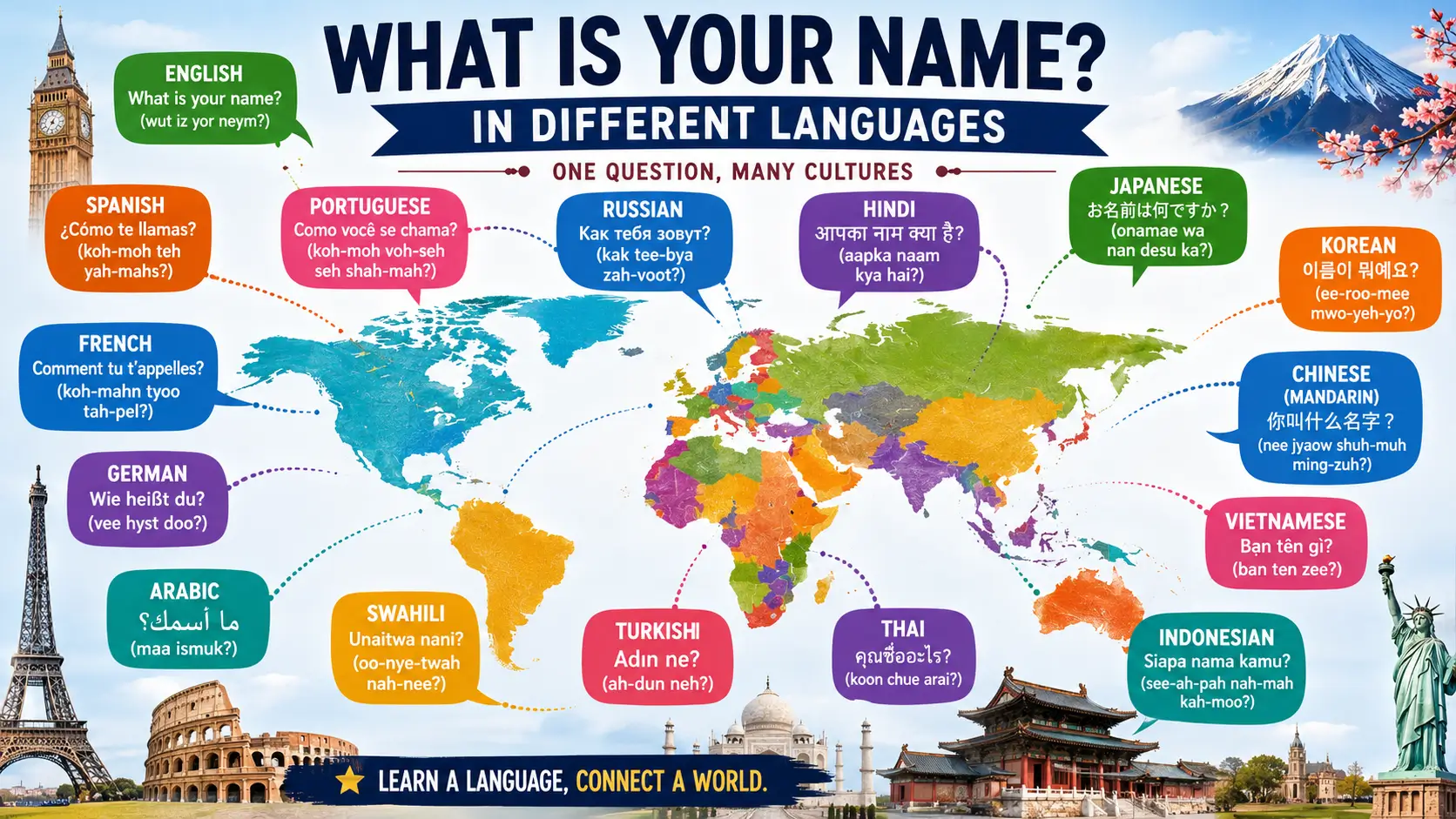
Learning how to ask “What is your name?” in different languages is a simple and useful way to start conversations with people from different cultures. Whether you are traveling, learning a new language, meeting international friends, or simply exploring world languages, this everyday question is a great phrase to know.
In this guide, you will discover what is your name in different languages, including the native phrase, an easy English pronunciation, and a practical example sentence with its English meaning.
From Spanish and French to Japanese, Arabic, Hindi, Korean, and many more, these what is your name translations show how people introduce themselves and begin conversations around the world.
What Is “What Is Your Name?” in Different Languages?
The phrase “What is your name?” is usually used when meeting someone for the first time. Some languages have formal and informal versions, while others change the wording depending on age, social status, or familiarity.
Here are 70 ways to ask the question naturally.
| # | Language | Native Phrase | Easy English Pronunciation | Example Sentence | English Meaning |
|---|---|---|---|---|---|
| 1 | English | What is your name? | wuht iz yor naym | What is your name? | What is your name? |
| 2 | Spanish | ¿Cómo te llamas? | KOH-moh teh YAH-mahs | Hola, ¿cómo te llamas? | Hello, what is your name? |
| 3 | French | Comment tu t’appelles ? | koh-MAHN tyoo tah-PELL | Bonjour, comment tu t’appelles ? | Hello, what is your name? |
| 4 | German | Wie heißt du? | vee HYST doo | Hallo, wie heißt du? | Hello, what is your name? |
| 5 | Italian | Come ti chiami? | KOH-meh tee KYAH-mee | Ciao, come ti chiami? | Hi, what is your name? |
| 6 | Portuguese | Como você se chama? | KOH-moh voh-SEH seh SHAH-mah | Olá, como você se chama? | Hello, what is your name? |
| 7 | Dutch | Hoe heet je? | hoo hayt yuh | Hallo, hoe heet je? | Hello, what is your name? |
| 8 | Swedish | Vad heter du? | vahd HAY-ter doo | Hej, vad heter du? | Hi, what is your name? |
| 9 | Norwegian | Hva heter du? | vah HAY-ter doo | Hei, hva heter du? | Hi, what is your name? |
| 10 | Danish | Hvad hedder du? | veh HEL-er doo | Hej, hvad hedder du? | Hi, what is your name? |
| 11 | Finnish | Mikä sinun nimesi on? | MEE-kah SEE-noon NEE-meh-see on | Hei, mikä sinun nimesi on? | Hi, what is your name? |
| 12 | Icelandic | Hvað heitir þú? | kvah HAY-tir thoo | Halló, hvað heitir þú? | Hello, what is your name? |
| 13 | Irish | Cad is ainm duit? | kad iss AN-im ditch | Dia dhuit, cad is ainm duit? | Hello, what is your name? |
| 14 | Welsh | Beth yw dy enw di? | beth oo duh EN-oo dee | Helo, beth yw dy enw di? | Hello, what is your name? |
| 15 | Polish | Jak masz na imię? | yahk mash nah EE-myeh | Cześć, jak masz na imię? | Hi, what is your name? |
| 16 | Czech | Jak se jmenuješ? | yak seh MYEH-noo-yesh | Ahoj, jak se jmenuješ? | Hi, what is your name? |
| 17 | Slovak | Ako sa voláš? | AH-koh sah VOH-lahsh | Ahoj, ako sa voláš? | Hi, what is your name? |
| 18 | Slovenian | Kako ti je ime? | KAH-koh tee yeh EE-meh | Živjo, kako ti je ime? | Hi, what is your name? |
| 19 | Croatian | Kako se zoveš? | KAH-koh seh ZOH-vesh | Bok, kako se zoveš? | Hi, what is your name? |
| 20 | Serbian | Kako se zoveš? | KAH-koh seh ZOH-vesh | Zdravo, kako se zoveš? | Hello, what is your name? |
| 21 | Bosnian | Kako se zoveš? | KAH-koh seh ZOH-vesh | Zdravo, kako se zoveš? | Hello, what is your name? |
| 22 | Bulgarian | Как се казваш? | kak seh KAHZ-vash | Здравей, как се казваш? | Hello, what is your name? |
| 23 | Macedonian | Како се викаш? | KAH-koh seh VEE-kash | Здраво, како се викаш? | Hello, what is your name? |
| 24 | Russian | Как тебя зовут? | kak tee-BYAH zah-VOOT | Привет, как тебя зовут? | Hi, what is your name? |
| 25 | Ukrainian | Як тебе звати? | yak teh-BEH ZVAH-ty | Привіт, як тебе звати? | Hi, what is your name? |
| 26 | Belarusian | Як цябе завуць? | yak TSYA-beh zah-VOOTS | Прывітанне, як цябе завуць? | Hello, what is your name? |
| 27 | Lithuanian | Koks tavo vardas? | koks TAH-voh VAR-dahs | Labas, koks tavo vardas? | Hello, what is your name? |
| 28 | Latvian | Kā tevi sauc? | kah TEH-vee sowts | Sveiki, kā tevi sauc? | Hello, what is your name? |
| 29 | Estonian | Mis su nimi on? | miss soo NEE-mee on | Tere, mis su nimi on? | Hello, what is your name? |
| 30 | Hungarian | Hogy hívnak? | HOH-dy HEE-vahnk | Szia, hogy hívnak? | Hi, what is your name? |
| 31 | Romanian | Cum te cheamă? | koom teh KYAH-mah | Salut, cum te cheamă? | Hi, what is your name? |
| 32 | Greek | Πώς σε λένε; | pos seh LEH-neh | Γεια, πώς σε λένε; | Hi, what is your name? |
| 33 | Albanian | Si quhesh? | see KOO-hesh | Përshëndetje, si quhesh? | Hello, what is your name? |
| 34 | Armenian | Անունդ ի՞նչ է։ | ah-NOONT inch eh | Բարև, անունդ ի՞նչ է։ | Hello, what is your name? |
| 35 | Georgian | რა გქვია? | rah GKvee-ah | გამარჯობა, რა გქვია? | Hello, what is your name? |
| 36 | Turkish | Adın ne? | ah-DUN neh | Merhaba, adın ne? | Hello, what is your name? |
| 37 | Azerbaijani | Sənin adın nədir? | seh-NEEN ah-DUN nah-DEER | Salam, sənin adın nədir? | Hello, what is your name? |
| 38 | Persian | اسمت چیه؟ | ES-met CHEE-yeh | سلام، اسمت چیه؟ | Hello, what is your name? |
| 39 | Arabic | ما اسمك؟ | maa IS-mak | مرحبًا، ما اسمك؟ | Hello, what is your name? |
| 40 | Hebrew | מה שמך? | mah shim-KHA | שלום, מה שמך? | Hello, what is your name? |
| 41 | Hindi | आपका नाम क्या है? | AAP-ka naam kya hai | नमस्ते, आपका नाम क्या है? | Hello, what is your name? |
| 42 | Urdu | آپ کا نام کیا ہے؟ | AAP ka naam kya hai | السلام علیکم، آپ کا نام کیا ہے؟ | Hello, what is your name? |
| 43 | Bengali | আপনার নাম কী? | AAP-nar naam kee | আপনার নাম কী? | What is your name? |
| 44 | Punjabi | ਤੁਹਾਡਾ ਨਾਮ ਕੀ ਹੈ? | tuh-HAH-daa naam kee hai | ਸਤ ਸ੍ਰੀ ਅਕਾਲ, ਤੁਹਾਡਾ ਨਾਮ ਕੀ ਹੈ? | Hello, what is your name? |
| 45 | Gujarati | તમારું નામ શું છે? | tuh-MAH-roo naam shoo chhay | તમારું નામ શું છે? | What is your name? |
| 46 | Marathi | तुमचे नाव काय आहे? | TOOM-cheh naav kaay aa-HAY | नमस्कार, तुमचे नाव काय आहे? | Hello, what is your name? |
| 47 | Nepali | तपाईंको नाम के हो? | tap-AI-ko naam keh ho | नमस्ते, तपाईंको नाम के हो? | Hello, what is your name? |
| 48 | Sinhala | ඔයාගේ නම මොකක්ද? | oh-YAA-geh nah-mah moh-kak-dah | ආයුබෝවන්, ඔයාගේ නම මොකක්ද? | Hello, what is your name? |
| 49 | Tamil | உங்கள் பெயர் என்ன? | OON-gal pay-yar EN-na | வணக்கம், உங்கள் பெயர் என்ன? | Hello, what is your name? |
| 50 | Telugu | మీ పేరు ఏమిటి? | mee PAY-roo AY-mee-tee | నమస్కారం, మీ పేరు ఏమిటి? | Hello, what is your name? |
| 51 | Kannada | ನಿಮ್ಮ ಹೆಸರೇನು? | NIM-ma heh-suh-RAY-noo | ನಮಸ್ಕಾರ, ನಿಮ್ಮ ಹೆಸರೇನು? | Hello, what is your name? |
| 52 | Malayalam | നിങ്ങളുടെ പേര് എന്താണ്? | NING-gal-deh payr EN-thaa-nu | നമസ്കാരം, നിങ്ങളുടെ പേര് എന്താണ്? | Hello, what is your name? |
| 53 | Chinese (Mandarin) | 你叫什么名字? | nee jyaow shuh-muh MING-zuh | 你好,你叫什么名字? | Hello, what is your name? |
| 54 | Japanese | お名前は何ですか? | oh-NAH-mah-eh wah nan dess kah | こんにちは、お名前は何ですか? | Hello, what is your name? |
| 55 | Korean | 이름이 뭐예요? | ee-ROO-mee mwo-YEH-yo | 안녕하세요, 이름이 뭐예요? | Hello, what is your name? |
| 56 | Vietnamese | Bạn tên gì? | ban ten zee | Xin chào, bạn tên gì? | Hello, what is your name? |
| 57 | Thai | คุณชื่ออะไร? | koon chue A-rai | สวัสดี คุณชื่ออะไร? | Hello, what is your name? |
| 58 | Indonesian | Siapa nama kamu? | see-AH-pah NAH-mah KAH-moo | Halo, siapa nama kamu? | Hello, what is your name? |
| 59 | Malay | Siapa nama awak? | see-AH-pah NAH-mah AH-wak | Hai, siapa nama awak? | Hi, what is your name? |
| 60 | Filipino | Ano ang pangalan mo? | AH-noh ang pang-AH-lan mo | Kumusta, ano ang pangalan mo? | Hello, what is your name? |
| 61 | Burmese | နာမည်ဘယ်လိုခေါ်လဲ? | NAH-meh beh-loh khaw-leh | မင်္ဂလာပါ၊ နာမည်ဘယ်လိုခေါ်လဲ? | Hello, what is your name? |
| 62 | Khmer | អ្នកឈ្មោះអ្វី? | neak chmoh a-VAI | សួស្តី អ្នកឈ្មោះអ្វី? | Hello, what is your name? |
| 63 | Mongolian | Таны нэр хэн бэ? | TAH-nee nair hen beh | Сайн байна уу, таны нэр хэн бэ? | Hello, what is your name? |
| 64 | Swahili | Unaitwa nani? | oo-NYE-twah NAH-nee | Habari, unaitwa nani? | Hello, what is your name? |
| 65 | Zulu | Ubani igama lakho? | oo-BAH-nee ee-GAH-mah LAH-kho | Sawubona, ubani igama lakho? | Hello, what is your name? |
| 66 | Afrikaans | Wat is jou naam? | vut iss yoh nahm | Hallo, wat is jou naam? | Hello, what is your name? |
| 67 | Somali | Magacaa? | ma-GAH-kaa | Salaan, magacaa? | Hello, what is your name? |
| 68 | Amharic | ስምህ ማን ነው? | sim-eh man new | ሰላም፣ ስምህ ማን ነው? | Hello, what is your name? |
| 69 | Malagasy | Iza no anaranao? | EE-zah no ah-nah-RAH-now | Salama, iza no anaranao? | Hello, what is your name? |
| 70 | Haitian Creole | Kijan ou rele? | kee-ZHAN oo reh-LEH | Bonjou, kijan ou rele? | Hello, what is your name? |
How to Say “What Is Your Name?” in Different Languages
The easiest way to learn how to say “what is your name” in different languages is to focus on the structure of the phrase rather than memorizing every word separately.
For example, Spanish uses “¿Cómo te llamas?” while German uses “Wie heißt du?” Both have the same purpose, but their literal structures are different.
This is common across languages. A direct word-for-word translation may sound unnatural, so it is better to learn the phrase as a complete expression.
What Is Your Name in All Languages: Formal vs. Informal
One important point about what is your name in all languages is that many languages distinguish between formal and informal speech.
For example, Spanish has “¿Cómo te llamas?” for informal situations and “¿Cómo se llama?” when speaking formally. German similarly uses “Wie heißt du?” informally and “Wie heißen Sie?” formally.
When speaking to a stranger, teacher, older person, customer, or professional contact, using the appropriate formal form can be more respectful.
What Is Your Name Translations Around the World
The phrase appears in many different grammatical forms around the world.
Some languages translate the idea as “What do you call yourself?” Others use a structure closer to “What is your name?” These differences are a useful reminder that languages do not always organize ideas in the same way.
Learning these what is your name translations can therefore teach you more than vocabulary. They can also help you understand how different languages express identity, introductions, and everyday conversation.
How to Answer “What Is Your Name?” in Different Languages
After someone asks your name, you will usually need a simple response.
In English, you can say:
“My name is Sarah.”
Or simply:
“I’m Sarah.”
The same idea can be expressed differently depending on the language. For example:
- Spanish: Me llamo Sarah.
- French: Je m’appelle Sarah.
- German: Ich heiße Sarah.
- Italian: Mi chiamo Sarah.
- Portuguese: Eu me chamo Sarah.
- Japanese: 私はサラです。 (Watashi wa Sara desu.)
- Korean: 저는 사라예요. (Jeoneun Sara-yeyo.)
- Hindi: मेरा नाम सारा है। (Mera naam Sara hai.)
- Urdu: میرا نام سارہ ہے۔ (Mera naam Sara hai.)
Knowing both the question and the answer makes your first conversation much easier.
Why Learn “What Is Your Name?” in Different Languages?
Learning this phrase has several practical benefits.
Travel
When traveling internationally, knowing how to ask someone’s name can help you begin friendly conversations with locals, guides, hotel staff, and other travelers.
Language Learning
“What is your name?” is one of the first phrases commonly learned by beginners because it introduces useful vocabulary related to names, people, greetings, and introductions.
Meeting New People
A simple greeting followed by a person’s name can make conversations feel more natural and welcoming.
Cultural Understanding
Different languages use different levels of formality. Learning the appropriate phrase can help you communicate respectfully in unfamiliar cultures.
Tips for Pronouncing “What Is Your Name?” Correctly
Pronunciation is just as important as knowing the written phrase.
Start by listening carefully to native speakers whenever possible. Pay attention to the rhythm and stress of the entire sentence instead of pronouncing every word separately.
The pronunciation column above is designed as an easy guide for English speakers, but it is only an approximation. Some sounds do not have exact equivalents in English.
For the best results, practice each phrase slowly and then repeat it at a natural conversational speed.
Common Mistakes When Asking Someone’s Name
A common mistake is translating the English phrase word for word. Languages often use completely different sentence structures.
Another mistake is ignoring formality. A phrase that is perfectly natural with a friend may not be appropriate when speaking to an older person or someone in a professional setting.
It is also important to pronounce the person’s name carefully after they introduce themselves. Repeating the name once can help you remember it and shows that you are paying attention.
Frequently Asked Questions
1. What is “what is your name?” in Spanish?
In Spanish, “What is your name?” is commonly ¿Cómo te llamas? The approximate pronunciation is “KOH-moh teh YAH-mahs.”
2. What is “what is your name?” in French?
In French, the informal phrase is Comment tu t’appelles ? It is approximately pronounced “koh-MAHN tyoo tah-PELL.” A formal version is Comment vous appelez-vous ?
3. How do you say “what is your name?” in Hindi?
In Hindi, you can say आपका नाम क्या है? (Aapka naam kya hai?) This is a polite and commonly used way to ask someone’s name.
4. What is “what is your name?” in Japanese?
A polite Japanese version is お名前は何ですか? (Onamae wa nan desu ka?) It is appropriate for many everyday introductions and polite conversations.
5. What is the easiest way to learn “what is your name?” in different languages?
Start with a few languages that interest you and practice both the question and a possible answer. Learning the phrase with a real conversation example makes it easier to remember than studying isolated vocabulary.
Conclusion
Knowing what is your name in different languages is a useful first step toward communicating across cultures. The 70 translations in this guide show that a simple introduction can be expressed in many fascinating ways.
Whether you are preparing for travel, studying languages, meeting international friends, or exploring what is your name around the world, learning this everyday phrase can help you start conversations with confidence.
Practice the pronunciation, pay attention to formal and informal situations, and remember that even a few words in someone’s native language can make a friendly first impression.

I’m Jesse Crawford, a language enthusiast and writer passionate about exploring different languages. I create helpful content that makes words, meanings, translations, and language learning simple, useful, and enjoyable for everyone.