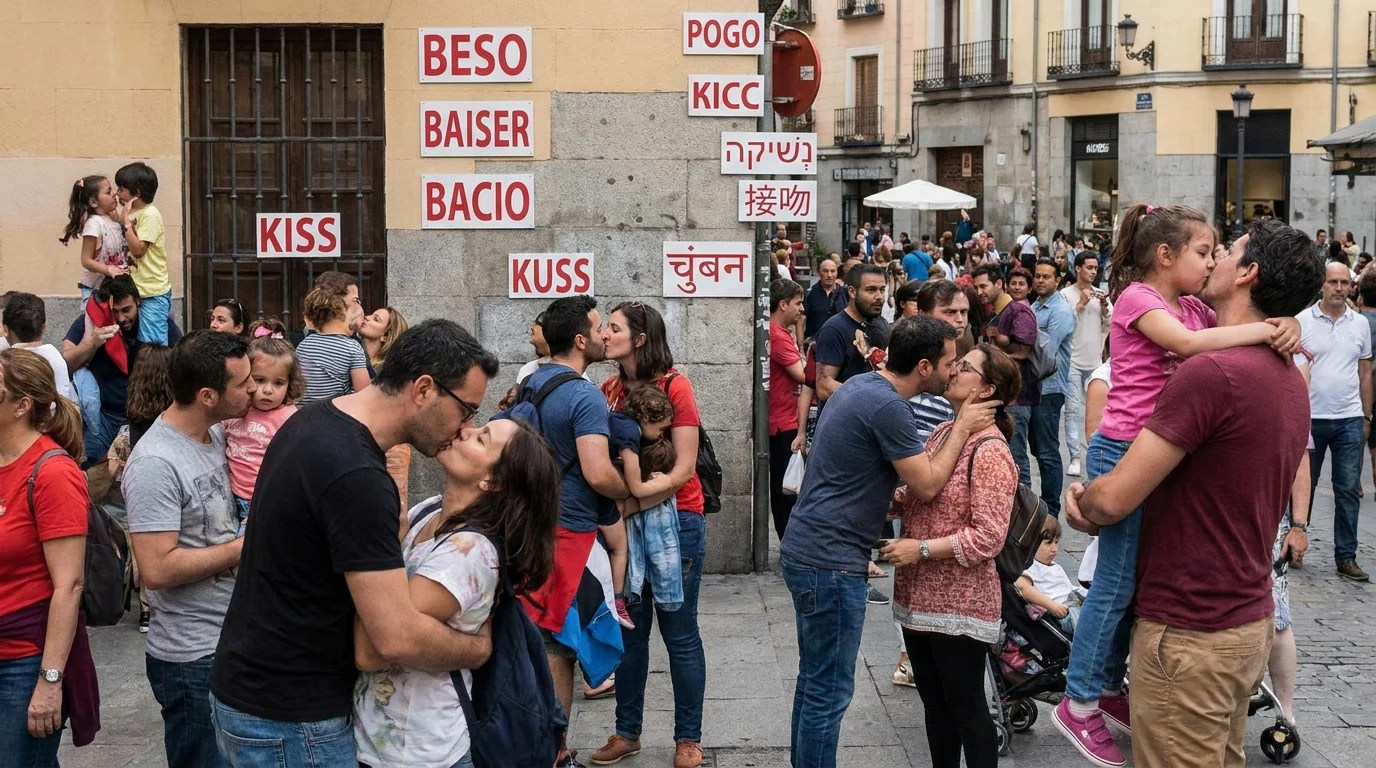
A kiss can express love, affection, friendship, or a warm greeting, depending on the language and situation. Learning how to say kiss in different languages is a fun way to discover how people around the world express these feelings. Some languages use one word for the act of kissing, while others use different words for a kiss, a kiss on the cheek, or the action of kissing someone.
In this guide, you will find 70 languages, their native words for kiss, easy English pronunciations, and practical example sentences with English meanings. You will also learn how to use these words naturally, understand common pronunciation differences, and choose the right expression for different situations.
How Do You Say Kiss in Different Languages?
The word kiss has different translations around the world. For example, it is beso in Spanish, baiser as a noun in French, Bacio in Italian, and キス (kisu) in Japanese. The exact word and pronunciation depend on the language, and some languages distinguish between a kiss and the act of kissing.
Here are eight quick examples to help you get started.
| Language | Native Word | Easy Pronunciation | Example Sentence | English Meaning |
|---|---|---|---|---|
| Spanish | Beso | BEH-soh | Quiero un beso. | I want a kiss. |
| French | Baiser | beh-ZAY | Elle m’a donné un baiser. | She gave me a kiss. |
| Italian | Bacio | BAH-choh | Ti mando un bacio. | I am sending you a kiss. |
| German | Kuss | KOOS | Ich gebe dir einen Kuss. | I give you a kiss. |
| Portuguese | Beijo | BAY-zhoo | Quero um beijo. | I want a kiss. |
| Japanese | キス | KEE-soo | キスをしたい。 | I want to kiss you. |
| Korean | 키스 | kee-seu | 키스하고 싶어요. | I want to kiss you. |
| Arabic | قُبْلَة | QUB-lah | أريد قبلة. | I want a kiss. |
Kiss in South Asian Languages
South Asian languages have several words for a kiss, with differences in pronunciation and everyday usage.
| Language | Native Phrase | Easy Pronunciation | Example Sentence | English Meaning |
|---|---|---|---|---|
| Hindi | चुंबन | CHOOM-ban | उसने मुझे एक चुंबन दिया। | She gave me a kiss. |
| Urdu | بوسہ | BOH-sah | اس نے مجھے بوسہ دیا۔ | She gave me a kiss. |
| Bengali | চুমু | CHOO-moo | সে আমাকে একটা চুমু দিল। | She gave me a kiss. |
| Punjabi | ਚੁੰਮਣ | CHOOM-man | ਉਸ ਨੇ ਮੈਨੂੰ ਚੁੰਮਣ ਦਿੱਤਾ। | She gave me a kiss. |
| Gujarati | ચુંબન | CHOOM-ban | તેણે મને એક ચુંબન આપ્યું. | She gave me a kiss. |
| Marathi | चुंबन | CHOOM-ban | तिने मला एक चुंबन दिले. | She gave me a kiss. |
| Nepali | चुम्बन | CHOOM-ban | उनले मलाई चुम्बन दिइन्। | She gave me a kiss. |
Kiss in East Asian Languages
In East Asia, words for a kiss may be borrowed from other languages or expressed through traditional vocabulary.
| Language | Native Phrase | Easy Pronunciation | Example Sentence | English Meaning |
|---|---|---|---|---|
| Mandarin Chinese | 亲吻 | CHEEN-wen | 她给了我一个吻。 | She gave me a kiss. |
| Japanese | キス | KEE-soo | 彼女は私にキスをした。 | She kissed me. |
| Korean | 키스 | kee-seu | 그녀가 나에게 키스했어요. | She kissed me. |
| Mongolian | Үнсэлт | oon-SELT | Тэр надад үнсэлт өгсөн. | She gave me a kiss. |
| Tibetan | འོ་བརྒྱལ། | OH-gyal | ཁོ་མོས་ང་ལ་འོ་བརྒྱལ་བྱས། | She kissed me. |
| Cantonese | 錫 | sek | 佢錫咗我。 | She kissed me. |
| Taiwanese Hokkien | 啾 | TSIOO | 伊啾我一下。 | She gave me a kiss. |
Kiss in Southeast Asian Languages
These languages offer useful expressions for talking about affection, romance, and kisses in everyday conversation.
| Language | Native Phrase | Easy Pronunciation | Example Sentence | English Meaning |
|---|---|---|---|---|
| Indonesian | Ciuman | CHEE-oo-man | Dia memberiku ciuman. | She gave me a kiss. |
| Malay | Ciuman | CHEE-oo-man | Dia memberi saya ciuman. | She gave me a kiss. |
| Filipino | Halik | HAH-lik | Binigyan niya ako ng halik. | She gave me a kiss. |
| Vietnamese | Nụ hôn | noo hon | Cô ấy trao cho tôi một nụ hôn. | She gave me a kiss. |
| Thai | จูบ | JOOB | เธอจูบฉัน | She kissed me. |
| Burmese | အနမ်း | ah-NAN | သူမက ကျွန်တော့်ကို အနမ်းပေးခဲ့တယ်။ | She gave me a kiss. |
| Khmer | ការថើប | kaa thaeub | នាងបានថើបខ្ញុំ។ | She kissed me. |
Kiss in Middle Eastern Languages
Arabic, Persian, Hebrew, and other regional languages have their own words for a kiss. Some expressions are more literary, while others are more common in conversation.
| Language | Native Phrase | Easy Pronunciation | Example Sentence | English Meaning |
|---|---|---|---|---|
| Arabic | قُبْلَة | QUB-lah | أعطتني قبلة. | She gave me a kiss. |
| Persian | بوسه | BOO-seh | او به من یک بوسه داد. | She gave me a kiss. |
| Hebrew | נשיקה | neh-shee-KAH | היא נתנה לי נשיקה. | She gave me a kiss. |
| Turkish | Öpücük | uh-puh-JOOK | Bana bir öpücük verdi. | She gave me a kiss. |
| Kurdish (Kurmanji) | Maç | MAHCH | Ew maçek da min. | She gave me a kiss. |
| Pashto | مچ | MUCH | هغې ماته مچ راکړ. | She gave me a kiss. |
| Azerbaijani | Öpüş | uh-PÜSH | O, mənə bir öpüş verdi. | She gave me a kiss. |
Kiss in Western European Languages
Many Western European languages have distinct words for a kiss, a little affectionate kiss, or the action of kissing someone.
| Language | Native Phrase | Easy Pronunciation | Example Sentence | English Meaning |
|---|---|---|---|---|
| English | Kiss | KISS | She gave me a kiss. | She gave me a kiss. |
| French | Bisou | bee-ZOO | Elle m’a fait un bisou. | She gave me a kiss. |
| German | Kuss | KOOS | Sie gab mir einen Kuss. | She gave me a kiss. |
| Dutch | Kus | KUSS | Ze gaf me een kus. | She gave me a kiss. |
| Luxembourgish | Kuss | KOOS | Si huet mir e Kuss ginn. | She gave me a kiss. |
| Frisian | Tút | TOOT | Sy joech my in tút. | She gave me a kiss. |
| Yiddish | אַ קוש | ah KOOSH | זי האָט מיר געגעבן אַ קוש. | She gave me a kiss. |
Kiss in Northern European Languages
In Northern Europe, words for a kiss can vary between formal writing, casual speech, and affectionate expressions.
| Language | Native Phrase | Easy Pronunciation | Example Sentence | English Meaning |
|---|---|---|---|---|
| Swedish | Kyss | SHUSS | Hon gav mig en kyss. | She gave me a kiss. |
| Norwegian | Kyss | SHUSS | Hun ga meg et kyss. | She gave me a kiss. |
| Danish | Kys | KOOS | Hun gav mig et kys. | She gave me a kiss. |
| Icelandic | Koss | KOSS | Hún gaf mér koss. | She gave me a kiss. |
| Finnish | Suudelma | SOO-dehl-mah | Hän antoi minulle suudelman. | She gave me a kiss. |
| Estonian | Suudlus | SOOD-loos | Ta andis mulle suudluse. | She gave me a kiss. |
| Faroese | Kossur | KOSS-ur | Hon gav mær ein koss. | She gave me a kiss. |
Kiss in Southern European Languages
Southern European languages have several familiar expressions for romantic and affectionate kisses.
| Language | Native Phrase | Easy Pronunciation | Example Sentence | English Meaning |
|---|---|---|---|---|
| Italian | Bacio | BAH-choh | Lei mi ha dato un bacio. | She gave me a kiss. |
| Spanish | Beso | BEH-soh | Ella me dio un beso. | She gave me a kiss. |
| Portuguese | Beijo | BAY-zhoo | Ela me deu um beijo. | She gave me a kiss. |
| Catalan | Petó | puh-TOH | Ella em va fer un petó. | She gave me a kiss. |
| Galician | Bico | BEE-koh | Ela deume un bico. | She gave me a kiss. |
| Greek | Φιλί | fee-LEE | Μου έδωσε ένα φιλί. | She gave me a kiss. |
| Maltese | Bewsa | BEW-sah | Tatni bewsa. | She gave me a kiss. |
Kiss in Slavic and Eastern European Languages
These languages often use words derived from local roots for kissing, with some similarities in sound across neighboring languages.
| Language | Native Phrase | Easy Pronunciation | Example Sentence | English Meaning |
|---|---|---|---|---|
| Russian | Поцелуй | pah-tsee-LOOY | Она подарила мне поцелуй. | She gave me a kiss. |
| Ukrainian | Поцілунок | poh-tsee-LOO-nok | Вона подарувала мені поцілунок. | She gave me a kiss. |
| Polish | Pocałunek | poh-tsah-WOO-nek | Dała mi pocałunek. | She gave me a kiss. |
| Czech | Polibek | POH-lee-bek | Dala mi polibek. | She gave me a kiss. |
| Slovak | Bozk | BOSK | Dala mi bozk. | She gave me a kiss. |
| Bulgarian | Целувка | tseh-LOOV-kah | Тя ми даде целувка. | She gave me a kiss. |
| Serbian | Пољубац | POH-lyoo-bats | Дала ми је пољубац. | She gave me a kiss. |
Kiss in African Languages
Africa is home to thousands of languages. The following examples represent a small selection of languages spoken across different parts of the continent.
| Language | Native Phrase | Easy Pronunciation | Example Sentence | English Meaning |
|---|---|---|---|---|
| Swahili | Busu | BOO-soo | Alinipa busu. | She gave me a kiss. |
| Zulu | Ukuqabula | oo-koo-qa-BOO-lah | Wanganga ngokungiqabula. | She kissed me. |
| Xhosa | Ukwanga | oo-kwah-NGAH | Wandanga. | She kissed me. |
| Yoruba | Ifẹnukonu | ee-feh-noo-KOH-noo | Ó fún mi ní ìfẹnukonu. | She gave me a kiss. |
| Igbo | Isusu ọnụ | ee-SOO-soo OH-noo | O nyere m isusu ọnụ. | She gave me a kiss. |
| Hausa | Sumbata | soom-BAH-tah | Ta ba ni sumba. | She gave me a kiss. |
| Somali | Dhunkasho | dhun-KAH-shoh | Waxay i siisay dhunkasho. | She gave me a kiss. |
Kiss in Central Asian and Other World Languages
These additional languages broaden the collection with words from Central Asia, the Caucasus, and other parts of the world.
| Language | Native Phrase | Easy Pronunciation | Example Sentence | English Meaning |
|---|---|---|---|---|
| Kazakh | Сүйіс | soo-YEES | Ол маған сүйіс берді. | She gave me a kiss. |
| Kyrgyz | Өбүү | uh-BÜÜ | Ал мага өбүү берди. | She gave me a kiss. |
| Uzbek | O’pich | uh-PICH | U menga o’pich berdi. | She gave me a kiss. |
| Tajik | Бӯса | BOO-sah | Ӯ ба ман бӯса дод. | She gave me a kiss. |
| Armenian | Համբույր | ham-BOOYR | Նա ինձ համբույր տվեց։ | She gave me a kiss. |
| Georgian | კოცნა | KOTS-nah | მან მაკოცა. | She kissed me. |
| Esperanto | Kiso | KEE-soh | Ŝi donis al mi kison. | She gave me a kiss. |
How to Use the Word Kiss in Everyday Conversations
The word kiss can be used as a noun or a verb in English. Many other languages also distinguish between the kiss itself and the action of kissing.
Here are some common expressions:
- Give me a kiss: An affectionate request for a kiss.
- Send a kiss: A way to express affection through a message or gesture.
- Blow a kiss: To make a kissing gesture with your lips, often toward someone far away.
- Kiss on the cheek: A greeting or affectionate gesture in some cultures.
- First kiss: The first romantic kiss someone experiences.
When translating these expressions, use the natural phrase in the target language rather than translating every English word separately.
Romantic and Affectionate Words for Kiss
Some languages have informal or affectionate alternatives to their standard word for a kiss. These expressions are especially common between partners, family members, and close friends.
| Expression | Language | Meaning |
|---|---|---|
| Besito | Spanish | Little kiss |
| Bisou | French | Kiss or affectionate peck |
| Bacio | Italian | Kiss |
| Beijinho | Portuguese | Little kiss |
| Küsschen | German | Little kiss |
| Bise | French | A cheek kiss or customary greeting |
| Un beso | Spanish | A kiss |
The meaning depends on the relationship and situation. For example, a kiss on the cheek may be a friendly greeting rather than a romantic gesture.
Formal and Informal Ways to Say Kiss
The appropriate word for a kiss depends on the language, the relationship between speakers, and the situation.
- Formal or literary expressions: Some languages have words that are more common in writing, poetry, or formal descriptions.
- Everyday expressions: Shorter, familiar words are often used in conversations between friends and family.
- Romantic expressions: Couples may use affectionate diminutives or playful expressions.
- Greeting expressions: In some places, cheek kisses are customary greetings, while other communities prefer handshakes or verbal greetings.
French provides a useful example. Un baiser means a kiss, while un bisou is a common, affectionate alternative. In modern French, the verb baiser can have a vulgar sexual meaning, so learners should be careful about its use as a verb.
Common Translation and Pronunciation Mistakes
When learning how to say kiss in different languages, avoid these common mistakes:
- Confusing the noun with the verb: A word for a kiss is not always the correct word for kissing someone.
- Ignoring accents: Diacritics can change spelling and sometimes pronunciation.
- Using literal translations: A phrase that sounds natural in English may sound awkward when translated word for word.
- Assuming every kiss is romantic: Kisses can express friendship, family affection, respect, or greeting.
- Relying entirely on English pronunciation: Pronunciation guides are approximate. Listening to native speakers is helpful for learning unfamiliar sounds.
For example, Spanish beso is a noun meaning kiss, while besar is the verb meaning to kiss. Knowing this distinction makes it easier to form complete sentences.
How to Learn and Remember Kiss in Different Languages
You do not need to memorize all 70 words at once. Use a simple learning strategy to remember the expressions more effectively.
- Start with five languages: Choose the languages you encounter most often.
- Practice aloud: Repeat each native word several times while checking its pronunciation.
- Learn complete sentences: Remembering a phrase such as Quiero un beso is often more useful than memorizing beso alone.
- Use spaced repetition: Review the words after one day, three days, and one week.
- Listen to native speakers: Audio examples help you recognize natural rhythm and sounds.
- Keep cultural context in mind: Learn when an expression is suitable for romantic partners, relatives, friends, or greetings.
Practicing short phrases in context helps you remember both their meanings and their natural usage.
Frequently Asked Questions
How do you say kiss in different languages?
Some common translations are beso in Spanish, bacio in Italian, bisou in French, Kuss in German, beijo in Portuguese, and キス in Japanese.
What is the most common word for kiss in Spanish?
The Spanish word for a kiss is beso. The verb besar means to kiss, as in Quiero besarte, meaning “I want to kiss you.”
How do you say kiss in a romantic way?
Romantic expressions vary by language. In Spanish, un besito means a little kiss. In French, un bisou is an affectionate expression. The best choice depends on the context and relationship.
Do all languages use the same word for a kiss on the cheek?
No. Languages may have separate expressions for a cheek kiss, a romantic kiss, or a greeting involving kisses. The cultural meaning also varies between communities.
What is the difference between a kiss and kissing in other languages?
A kiss is usually a noun referring to the act or gesture, while kissing describes the action. For example, Spanish uses beso for a kiss and besar for the verb to kiss. Other languages may use different grammatical forms or constructions.
Conclusion
Learning how to say kiss in different languages introduces you to 70 languages and their ways of expressing affection. From beso in Spanish to bacio in Italian and قُبْلَة in Arabic, each expression offers a useful glimpse into language and communication. For the best results, practice the words in complete sentences and remember that pronunciation, context, and cultural customs matter as much as the translation itself.

I am Ricardo Hunter, Administrator at LingoBuz, passionate about languages, translations, and global communication. I help create useful, clear content that makes exploring different languages simple, enjoyable, and accessible.