The word “cute” is a simple way to describe someone or something that looks attractive, charming, sweet, or adorable. But the way people express this idea changes from one language to another.
If you are learning languages, traveling, writing captions, talking with international friends, or simply curious about cute in different languages, learning these translations can be both useful and fun. Some languages use a direct adjective, while others may choose words closer to “adorable,” “pretty,” “sweet,” or “charming.”
Below, you will find cute in all languages with native translations, easy English pronunciations, and practical example sentences.
Cute in Different Languages: 70 Translations
The table below answers the common question, “How do you say cute in different languages?” The examples show how each translation can naturally appear in everyday conversation.
| # | Language | Native word or phrase | Easy English pronunciation | Example sentence | English meaning |
|---|---|---|---|---|---|
| 1 | English | cute | kyoot | That puppy is cute. | That puppy is adorable. |
| 2 | Spanish | lindo / linda | LEEN-doh / LEEN-dah | ¡Qué lindo perro! | What a cute dog! |
| 3 | French | mignon / mignonne | meen-YON / meen-YON | Ce chat est mignon. | This cat is cute. |
| 4 | German | süß | zooss | Das Baby ist süß. | The baby is cute. |
| 5 | Italian | carino / carina | kah-REE-noh / kah-REE-nah | Quel cane è carino. | That dog is cute. |
| 6 | Portuguese | fofo / fofa | FOH-foh / FOH-fah | Que bebê fofo! | What a cute baby! |
| 7 | Dutch | schattig | SKHAH-tikh | Die puppy is schattig. | That puppy is cute. |
| 8 | Swedish | söt | suhrt | Vilken söt katt! | What a cute cat! |
| 9 | Norwegian | søt | suht | For en søt hund! | What a cute dog! |
| 10 | Danish | sød | suuth | Hun er så sød. | She is so cute. |
| 11 | Finnish | söpö | SUH-puh | Mikä söpö kissa! | What a cute cat! |
| 12 | Icelandic | sætur / sæt | SAI-tur / SAI-t | Hann er sætur. | He is cute. |
| 13 | Irish | gleoite | GLYOH-teh | Tá sé gleoite. | It is cute. |
| 14 | Welsh | ciwt | KYOOT | Mae’r ci’n ciwt. | The dog is cute. |
| 15 | Scottish Gaelic | grinn | gryeen | Tha an cù grinn. | The dog is cute. |
| 16 | Polish | słodki / słodka | SWOHT-kee / SWOHT-kah | To jest słodki pies. | This is a cute dog. |
| 17 | Czech | roztomilý / roztomilá | ROZ-toh-mee-lee / ROZ-toh-mee-lah | To kotě je roztomilé. | This kitten is cute. |
| 18 | Slovak | roztomilý / roztomilá | ROZ-toh-mee-lee / ROZ-toh-mee-lah | To je roztomilé. | That is cute. |
| 19 | Slovenian | ljubek / ljubka | LYOO-bek / LYOO-bkah | Ta kuža je ljubek. | This puppy is cute. |
| 20 | Croatian | sladak / slatka | SLAH-dahk / SLAHT-kah | Kako sladak pas! | What a cute dog! |
| 21 | Serbian | sladak / slatka | SLAH-dahk / SLAHT-kah | Kako je sladak! | How cute he is! |
| 22 | Bosnian | sladak / slatka | SLAH-dahk / SLAHT-kah | Kako slatka beba! | What a cute baby! |
| 23 | Bulgarian | сладък / сладка | SLAH-duhk / SLAH-dkah | Какво сладко куче! | What a cute dog! |
| 24 | Macedonian | сладок / слатка | SLAH-dok / SLAHT-kah | Колку е слатко! | How cute it is! |
| 25 | Russian | милый / милая | MEE-lee / MEE-lah-yah | Какой милый кот! | What a cute cat! |
| 26 | Ukrainian | милий / мила | MEE-lee / MEE-lah | Який милий пес! | What a cute dog! |
| 27 | Belarusian | мілы / мілая | MEE-ly / MEE-lah-yah | Які мілы кот! | What a cute cat! |
| 28 | Lithuanian | mielas / miela | MYEH-las / MYEH-lah | Koks mielas šuniukas! | What a cute puppy! |
| 29 | Latvian | mīļš / mīļa | MEELSH / MEE-lyah | Cik mīļš kaķis! | What a cute cat! |
| 30 | Estonian | armas | AHR-mas | Kui armas kass! | What a cute cat! |
| 31 | Hungarian | aranyos | AH-rah-nyosh | Milyen aranyos! | How cute! |
| 32 | Romanian | drăguț / drăguță | druh-GOOTS / druh-GOOTS-uh | Ce cățel drăguț! | What a cute puppy! |
| 33 | Albanian | i/e lezetshëm | ee/eh leh-ZET-shum | Sa i lezetshëm! | How cute! |
| 34 | Greek | χαριτωμένος / χαριτωμένη | kha-ree-toh-MEH-nos / kha-ree-toh-MEH-nee | Είναι χαριτωμένο. | It is cute. |
| 35 | Turkish | sevimli | seh-VEEM-lee | Ne kadar sevimli! | How cute! |
| 36 | Azerbaijani | şirin | shee-REEN | Nə şirin pişikdir! | What a cute cat! |
| 37 | Armenian | սիրուն | see-ROON | Ինչ սիրուն է։ | How cute it is! |
| 38 | Georgian | საყვარელი | sah-kvah-REH-lee | რა საყვარელი ლეკვია! | What a cute puppy! |
| 39 | Persian | بامزه | ba-MEH-zeh | چه گربه بامزهای! | What a cute cat! |
| 40 | Arabic | لطيف / لطيفة | la-TEEF / la-TEE-fah | هذا الطفل لطيف. | This child is cute. |
| 41 | Hebrew | חמוד / חמודה | kha-MOOD / kha-moo-DAH | איזה חתול חמוד! | What a cute cat! |
| 42 | Hindi | प्यारा / प्यारी | PYAAR-ah / PYAAR-ee | यह बच्चा प्यारा है। | This child is cute. |
| 43 | Urdu | پیارا / پیاری | PYAAR-ah / PYAAR-ee | یہ بچہ پیارا ہے۔ | This child is cute. |
| 44 | Bengali | মিষ্টি | MISH-tee | বিড়ালটি খুব মিষ্টি। | The cat is very cute. |
| 45 | Punjabi | ਪਿਆਰਾ / ਪਿਆਰੀ | PYAAR-ah / PYAAR-ee | ਇਹ ਬੱਚਾ ਪਿਆਰਾ ਹੈ। | This child is cute. |
| 46 | Gujarati | સુંદર / મીઠું | SOON-dar / MEE-thoo | આ બાળક ખૂબ મીઠું છે. | This child is very cute. |
| 47 | Marathi | गोंडस | GON-das | हे बाळ गोंडस आहे. | This baby is cute. |
| 48 | Nepali | प्यारो / प्यारी | PYAAR-oh / PYAAR-ee | यो बच्चा प्यारो छ। | This child is cute. |
| 49 | Sinhala | හුරුබුහුටි | hoo-roo-boo-HOO-tee | මේ බළලා හුරුබුහුටියි. | This cat is cute. |
| 50 | Tamil | அழகான | ah-la-GAA-nah | இந்த பூனை அழகானது. | This cat is cute. |
| 51 | Telugu | ముద్దుగా | mood-DOO-gah | ఈ కుక్కపిల్ల ముద్దుగా ఉంది. | This puppy is cute. |
| 52 | Kannada | ಮುದ್ದಾದ | MOOD-dah-dah | ಈ ಮಗು ಮುದ್ದಾಗಿದೆ. | This baby is cute. |
| 53 | Malayalam | സുന്ദരം | SOON-dah-ram | ഈ കുഞ്ഞ് സുന്ദരമാണ്. | This child is cute. |
| 54 | Thai | น่ารัก | nah-RAK | แมวน่ารักมาก | The cat is very cute. |
| 55 | Lao | ໜ້າຮັກ | nah HAK | ແມວໜ້າຮັກຫຼາຍ | The cat is very cute. |
| 56 | Khmer | គួរឱ្យស្រឡាញ់ | koo-oy aoy srah-LANH | កូនឆ្កែគួរឱ្យស្រឡាញ់ណាស់។ | The puppy is very cute. |
| 57 | Vietnamese | dễ thương | zeh thuh-ung | Con mèo rất dễ thương. | The cat is very cute. |
| 58 | Indonesian | lucu | LOO-choo | Kucing itu lucu. | That cat is cute. |
| 59 | Malay | comel | CHOH-mel | Anak kucing itu comel. | That kitten is cute. |
| 60 | Filipino | cute / kaibig-ibig | kyoot / kah-ee-BIG-ee-big | Ang cute ng bata! | The child is so cute! |
| 61 | Chinese (Mandarin) | 可爱 | kě’ài | 这只猫很可爱。 | This cat is very cute. |
| 62 | Japanese | かわいい | kawaii | この猫はかわいいです。 | This cat is cute. |
| 63 | Korean | 귀엽다 | gwi-yeop-da | 이 강아지는 귀여워요. | This puppy is cute. |
| 64 | Mongolian | хөөрхөн | KHOOR-khon | Энэ муур хөөрхөн. | This cat is cute. |
| 65 | Swahili | mrembo / mzuri | mrem-boh / m-ZOO-ree | Mtoto huyu ni mzuri. | This child is cute. |
| 66 | Afrikaans | oulik | OH-lik | Die hondjie is oulik. | The puppy is cute. |
| 67 | Zulu | muhle | MOO-hleh | Le ngane imnandi. | This child is cute. |
| 68 | Xhosa | mhle | m-hleh | Lo mntwana mhle. | This child is cute. |
| 69 | Haitian Creole | bèl | bel | Ti chat la bèl. | The kitten is cute. |
| 70 | Esperanto | ĉarma | CHAR-mah | La katido estas ĉarma. | The kitten is cute. |
How to Say Cute in Different Languages
The translation of cute depends heavily on context. In English, “cute” can describe a baby, animal, person, outfit, object, or even an amusing idea. Other languages may use different words depending on whether you mean adorable, attractive, sweet, or charming.
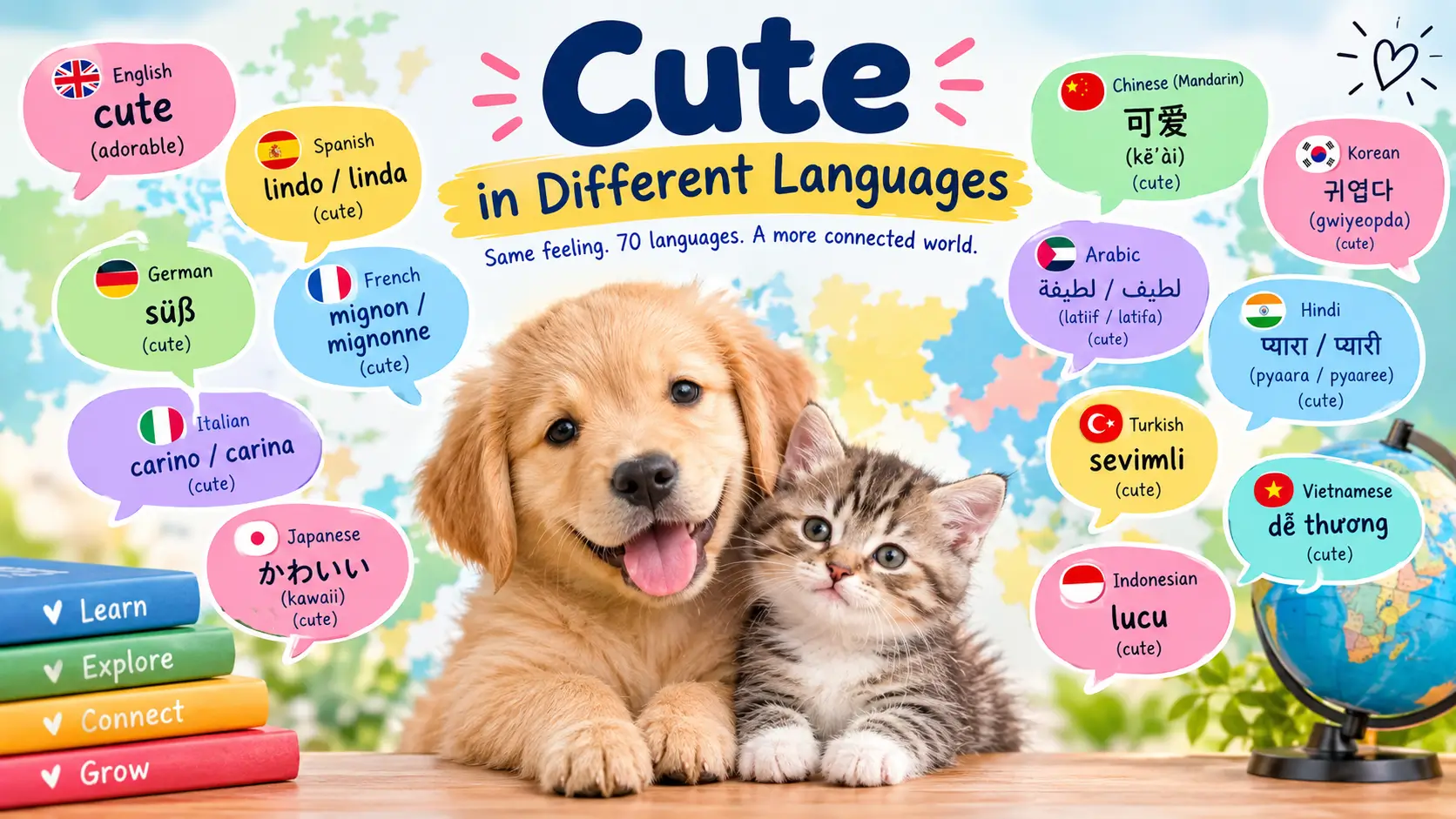
For example, Japanese かわいい (kawaii) is widely used for things considered cute or adorable. Mandarin Chinese uses 可爱 (kě’ài), while Korean commonly uses 귀엽다 (gwiyeopda).
In many European languages, the word also changes according to grammatical gender. Spanish uses lindo for masculine nouns and linda for feminine nouns, while Italian commonly uses carino and carina.
Cute Translations Around the World
The idea of cuteness appears in everyday conversations across cultures. People may use a cute word when complimenting a pet, reacting to a baby, describing clothing, or talking about someone they find charming.
Some translations are especially common in casual speech:
- Spanish: lindo / linda
- French: mignon / mignonne
- German: süß
- Italian: carino / carina
- Portuguese: fofo / fofa
- Japanese: かわいい
- Chinese: 可爱
- Korean: 귀엽다
- Arabic: لطيف / لطيفة
- Hindi: प्यारा / प्यारी
- Urdu: پیارا / پیاری
- Turkish: sevimli
- Vietnamese: dễ thương
- Indonesian: lucu
These cute translations are useful when communicating with native speakers or creating multilingual content.
Cute in All Languages: What Should You Remember?
There is not always one perfect word-for-word translation for “cute.” The closest expression can change according to the person, object, situation, and level of affection.
For example, a word can mean “cute” in one situation but “sweet,” “lovely,” “charming,” or “adorable” in another. Gender and grammar can also affect the form of the word.
When speaking naturally, it is better to learn the expression together with a simple example rather than memorizing the translation alone.
Why Learn the Word Cute in Different Languages?
Learning everyday adjectives such as “cute” can make language learning more practical. These words appear frequently in conversations, social media captions, messages, travel situations, and informal discussions.
Knowing how to say cute in another language can also help you understand compliments and casual conversations more naturally. It is a small vocabulary item, but it can be surprisingly useful.
Common Contexts for the Word Cute
The word “cute” is commonly used for:
- Babies and children
- Puppies, kittens, and other animals
- Clothes and accessories
- Small objects
- Gifts and decorations
- Photos and social media posts
- Friendly compliments
- Charming behavior
- Sweet or amusing situations
Remember that the most natural translation can change depending on what you are describing.
5 Frequently Asked Questions About Cute in Different Languages
1. How do you say “cute” in different languages?
“Cute” has many translations around the world. Common examples include lindo in Spanish, mignon in French, süß in German, 可爱 (kě’ài) in Mandarin Chinese, かわいい (kawaii) in Japanese, and 귀엽다 (gwiyeopda) in Korean.
2. What is the Japanese word for cute?
The Japanese word for cute is かわいい (kawaii). It is commonly used for people, animals, clothing, objects, and other things considered adorable or charming.
3. What is the Spanish word for cute?
Spanish commonly uses lindo or linda for “cute,” depending on grammatical gender and context. Bonito/bonita can also express a similar idea in some situations.
4. What is the Korean word for cute?
The Korean dictionary form is 귀엽다 (gwiyeopda). In everyday conversation, you may hear the polite conversational form 귀여워요, especially when reacting to something cute.
5. Is “cute” the same as “beautiful” in every language?
No. “Cute,” “beautiful,” “pretty,” “adorable,” and “charming” can have different meanings. Some languages use one word in contexts where English speakers might choose another, so the surrounding situation matters.
Conclusion
Learning cute in different languages is a simple and enjoyable way to expand your everyday vocabulary. From Japanese かわいい and Mandarin 可爱 to Spanish lindo, French mignon, and German süß, each language has its own natural way to express the idea of cuteness.
Whether you are studying languages, traveling, chatting with international friends, or looking for cute translations around the world, learning the word together with a real-life example makes it easier to remember and use naturally.

I am Ava Jones, a language enthusiast and author passionate about exploring different languages, sharing useful phrases, explaining meanings, and helping readers communicate confidently across cultures and countries.