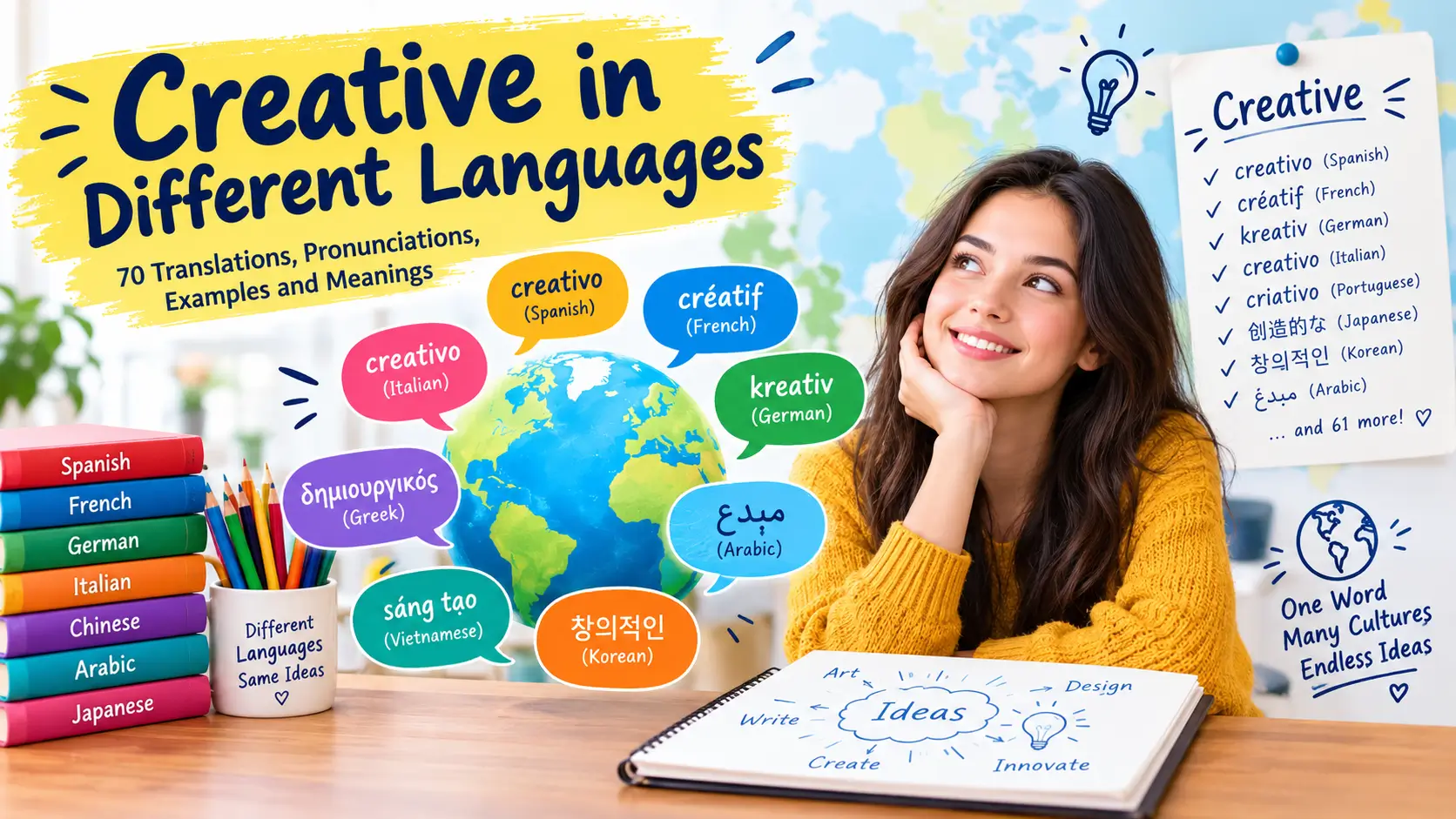
The word creative describes someone or something that shows imagination, originality, and fresh ideas. It is useful when talking about artists, designers, writers, problem-solvers, business ideas, and many other forms of original thinking.
If you are learning languages, traveling, writing, or simply curious about how people around the world express the idea of creativity, learning the word creative in different languages is a useful place to start.
Below, you will find 70 creative translations, along with easy English pronunciations and practical example sentences.
Creative in All Languages
The translations below focus on the common adjective meaning creative, imaginative, or inventive. Because some languages use grammatical gender or different forms depending on context, the form shown is a natural commonly used form.
| # | Language | Native phrase | Easy English pronunciation | Example sentence | English meaning |
|---|---|---|---|---|---|
| 1 | Spanish | creativo | kree-ah-TEE-boh | Él es muy creativo. | He is very creative. |
| 2 | French | créatif | kray-ah-TEEF | Il est très créatif. | He is very creative. |
| 3 | German | kreativ | kray-ah-TEEF | Sie ist sehr kreativ. | She is very creative. |
| 4 | Italian | creativo | kray-ah-TEE-voh | Marco è creativo. | Marco is creative. |
| 5 | Portuguese | criativo | kree-ah-TEE-voh | Ele é muito criativo. | He is very creative. |
| 6 | Dutch | creatief | kray-ah-TEEF | Zij is erg creatief. | She is very creative. |
| 7 | Swedish | kreativ | kray-ah-TEEV | Hon är kreativ. | She is creative. |
| 8 | Norwegian | kreativ | kray-ah-TEEV | Hun er kreativ. | She is creative. |
| 9 | Danish | kreativ | kray-ah-TEEV | Hun er kreativ. | She is creative. |
| 10 | Finnish | luova | LOO-oh-vah | Hän on luova. | He is creative. |
| 11 | Icelandic | skapandi | SKAH-pan-dee | Hún er skapandi. | She is creative. |
| 12 | Irish | cruthaitheach | KROO-hi-hakh | Tá sí cruthaitheach. | She is creative. |
| 13 | Welsh | creadigol | kray-ah-DIG-ol | Mae hi’n greadigol. | She is creative. |
| 14 | Polish | kreatywny | kray-ah-TEEV-nih | On jest kreatywny. | He is creative. |
| 15 | Czech | kreativní | kray-ah-TEEV-nee | Je kreativní. | He is creative. |
| 16 | Slovak | kreatívny | kray-ah-TEEV-nee | Je veľmi kreatívny. | He is very creative. |
| 17 | Slovenian | ustvarjalen | oosh-TVAR-yah-len | On je ustvarjalen. | He is creative. |
| 18 | Croatian | kreativan | kray-ah-TEE-vahn | On je kreativan. | He is creative. |
| 19 | Serbian | креативан | kray-ah-tee-VAHN | On je kreativan. | He is creative. |
| 20 | Bulgarian | креативен | kray-ah-tee-VEHN | Той е креативен. | He is creative. |
| 21 | Macedonian | креативен | kray-ah-tee-VEHN | Тој е креативен. | He is creative. |
| 22 | Russian | креативный | kray-ah-TEE-veen | Он креативный. | He is creative. |
| 23 | Ukrainian | креативний | kray-ah-TEEV-nee | Він креативний. | He is creative. |
| 24 | Belarusian | крэатыўны | kray-ah-TOO-nee | Ён крэатыўны. | He is creative. |
| 25 | Lithuanian | kūrybingas | KOO-ree-bing-gahs | Jis kūrybingas. | He is creative. |
| 26 | Latvian | radošs | RAH-dohshs | Viņš ir radošs. | He is creative. |
| 27 | Estonian | loominguline | LOH-ming-oo-lee-neh | Ta on loominguline. | He is creative. |
| 28 | Hungarian | kreatív | KRAY-teev | Ő kreatív. | He is creative. |
| 29 | Romanian | creativ | kray-ah-TEEV | El este creativ. | He is creative. |
| 30 | Albanian | krijues | kree-YOOS | Ai është krijues. | He is creative. |
| 31 | Greek | δημιουργικός | dhee-mee-oor-yee-KOS | Είναι δημιουργικός. | He is creative. |
| 32 | Turkish | yaratıcı | yah-rah-tuh-JUH | O yaratıcı. | He is creative. |
| 33 | Azerbaijani | yaradıcı | yah-rah-duh-JUH | O yaradıcıdır. | He is creative. |
| 34 | Georgian | კრეატიული | kreh-ah-TEE-oo-lee | ის კრეატიულია. | He is creative. |
| 35 | Armenian | ստեղծագործ | stegh-tsah-gor-TS | Նա ստեղծագործ է։ | He is creative. |
| 36 | Hebrew | יצירתי | yee-tsir-ah-TEE | הוא יצירתי. | He is creative. |
| 37 | Arabic | مبدع | MUB-di | هو مبدع. | He is creative. |
| 38 | Persian | خلاق | kha-LAAGH | او خلاق است. | He is creative. |
| 39 | Urdu | تخلیقی | takh-LEE-kee | وہ تخلیقی ہے۔ | He is creative. |
| 40 | Hindi | रचनात्मक | rach-naat-MAK | वह रचनात्मक है। | He is creative. |
| 41 | Bengali | সৃজনশীল | shri-jon-SHEEL | সে সৃজনশীল। | He is creative. |
| 42 | Punjabi | ਰਚਨਾਤਮਕ | rach-naa-TMAK | ਉਹ ਰਚਨਾਤਮਕ ਹੈ। | He is creative. |
| 43 | Gujarati | સર્જનાત્મક | sar-jan-AAT-mak | તે સર્જનાત્મક છે. | He is creative. |
| 44 | Marathi | सर्जनशील | sar-jan-SHEEL | तो सर्जनशील आहे. | He is creative. |
| 45 | Nepali | रचनात्मक | ra-cha-naat-MAK | ऊ रचनात्मक छ। | He is creative. |
| 46 | Sinhala | නිර්මාණශීලී | neer-maa-na-shEE-lee | ඔහු නිර්මාණශීලීයි. | He is creative. |
| 47 | Tamil | படைப்பாற்றல் மிக்க | pa-daip-paat-ral MIK-ka | அவர் படைப்பாற்றல் மிக்கவர். | He is creative. |
| 48 | Telugu | సృజనాత్మక | sru-ja-naat-MA-ka | అతను సృజనాత్మకుడు. | He is creative. |
| 49 | Kannada | ಸೃಜನಶೀಲ | sru-ja-na-SHEE-la | ಅವನು ಸೃಜನಶೀಲ. | He is creative. |
| 50 | Malayalam | സൃഷ്ടിപരമായ | srishti-pa-ra-MAA-ya | അവൻ സൃഷ്ടിപരനാണ്. | He is creative. |
| 51 | Thai | สร้างสรรค์ | saang-SAN | เขาสร้างสรรค์มาก | He is very creative. |
| 52 | Vietnamese | sáng tạo | sahng TAO | Cô ấy rất sáng tạo. | She is very creative. |
| 53 | Indonesian | kreatif | kray-ah-TEEF | Dia sangat kreatif. | He is very creative. |
| 54 | Malay | kreatif | kray-ah-TEEF | Dia sangat kreatif. | He is very creative. |
| 55 | Filipino | malikhain | mah-lee-KHA-in | Malikhain siya. | He is creative. |
| 56 | Chinese | 有创意的 | yoo CHWANG-yee duh | 她很有创意。 | She is very creative. |
| 57 | Japanese | 創造的な | soh-ZOH-teh-NAH | 彼は創造的です。 | He is creative. |
| 58 | Korean | 창의적인 | chang-ee-JUH-in | 그는 창의적이에요. | He is creative. |
| 59 | Mongolian | бүтээлч | boo-TEELCH | Тэр бүтээлч. | He is creative. |
| 60 | Kazakh | шығармашыл | shuh-gar-MA-shul | Ол шығармашыл. | He is creative. |
| 61 | Uzbek | ijodkor | ee-jod-KOR | U ijodkor. | He is creative. |
| 62 | Swahili | mbunifu | m-boo-NEE-foo | Yeye ni mbunifu. | He is creative. |
| 63 | Afrikaans | kreatief | kray-ah-TEEF | Hy is kreatief. | He is creative. |
| 64 | Amharic | ፈጠራ ያለው | feh-teh-RAH yah-lew | እሱ ፈጠራ ያለው ነው። | He is creative. |
| 65 | Somali | hal-abuur leh | hal-ah-BOOR leh | Waa qof hal-abuur leh. | He is a creative person. |
| 66 | Hausa | kirkira | keer-KEE-rah | Shi mutum ne mai kirkira. | He is a creative person. |
| 67 | Yoruba | àtinúdá | ah-tee-noo-DAH | Ó jẹ́ ẹni àtinúdá. | He is a creative person. |
| 68 | Zulu | nobuciko | noh-boo-SEE-koh | Unobuciko. | He is creative. |
| 69 | Xhosa | uyilo | oo-YEE-loh | Unobuchule bokuyila. | He has creative ability. |
| 70 | Latin | creativus | kray-ah-TEE-voos | Ille creativus est. | He is creative. |
How to Say “Creative” in Different Languages
The word creative changes considerably from one language to another. In many European languages, it has a form that resembles the English word because the modern international vocabulary of creativity often shares Latin-based roots.
For example, Spanish uses creativo, Italian uses creativo, Portuguese uses criativo, French uses créatif, and Dutch uses creatief.
Other languages use a word built around ideas such as imagination, creation, originality, or inventiveness. This is particularly noticeable in languages such as Finnish, Turkish, Hindi, Urdu, Japanese, Korean, and several African and Asian languages.
Creative Translations Around the World
When learning creative translations, it is important to remember that an adjective may change according to gender, number, case, or grammatical structure.
For example, Romance languages can have masculine and feminine forms. Spanish commonly uses creativo for masculine nouns and creativa for feminine nouns. French similarly distinguishes forms such as créatif and créative.
In other languages, the form can stay the same regardless of the person’s gender.
Creative as a Personality Trait
When creative describes a person, it usually means that the person produces original ideas or approaches problems in unusual ways.
Examples include:
- A creative writer develops original stories.
- A creative designer finds fresh visual solutions.
- A creative student approaches a difficult project differently.
- A creative entrepreneur develops new business ideas.
- A creative artist experiments with new styles.
This meaning is useful in everyday conversations, education, workplaces, and artistic settings.
Creative for Ideas and Work
The word can also describe an idea, solution, method, project, or design.
For example, someone might say:
- “That is a creative solution.”
- “She came up with a creative idea.”
- “The team developed a creative campaign.”
- “He found a creative way to solve the problem.”
In these cases, creative usually means original, imaginative, or different from the usual approach.
Why Learn Creative in Different Languages?
Learning creative in different languages can help language learners build vocabulary around personality, art, work, education, and innovation.
It can also be useful for:
- International communication
- Language-learning projects
- Travel vocabulary
- Multilingual writing
- Cultural studies
- Classroom activities
- Translation practice
- Creative writing
- Social media content
Knowing a single descriptive word in many languages can also make it easier to recognize related words when reading or listening to foreign languages.
Common Uses of the Word Creative
The English word creative is commonly used in several situations.
Describing people:
“She is a creative artist.”
Describing ideas:
“That was a creative idea.”
Describing solutions:
“We need a creative solution.”
Describing work:
“He has a creative job.”
Describing activities:
“Creative writing is my favorite class.”
The exact translation depends on the language and the context in which the word is used.
Creative vs. Creativity
Although these words are closely related, they have different grammatical roles.
Creative is an adjective. It describes a person, thing, idea, or action.
Example:
“She is creative.”
Creativity is a noun. It refers to the ability or quality of producing original ideas.
Example:
“Her creativity is impressive.”
When translating these words, do not automatically assume that the same word structure is used in every language.
Tips for Learning Creative Translations
Start by learning the native spelling together with the pronunciation. Then practice the word in a complete sentence instead of memorizing it alone.
A useful method is to connect the word with familiar topics such as art, writing, design, music, school, or work.
For example, you can create a simple vocabulary sentence in each language that says that someone is creative. This gives you both the word and a practical grammatical pattern.
Frequently Asked Questions
1. How do you say creative in different languages?
The word creative has different translations around the world. Examples include creativo in Spanish, créatif in French, kreativ in German, yaratıcı in Turkish, مبدع in Arabic, 創造的な in Japanese, and 창의적인 in Korean.
2. What is creative in Spanish?
“Creative” in Spanish is commonly creativo for masculine forms and creativa for feminine forms. For example, “He is creative” can be translated as Él es muy creativo.
3. What is the meaning of creative?
Creative means having or showing the ability to produce original ideas, artistic work, solutions, or approaches. It can describe people, ideas, designs, projects, and methods.
4. What is creative in French?
“Creative” in French is créatif in the masculine form and créative in the feminine form. A common example is Il est très créatif, meaning “He is very creative.”
5. What are some common synonyms for creative?
Common English synonyms include imaginative, inventive, original, innovative, artistic, resourceful, and ingenious. The best synonym depends on the context.
Conclusion
Learning how to say creative in different languages is a simple way to expand your international vocabulary. The word can describe people, ideas, solutions, art, designs, and many other forms of original thinking.
From creativo in Spanish and créatif in French to 創造的な in Japanese and 창의적인 in Korean, these 70 translations show how languages around the world express the idea of creativity in their own ways.

I am Scarlett Wilson, a passionate language writer who loves exploring different languages, words, meanings, translations, and useful phrases. I enjoy making language learning simple, clear, and interesting for everyone.