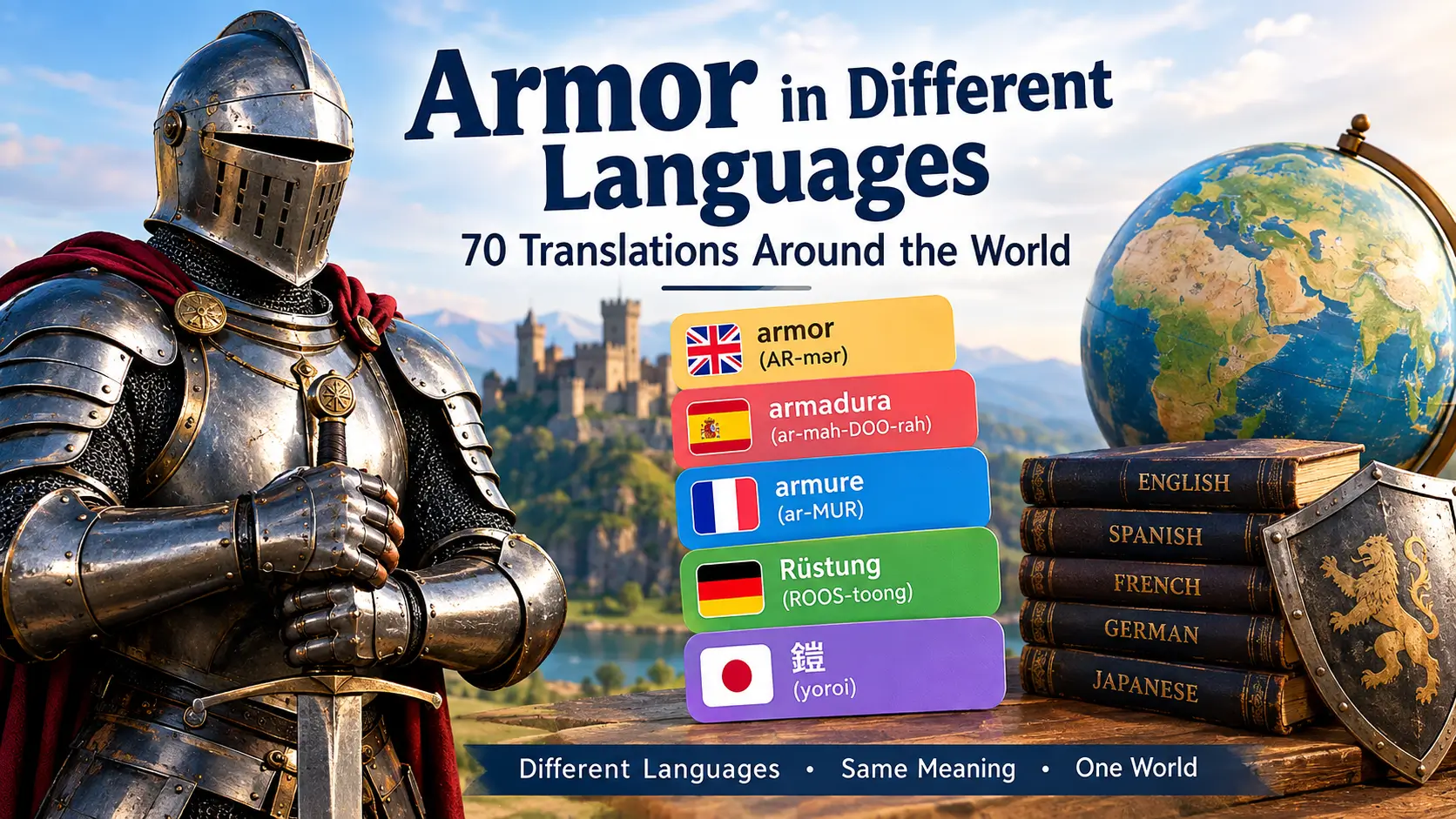
The word armor refers to protective clothing or equipment worn to protect the body from weapons, impact, or other forms of physical harm. It is strongly associated with knights, soldiers, warriors, and historical battles, but the idea of protective armor also appears in modern protective equipment.
If you want to know how to say armor in different languages, this guide provides 70 useful translations with native terms, easy English pronunciations, and practical example sentences. These armor translations are useful for language learners, writers, travelers, students, gamers, and anyone interested in how the concept of armor is expressed around the world.
The table below shows armor in all languages in a simple format so you can quickly find the translation you need.
Armor in Different Languages: 70 Translations
| # | Language | Native Phrase | Easy English Pronunciation | Example Sentence | English Meaning |
|---|---|---|---|---|---|
| 1 | English | armor | AR-mər | The knight wore heavy armor. | The knight wore heavy protective equipment. |
| 2 | Spanish | armadura | ar-mah-DOO-rah | La armadura del caballero es pesada. | The knight’s armor is heavy. |
| 3 | French | armure | ar-MUR | Le chevalier porte une armure. | The knight wears armor. |
| 4 | German | Rüstung | ROOS-toong | Der Ritter trägt eine Rüstung. | The knight wears armor. |
| 5 | Italian | armatura | ar-mah-TOO-rah | Il cavaliere indossa un’armatura. | The knight wears armor. |
| 6 | Portuguese | armadura | ar-mah-DOO-rah | O cavaleiro usa uma armadura. | The knight wears armor. |
| 7 | Dutch | harnas | HAR-nas | De ridder draagt een harnas. | The knight wears armor. |
| 8 | Swedish | rustning | ROOST-ning | Riddaren bär en rustning. | The knight wears armor. |
| 9 | Norwegian | rustning | ROOST-ning | Ridderen har på seg rustning. | The knight is wearing armor. |
| 10 | Danish | rustning | ROOST-ning | Ridderen bærer rustning. | The knight wears armor. |
| 11 | Finnish | haarniska | HAAR-nis-kah | Ritari käyttää haarniskaa. | The knight wears armor. |
| 12 | Icelandic | brynja | BRIN-yah | Riddarinn klæðist brynju. | The knight wears armor. |
| 13 | Irish | armúr | AR-moor | Tá armúr á an ridire. | The knight has armor on. |
| 14 | Welsh | arfwisg | ar-VISK | Mae’r marchog yn gwisgo arfwisg. | The knight is wearing armor. |
| 15 | Scottish Gaelic | armachd | AR-makhk | Tha an gaisgeach a’ caitheamh armachd. | The warrior is wearing armor. |
| 16 | Latin | armatura | ar-mah-TOO-rah | Miles armaturam gerit. | The soldier wears armor. |
| 17 | Greek | πανοπλία | pa-noh-PLEE-ah | Ο ιππότης φορά πανοπλία. | The knight wears armor. |
| 18 | Russian | броня | brahn-YA | Рыцарь носит броню. | The knight wears armor. |
| 19 | Ukrainian | броня | brohn-YA | Лицар носить броню. | The knight wears armor. |
| 20 | Belarusian | браня | bra-NYA | Рыцар носіць браню. | The knight wears armor. |
| 21 | Polish | zbroja | ZBROH-yah | Rycerz nosi zbroję. | The knight wears armor. |
| 22 | Czech | brnění | BRN-yeh-nee | Rytíř nosí brnění. | The knight wears armor. |
| 23 | Slovak | brnenie | BRNEH-nyeh | Rytier nosí brnenie. | The knight wears armor. |
| 24 | Slovenian | oklep | oh-KLEHP | Vitez nosi oklep. | The knight wears armor. |
| 25 | Croatian | oklop | OH-klop | Vitez nosi oklop. | The knight wears armor. |
| 26 | Serbian | оклоп | OH-klop | Витез носи оклоп. | The knight wears armor. |
| 27 | Bosnian | oklop | OH-klop | Vitez nosi oklop. | The knight wears armor. |
| 28 | Bulgarian | броня | broh-NYA | Рицарят носи броня. | The knight wears armor. |
| 29 | Macedonian | оклоп | OH-klop | Витезот носи оклоп. | The knight wears armor. |
| 30 | Romanian | armură | ar-MOO-rah | Cavalerul poartă armură. | The knight wears armor. |
| 31 | Hungarian | páncél | PAAN-tsayl | A lovag páncélt visel. | The knight wears armor. |
| 32 | Albanian | parzmore | parz-MOH-reh | Kalorësi vesh parzmore. | The knight wears armor. |
| 33 | Lithuanian | šarvai | SHAR-vai | Riteris dėvi šarvus. | The knight wears armor. |
| 34 | Latvian | bruņas | BROO-nyas | Bruņinieks valkā bruņas. | The knight wears armor. |
| 35 | Estonian | raudrüü | ROWD-roo | Rüütel kannab raudrüüd. | The knight wears armor. |
| 36 | Maltese | armatura | ar-mah-TOO-rah | Il-kavallier jilbes armatura. | The knight wears armor. |
| 37 | Turkish | zırh | zuhrkh | Şövalye zırh giyiyor. | The knight is wearing armor. |
| 38 | Azerbaijani | zireh | zee-REH | Cəngavər zireh geyinir. | The knight wears armor. |
| 39 | Persian | زره | zeh-REH | شوالیه زره پوشیده است. | The knight is wearing armor. |
| 40 | Arabic | درع | DIR | الفارس يرتدي درعًا. | The knight wears armor. |
| 41 | Hebrew | שריון | shir-YON | האביר לובש שריון. | The knight wears armor. |
| 42 | Armenian | զրահ | zra-H | Ասպետը զրահ է կրում։ | The knight wears armor. |
| 43 | Georgian | ჯავშანი | jav-SHAH-nee | რაინდი ჯავშანს ატარებს. | The knight wears armor. |
| 44 | Hindi | कवच | kuh-VACH | योद्धा कवच पहनता है। | The warrior wears armor. |
| 45 | Urdu | زرہ | ZAR-rah | سپاہی زرہ پہنتا ہے۔ | The soldier wears armor. |
| 46 | Bengali | বর্ম | bormo | যোদ্ধা বর্ম পরে। | The warrior wears armor. |
| 47 | Punjabi | ਬਖਤਰ | BAKH-tar | ਯੋਧਾ ਬਖਤਰ ਪਹਿਨਦਾ ਹੈ। | The warrior wears armor. |
| 48 | Gujarati | બખ્તર | BAKH-tar | યોદ્ધા બખ્તર પહેરે છે. | The warrior wears armor. |
| 49 | Marathi | चिलखत | CHIL-khat | योद्धा चिलखत घालतो. | The warrior wears armor. |
| 50 | Nepali | कवच | kuh-VACH | योद्धाले कवच लगाउँछ। | The warrior wears armor. |
| 51 | Sanskrit | कवचम् | kuh-va-CHAM | योद्धा कवचं धारयति। | The warrior wears armor. |
| 52 | Tamil | கவசம் | kuh-vuh-SAM | வீரன் கவசம் அணிகிறான். | The warrior wears armor. |
| 53 | Telugu | కవచం | kuh-vuh-CHAM | యోధుడు కవచం ధరిస్తాడు. | The warrior wears armor. |
| 54 | Kannada | ಕವಚ | kuh-vuh-CHA | ಯೋಧನು ಕವಚವನ್ನು ಧರಿಸುತ್ತಾನೆ. | The warrior wears armor. |
| 55 | Malayalam | കവചം | kuh-vuh-CHAM | യോദ്ധാവ് കവചം ധരിക്കുന്നു. | The warrior wears armor. |
| 56 | Sinhala | සන්නාහය | san-NAH-hah-yah | සෙබලා සන්නාහය පැළඳ සිටී. | The soldier is wearing armor. |
| 57 | Chinese (Mandarin) | 盔甲 | kuī jiǎ | 骑士穿着盔甲。 | The knight is wearing armor. |
| 58 | Japanese | 鎧 | yoroi | 騎士は鎧を着ています。 | The knight is wearing armor. |
| 59 | Korean | 갑옷 | ga-boht | 기사가 갑옷을 입고 있습니다. | The knight is wearing armor. |
| 60 | Vietnamese | áo giáp | ow ziap | Hiệp sĩ mặc áo giáp. | The knight wears armor. |
| 61 | Thai | เกราะ | grò | อัศวินสวมเกราะ | The knight wears armor. |
| 62 | Indonesian | zirah | ZEE-rah | Ksatria itu memakai zirah. | The knight wears armor. |
| 63 | Malay | perisai | puh-ree-SAI | Kesatria itu memakai perisai. | The knight wears a shield/protective defense. |
| 64 | Filipino | baluti | ba-LOO-tee | Ang mandirigma ay may baluti. | The warrior has armor. |
| 65 | Mongolian | хуяг | kho-YAG | Дайчин хуяг өмсдөг. | The warrior wears armor. |
| 66 | Kazakh | сауыт | sah-OOYT | Жауынгер сауыт киеді. | The warrior wears armor. |
| 67 | Uzbek | zirh | zeerh | Jangchi zirh kiyadi. | The warrior wears armor. |
| 68 | Swahili | silaha za kujikinga | see-LAH-ha za koo-jee-KING-ah | Askari amevaa silaha za kujikinga. | The soldier is wearing protective armor. |
| 69 | Afrikaans | wapenrusting | VAH-pən-rus-ting | Die ridder dra ‘n wapenrusting. | The knight wears armor. |
| 70 | Esperanto | kiraso | kee-RAH-so | La kavaliro portas kirason. | The knight wears armor. |
What Does Armor Mean?
Armor means protective clothing, covering, or equipment designed to protect a person from injury. Historically, armor was commonly made from materials such as leather, bronze, iron, and steel.
In modern contexts, the word can describe protective equipment used by soldiers, law enforcement personnel, athletes, or workers. It can also be used figuratively, such as when someone describes emotional defenses as a type of “armor.”
The exact translation can depend on context. A historical suit of armor, modern body armor, and a protective shield may use different words in some languages.
How to Say Armor in Different Languages
If you are searching for how to say armor in different languages, the translations above provide common terms used for armor, protective equipment, or traditional body protection.
Some languages have a direct equivalent of the English word, while others use words connected with concepts such as protective gear, defensive covering, battle equipment, or a knight’s armor.
For example, Spanish uses armadura, French uses armure, German uses Rüstung, Italian uses armatura, and Japanese commonly uses 鎧 (yoroi) for traditional armor.
Armor Around the World
Armor has played an important role in many cultures throughout history. European knights are often shown wearing metal plate armor, while warriors in other parts of the world developed their own distinctive protective equipment.
Japanese samurai armor, for example, developed a unique construction and appearance. In South Asia, armor and protective equipment were used by various armies and warrior traditions. Across the Middle East, Central Asia, Europe, and East Asia, protective battle equipment developed according to local materials, military practices, and technology.
This makes armor around the world an interesting subject for both language and cultural study.
Historical Armor and Modern Armor
The meaning of armor has changed over time.
Historical armor was often designed to protect warriors from swords, arrows, spears, and other weapons. Metal helmets, shields, breastplates, chain mail, and complete suits of armor were used in different periods and cultures.
Modern armor is generally designed around contemporary threats and practical requirements. Body armor, helmets, protective plates, and other equipment can be made using advanced materials that are very different from traditional steel armor.
The same basic idea remains: armor provides protection against physical danger.
Armor Translations for Language Learners
Learning the word armor in another language is useful when studying history, military vocabulary, fantasy literature, video games, films, and cultural traditions.
When memorizing vocabulary, it can help to connect the word with a simple sentence rather than learning the translation by itself. For example, remembering a sentence about a knight wearing armor makes the word easier to understand in context.
The pronunciation column in this guide provides a simple English-friendly approximation, but pronunciation can vary by regional accent.
Common Uses of the Word Armor
The word armor can appear in several contexts:
- Historical armor — protective equipment used by warriors in the past.
- Body armor — protective equipment worn on the body.
- Knight’s armor — traditional protective equipment associated with medieval knights.
- Samurai armor — traditional Japanese warrior armor.
- Military armor — protective equipment associated with military use.
- Protective armor — a broad term for equipment intended to reduce injury.
- Emotional armor — a figurative expression for emotional defenses.
Understanding the context helps you choose the most suitable translation when looking at armor in all languages.
Armor in Literature, Games, and Popular Culture
Armor is a common theme in fantasy novels, historical fiction, movies, television, and video games. Characters may wear armor to represent strength, protection, status, or their role as a warrior.
Fantasy games often divide armor into categories such as light armor, medium armor, and heavy armor. These terms may also have specific translations in different languages.
Because of this, learning armor translations can be especially useful for gamers, writers, translators, and fans of fantasy and historical stories.
Why Armor Translations Can Differ
A single English word does not always have one perfect equivalent in every language.
For example, one language may use a word specifically meaning a suit of armor, while another may use a broader term for protective equipment. Some languages also distinguish between historical armor, body armor, shields, and defensive equipment.
Therefore, translations should always be considered in context rather than treated as interchangeable vocabulary in every situation.
Frequently Asked Questions About Armor in Different Languages
1. What is armor in Spanish?
Armor in Spanish is armadura. It is commonly used for protective equipment associated with knights, warriors, or historical combat.
2. How do you say armor in Japanese?
Armor in Japanese is 鎧 (yoroi). The word is especially associated with traditional Japanese armor worn by warriors.
3. What is armor in French?
Armor in French is armure. It can refer to protective armor, particularly in historical or military contexts.
4. What is the word for armor in German?
Armor in German is Rüstung. The term is commonly used for armor or protective military equipment, depending on context.
5. What is armor in Hindi?
Armor in Hindi is कवच (kavach). The word can refer to protective armor and is also found in traditional and literary contexts.
Conclusion
Learning how to say armor in different languages provides more than a simple vocabulary list. It reveals how different cultures describe protection, warriors, historical equipment, and defensive technology.
From armadura in Spanish and armure in French to 鎧 in Japanese and 盔甲 in Mandarin Chinese, these 70 translations show the variety of ways the idea of armor is expressed around the world.
Whether you are studying languages, researching history, writing fiction, playing games, or simply exploring armor in all languages, this collection gives you a practical starting point for understanding the word across cultures.

I am Ricardo Hunter, Administrator at LingoBuz, passionate about languages, translations, and global communication. I help create useful, clear content that makes exploring different languages simple, enjoyable, and accessible.