An artist is someone who creates art through painting, drawing, sculpture, music, performance, or other creative forms. Learning how to say artist in different languages is useful for travelers, language learners, writers, students, and anyone interested in art and culture.
The word “artist” can have slightly different meanings depending on the language and cultural context. In some languages, the same word is commonly used for a visual artist, while in others it may also refer broadly to a creative performer.
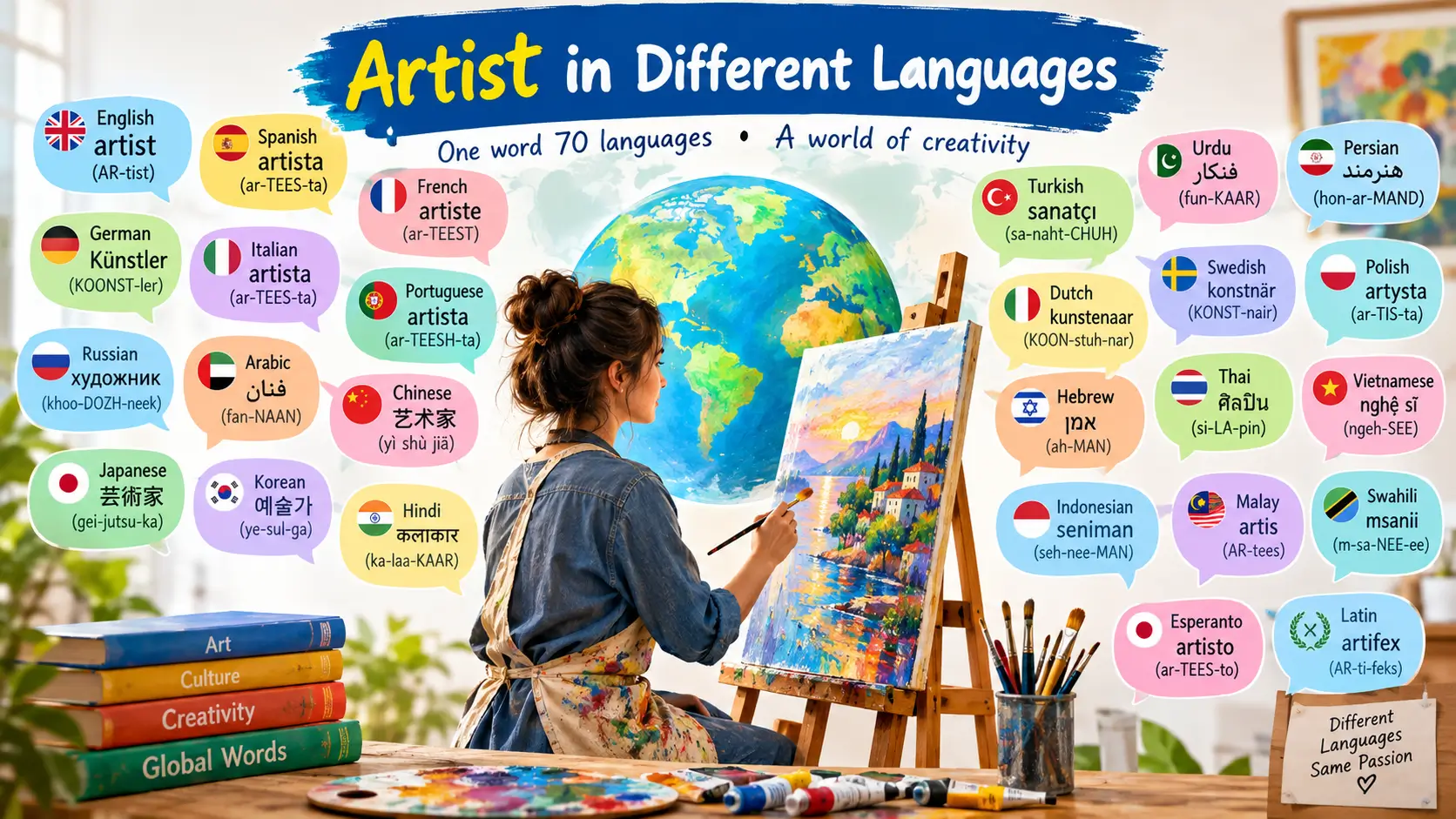
Below, you will find artist translations in 70 different languages, including the native word, an easy English pronunciation, and a practical example sentence.
Artist in Different Languages
| # | Language | Native Phrase | Easy English Pronunciation | Example Sentence | English Meaning |
|---|---|---|---|---|---|
| 1 | English | artist | AR-tist | She is a talented artist. | She is a talented artist. |
| 2 | Spanish | artista | ar-TEES-ta | Mi hermana es artista. | My sister is an artist. |
| 3 | French | artiste | ar-TEEST | Elle est une artiste célèbre. | She is a famous artist. |
| 4 | German | Künstler | KOONST-ler | Er ist ein Künstler. | He is an artist. |
| 5 | Italian | artista | ar-TEES-ta | Lei è un’artista. | She is an artist. |
| 6 | Portuguese | artista | ar-TEESH-ta | Ela é uma artista. | She is an artist. |
| 7 | Dutch | kunstenaar | KOON-stuh-nar | Hij is een kunstenaar. | He is an artist. |
| 8 | Swedish | konstnär | KONST-nair | Hon är en konstnär. | She is an artist. |
| 9 | Norwegian | kunstner | KOONST-ner | Han er kunstner. | He is an artist. |
| 10 | Danish | kunstner | KOONST-ner | Hun er kunstner. | She is an artist. |
| 11 | Finnish | taiteilija | TIE-tay-lee-ya | Hän on taiteilija. | He is an artist. |
| 12 | Icelandic | listamaður | LIS-ta-ma-thur | Hann er listamaður. | He is an artist. |
| 13 | Irish | ealaíontóir | al-AYN-tor | Is ealaíontóir í. | She is an artist. |
| 14 | Welsh | artist | AR-tist | Mae hi’n artist. | She is an artist. |
| 15 | Scottish Gaelic | neach-ealain | nyakh-YA-lin | Tha i na neach-ealain. | She is an artist. |
| 16 | Catalan | artista | ar-TEES-ta | Ella és artista. | She is an artist. |
| 17 | Galician | artista | ar-TEES-ta | Ela é artista. | She is an artist. |
| 18 | Basque | artista | ar-TEES-ta | Artista ona da. | He is a good artist. |
| 19 | Romanian | artist | ar-TEEST | El este artist. | He is an artist. |
| 20 | Albanian | artist | ar-TEEST | Ai është artist. | He is an artist. |
| 21 | Greek | καλλιτέχνης | ka-lee-TEKH-nees | Είναι καλλιτέχνης. | He is an artist. |
| 22 | Russian | художник | khoo-DOZH-neek | Он художник. | He is an artist. |
| 23 | Ukrainian | художник | khoo-DOZH-nyk | Він художник. | He is an artist. |
| 24 | Belarusian | мастак | mas-TAK | Ён мастак. | He is an artist. |
| 25 | Bulgarian | художник | khoo-DOZH-neek | Той е художник. | He is an artist. |
| 26 | Serbian | уметник | OO-met-neek | Он је уметник. | He is an artist. |
| 27 | Croatian | umjetnik | OO-myet-neek | On je umjetnik. | He is an artist. |
| 28 | Bosnian | umjetnik | OO-myet-neek | On je umjetnik. | He is an artist. |
| 29 | Slovenian | umetnik | OO-met-neek | On je umetnik. | He is an artist. |
| 30 | Slovak | umelec | OO-meh-lets | On je umelec. | He is an artist. |
| 31 | Czech | umělec | OO-myeh-lets | On je umělec. | He is an artist. |
| 32 | Polish | artysta | ar-TIS-ta | On jest artystą. | He is an artist. |
| 33 | Lithuanian | menininkas | meh-nee-NINK-as | Jis yra menininkas. | He is an artist. |
| 34 | Latvian | mākslinieks | MAHKS-lee-neeks | Viņš ir mākslinieks. | He is an artist. |
| 35 | Estonian | kunstnik | KOONST-neek | Ta on kunstnik. | He is an artist. |
| 36 | Hungarian | művész | MOO-vase | Ő művész. | He is an artist. |
| 37 | Turkish | sanatçı | sa-naht-CHUH | O bir sanatçı. | He is an artist. |
| 38 | Azerbaijani | rəssam | rehss-SAHM | O, rəssamdır. | He is an artist. |
| 39 | Armenian | նկարիչ | na-ka-REECH | Նա նկարիչ է։ | He is an artist. |
| 40 | Georgian | მხატვარი | mkhat-VA-ree | ის მხატვარია. | He is an artist. |
| 41 | Persian | هنرمند | hon-ar-MAND | او هنرمند است. | He is an artist. |
| 42 | Arabic | فنان | fan-NAAN | هو فنان. | He is an artist. |
| 43 | Hebrew | אמן | ah-MAN | הוא אמן. | He is an artist. |
| 44 | Hindi | कलाकार | ka-laa-KAAR | वह एक कलाकार है। | He is an artist. |
| 45 | Urdu | فنکار | fun-KAAR | وہ ایک فنکار ہے۔ | He is an artist. |
| 46 | Bengali | শিল্পী | SHIL-pee | সে একজন শিল্পী। | He is an artist. |
| 47 | Punjabi | ਕਲਾਕਾਰ | ka-laa-KAAR | ਉਹ ਇੱਕ ਕਲਾਕਾਰ ਹੈ। | He is an artist. |
| 48 | Gujarati | કલાકાર | ka-laa-KAAR | તે એક કલાકાર છે. | He is an artist. |
| 49 | Marathi | कलाकार | ka-laa-KAAR | तो एक कलाकार आहे. | He is an artist. |
| 50 | Nepali | कलाकार | ka-laa-KAAR | उहाँ कलाकार हुनुहुन्छ। | He is an artist. |
| 51 | Sinhala | කලාකරුවා | ka-laa-ka-ROO-va | ඔහු කලාකරුවෙකි. | He is an artist. |
| 52 | Tamil | கலைஞர் | ka-lai-nyar | அவர் ஒரு கலைஞர். | He is an artist. |
| 53 | Telugu | కళాకారుడు | ka-laa-KAA-roo-doo | అతను కళాకారుడు. | He is an artist. |
| 54 | Kannada | ಕಲಾವಿದ | ka-laa-VI-da | ಅವನು ಕಲಾವಿದ. | He is an artist. |
| 55 | Malayalam | കലാകാരൻ | ka-laa-KAA-ran | അവൻ ഒരു കലാകാരനാണ്. | He is an artist. |
| 56 | Thai | ศิลปิน | si-LA-pin | เขาเป็นศิลปิน | He is an artist. |
| 57 | Vietnamese | nghệ sĩ | ngeh-SEE | Anh ấy là nghệ sĩ. | He is an artist. |
| 58 | Indonesian | seniman | seh-nee-MAN | Dia seorang seniman. | He is an artist. |
| 59 | Malay | artis | AR-tees | Dia seorang artis. | He is an artist. |
| 60 | Filipino | artista | ar-TEES-ta | Isa siyang artista. | He is an artist. |
| 61 | Chinese | 艺术家 | yì shù jiā | 他是一位艺术家。 | He is an artist. |
| 62 | Japanese | 芸術家 | gei-jutsu-ka | 彼は芸術家です。 | He is an artist. |
| 63 | Korean | 예술가 | ye-sul-ga | 그는 예술가입니다. | He is an artist. |
| 64 | Mongolian | уран бүтээлч | oo-RAN boo-TEELCH | Тэр уран бүтээлч. | He is an artist. |
| 65 | Swahili | msanii | m-sa-NEE-ee | Yeye ni msanii. | He is an artist. |
| 66 | Afrikaans | kunstenaar | KOON-stuh-nar | Hy is ‘n kunstenaar. | He is an artist. |
| 67 | Zulu | umculi | oom-GOO-lee | Ungumculi. | He is an artist. |
| 68 | Xhosa | umzobi | oom-ZOH-bee | Ungumzobi. | He is an artist. |
| 69 | Esperanto | artisto | ar-TEES-to | Li estas artisto. | He is an artist. |
| 70 | Latin | artifex | AR-ti-feks | Ille artifex est. | He is an artist. |
How to Say Artist in Different Languages
The most common translations of artist vary according to the type of art being discussed. For example, Spanish, Italian, Portuguese, Catalan, and several other languages use forms related to the word “artista.” In German, Dutch, and Afrikaans, words derived from the concept of art are commonly used.
Some languages make a stronger distinction between a visual artist and other creative professionals. Russian художник, for example, is commonly associated with a visual artist or painter, while broader terms may be used for other kinds of artists.
This is why a direct dictionary translation is not always enough. The surrounding context can determine which word sounds most natural.
Artist Translations for Everyday Conversations
If you are learning a language, the easiest way to remember a new word is to use it in a complete sentence. Instead of memorizing only the translation, practice phrases such as:
- “She is an artist.”
- “He is a famous artist.”
- “My friend is an artist.”
- “The artist created this painting.”
- “I met an artist yesterday.”
Using the word in context helps you understand how it functions naturally in conversation.
Artist in All Languages: What Does the Word Mean?
The English word artist generally refers to a person who creates works of art. This can include painters, illustrators, sculptors, photographers, and other creative professionals.
The meaning can become broader depending on the context. In everyday English, “artist” can also describe someone involved in music or performance. However, individual languages may use separate words for painters, musicians, performers, craftspeople, or other creative specialists.
Therefore, when searching for artist in all languages, it is important to consider the intended type of artist.
Artist Around the World
Art exists in virtually every culture, but the vocabulary used to describe artists reflects each language’s history and traditions.
European languages often have related words derived from historical terms for art and artistic work. Asian languages may use expressions that emphasize artistic skill, creativity, or mastery. In South Asian languages, words such as “kalakar” are widely associated with people who practice artistic or creative professions.
These differences make artist around the world an interesting language-learning topic. Learning the local word can also help travelers communicate more naturally when visiting galleries, museums, studios, cultural centers, and art festivals.
Artist Translations for Artists and Creators
The word “artist” is useful when talking about many creative professions, but a more specific term may sometimes be appropriate.
For example, someone who paints may be called a painter, while someone who creates sculptures may be called a sculptor. A person who performs music may be called a musician, and a person who creates illustrations may be called an illustrator.
When translating “artist,” always consider the subject and the type of creative work being discussed.
Why Learn the Word Artist in Different Languages?
Learning the word “artist” in multiple languages can be useful for several reasons:
Travel: You can communicate more easily when visiting museums, galleries, and cultural attractions.
Language learning: Related vocabulary becomes easier to recognize when you compare words across languages.
Writing: Multilingual vocabulary can help writers describe international art and culture more naturally.
Education: Students can use these translations for language projects, cultural studies, and presentations.
Creative work: Artists working with international audiences can better understand how their profession is described in different countries.
Frequently Asked Questions
1. How do you say “artist” in different languages?
“Artist” has many translations. Examples include artista in Spanish and Italian, artiste in French, Künstler in German, artista in Portuguese, sanatçı in Turkish, فنکار in Urdu, कलाकार in Hindi, 艺术家 in Chinese, 芸術家 in Japanese, and 예술가 in Korean.
2. What is the word for artist in Spanish?
The Spanish word for artist is artista. It can be used for both male and female artists.
3. How do you say artist in French?
In French, “artist” is artiste. The same basic noun can refer to a male or female artist, with context or articles indicating gender.
4. What is artist in Hindi and Urdu?
In Hindi, artist is commonly translated as कलाकार (kalākār). In Urdu, a common translation is فنکار (fankār). Both words can describe someone involved in artistic or creative work.
5. Which languages use a word similar to “artista”?
Several languages use forms related to artista, including Spanish, Italian, Portuguese, Catalan, Galician, and Filipino. The exact pronunciation and grammatical usage can vary between languages.
Conclusion
Learning how to say artist in different languages is a simple way to explore the relationship between language, creativity, and culture. Although the English word “artist” has many direct equivalents, some languages make more specific distinctions based on the type of artistic work.
From artista in Spanish and Italian to 艺术家 in Chinese and 芸術家 in Japanese, these 70 translations provide a useful starting point for understanding how people around the world describe artists.

I’m Jesse Crawford, a language enthusiast and writer passionate about exploring different languages. I create helpful content that makes words, meanings, translations, and language learning simple, useful, and enjoyable for everyone.