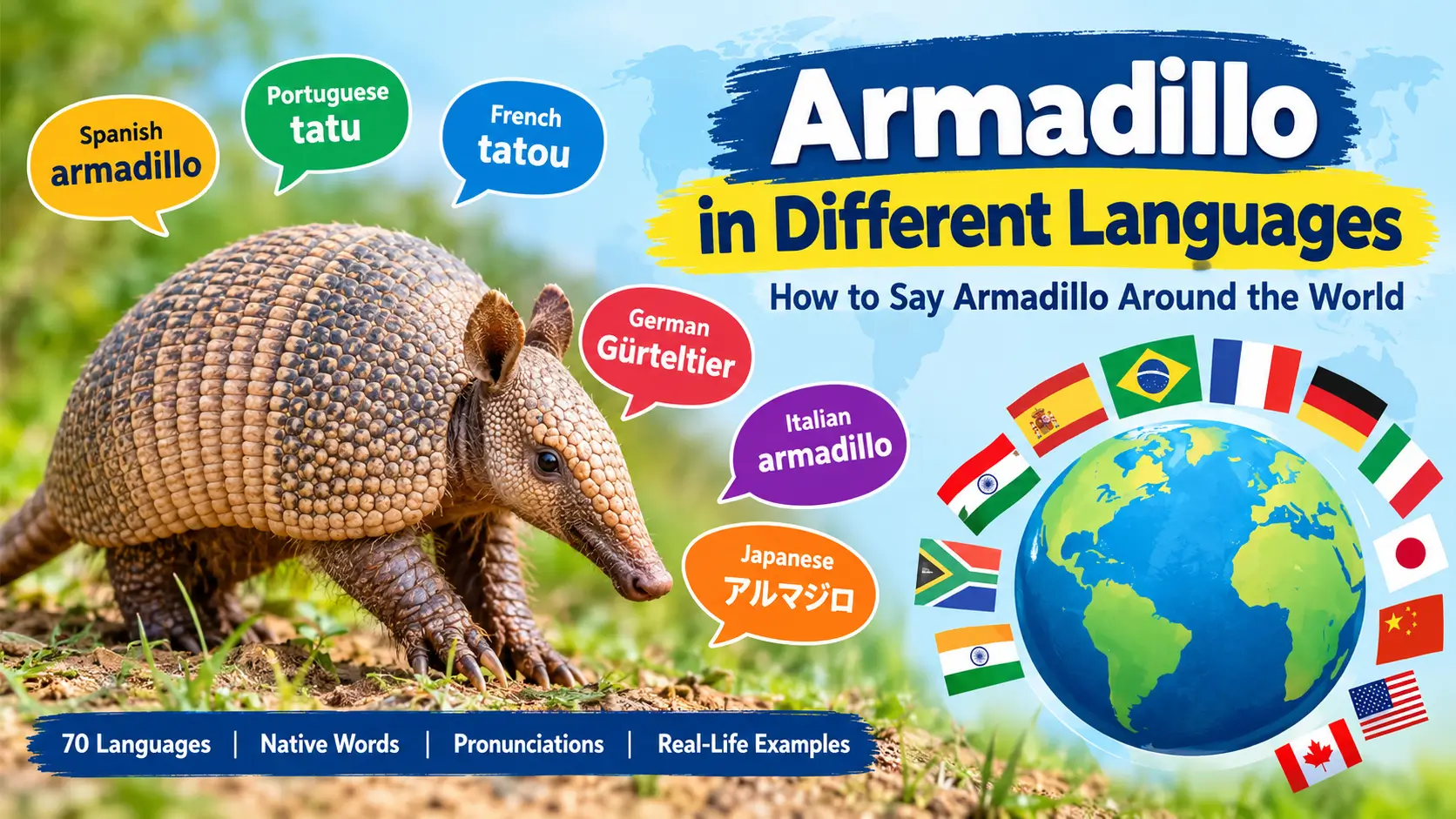
Learning how to say armadillo in different languages is a fun way to explore how cultures name this unique armored mammal. The word may look similar across some languages, while others use completely different native terms.
Whether you are studying languages, creating multilingual content, traveling, or simply curious about animal names, this guide gives you armadillo translations in 70 languages. Each entry includes the native word, an easy English pronunciation, and a short example sentence with its English meaning.
Armadillo in All Languages
The following table shows how to say armadillo in different languages. Pronunciations are simplified for English speakers and are intended as practical reading guides rather than exact phonetic transcriptions.
| Language | Native Phrase | Easy English Pronunciation | Example Sentence | English Meaning |
|---|---|---|---|---|
| Spanish | armadillo | ar-ma-DEE-yo | El armadillo camina lentamente. | The armadillo walks slowly. |
| Portuguese | tatu | tah-TOO | O tatu vive no campo. | The armadillo lives in the countryside. |
| French | tatou | tah-TOO | Le tatou cherche de la nourriture. | The armadillo is looking for food. |
| Italian | armadillo | ar-ma-DEEL-lo | L’armadillo è un animale curioso. | The armadillo is a curious animal. |
| German | Gürteltier | GUR-tel-teer | Das Gürteltier ist nachtaktiv. | The armadillo is nocturnal. |
| Dutch | gordeldier | KHOR-dul-deer | Het gordeldier zoekt voedsel. | The armadillo is looking for food. |
| Afrikaans | gordeldier | KHOR-dul-deer | Die gordeldier het ‘n harde dop. | The armadillo has a hard shell. |
| Swedish | bältdjur | BELT-dyoor | Bältdjuret går långsamt. | The armadillo walks slowly. |
| Norwegian | beltedyr | BEL-teh-deer | Beltedyret leter etter mat. | The armadillo is looking for food. |
| Danish | bæltedyr | BEL-teh-deer | Bæltedyret går om natten. | The armadillo walks at night. |
| Finnish | vyötiäinen | VUH-tee-eye-nen | Vyötiäinen etsii ruokaa. | The armadillo is looking for food. |
| Icelandic | belti | BEL-ti | Beltið er sjaldgæft dýr. | The armadillo is a rare animal. |
| Irish | armadillo | ar-ma-DEE-loh | Chonaic mé armadillo. | I saw an armadillo. |
| Welsh | armadillo | ar-ma-DEE-lo | Mae’r armadillo yn cerdded. | The armadillo is walking. |
| Catalan | armadillo | ar-ma-DEE-yo | L’armadillo camina a poc a poc. | The armadillo walks slowly. |
| Galician | armadillo | ar-ma-DEE-yo | O armadillo busca comida. | The armadillo is looking for food. |
| Basque | armadilo | ar-ma-DEE-lo | Armadiloa basoan bizi da. | The armadillo lives in the forest. |
| Romanian | tatu | tah-TOO | Tatuul caută hrană. | The armadillo is looking for food. |
| Hungarian | tatu | TAH-too | A tatu éjjel aktív. | The armadillo is active at night. |
| Polish | pancernik | pan-TSER-neek | Pancernik szuka jedzenia. | The armadillo is looking for food. |
| Czech | pásovec | PAH-so-vets | Pásovec žije v teplých oblastech. | The armadillo lives in warm regions. |
| Slovak | pásavec | PAH-sa-vets | Pásavec hľadá potravu. | The armadillo is looking for food. |
| Slovenian | pasavec | pah-SAH-vets | Pasavec hodi ponoči. | The armadillo walks at night. |
| Croatian | pasanac | PAH-sa-nats | Pasanac traži hranu. | The armadillo is looking for food. |
| Serbian | оклопник | OH-klohp-neek | Оклопник тражи храну. | The armadillo is looking for food. |
| Bulgarian | броненосец | broh-neh-NOH-sets | Броненосецът търси храна. | The armadillo is looking for food. |
| Macedonian | оклопник | OH-klohp-neek | Оклопникот оди бавно. | The armadillo walks slowly. |
| Russian | броненосец | broh-neh-NOH-sets | Броненосец ищет пищу. | The armadillo is looking for food. |
| Ukrainian | броненосець | broh-neh-NOH-sets | Броненосець шукає їжу. | The armadillo is looking for food. |
| Belarusian | браняносец | bra-nya-NOH-sets | Браняносец шукае ежу. | The armadillo is looking for food. |
| Lithuanian | šarvuotis | shar-VOO-oh-tis | Šarvuotis ieško maisto. | The armadillo is looking for food. |
| Latvian | bruņnesis | broon-NEH-sis | Bruņnesis meklē barību. | The armadillo is looking for food. |
| Estonian | vöölane | VUR-lah-neh | Vöölane otsib toitu. | The armadillo is looking for food. |
| Greek | αρμαντίλο | ar-man-DEE-lo | Το αρμαντίλο ψάχνει τροφή. | The armadillo is looking for food. |
| Albanian | armadillo | ar-ma-DEE-lo | Armadillo kërkon ushqim. | The armadillo is looking for food. |
| Maltese | armadillo | ar-ma-DEE-lo | L-armadillo qed ifittex l-ikel. | The armadillo is looking for food. |
| Turkish | armadillo | ar-ma-DEEL-lo | Armadillo yiyecek arıyor. | The armadillo is looking for food. |
| Arabic | أرماديلو | ar-ma-DEE-lo | الأرمديلو يبحث عن الطعام. | The armadillo is looking for food. |
| Hebrew | ארמדיל | ar-ma-DEEL | הארמדיל מחפש אוכל. | The armadillo is looking for food. |
| Persian | آرمادیلو | ar-ma-DEE-lo | آرمادیلو غذا پیدا میکند. | The armadillo finds food. |
| Hindi | आर्माडिलो | aar-maa-DEE-lo | आर्माडिलो धीरे चलता है। | The armadillo walks slowly. |
| Urdu | آرمڈیلو | aar-ma-DEE-lo | آرمڈیلو آہستہ چلتا ہے۔ | The armadillo walks slowly. |
| Bengali | আর্মাডিলো | aar-maa-DEE-lo | আর্মাডিলো ধীরে হাঁটে। | The armadillo walks slowly. |
| Punjabi | ਆਰਮਾਡੀਲੋ | aar-maa-DEE-lo | ਆਰਮਾਡੀਲੋ ਹੌਲੀ ਤੁਰਦਾ ਹੈ। | The armadillo walks slowly. |
| Gujarati | આર્માડિલો | aar-maa-DEE-lo | આર્માડિલો ધીમે ચાલે છે. | The armadillo walks slowly. |
| Marathi | आर्माडिलो | aar-maa-DEE-lo | आर्माडिलो हळू चालतो. | The armadillo walks slowly. |
| Nepali | आर्माडिलो | aar-maa-DEE-lo | आर्माडिलो बिस्तारै हिँड्छ। | The armadillo walks slowly. |
| Tamil | அர்மடில்லோ | ar-ma-DIL-lo | அர்மடில்லோ மெதுவாக நடக்கிறது. | The armadillo walks slowly. |
| Telugu | ఆర్మడిల్లో | aar-ma-DIL-lo | ఆర్మడిల్లో నెమ్మదిగా నడుస్తుంది. | The armadillo walks slowly. |
| Kannada | ಆರ್ಮಡಿಲ್ಲೊ | aar-ma-DIL-lo | ಆರ್ಮಡಿಲ್ಲೊ ನಿಧಾನವಾಗಿ ನಡೆಯುತ್ತದೆ. | The armadillo walks slowly. |
| Malayalam | അർമഡില്ലോ | ar-ma-DIL-lo | അർമഡില്ലോ പതുക്കെ നടക്കുന്നു. | The armadillo walks slowly. |
| Sinhala | ආමඩිලෝ | aa-ma-DEE-lo | ආමඩිලෝ සෙමින් ගමන් කරයි. | The armadillo moves slowly. |
| Thai | อาร์มาดิลโล | aa-maa-dee-lo | อาร์มาดิลโลเดินช้า | The armadillo walks slowly. |
| Vietnamese | tatu | tah-TOO | Tatu đi chậm. | The armadillo walks slowly. |
| Indonesian | armadillo | ar-ma-DEEL-lo | Armadillo itu berjalan pelan. | The armadillo walks slowly. |
| Malay | armadillo | ar-ma-DEEL-lo | Armadillo itu berjalan perlahan. | The armadillo walks slowly. |
| Filipino | armadilyo | ar-ma-DIL-yo | Mabagal maglakad ang armadilyo. | The armadillo walks slowly. |
| Chinese | 犰狳 | chyoh-YOO | 犰狳走得很慢。 | The armadillo walks very slowly. |
| Japanese | アルマジロ | a-ru-ma-ji-ro | アルマジロはゆっくり歩きます。 | The armadillo walks slowly. |
| Korean | 아르마딜로 | a-reu-ma-dil-lo | 아르마딜로가 천천히 걷습니다. | The armadillo walks slowly. |
| Mongolian | хуягт амьтан | kho-yagt am-tan | Хуягт амьтан удаан явдаг. | The armadillo moves slowly. |
| Georgian | არმადილო | ar-ma-dee-lo | არმადილო ნელა დადის. | The armadillo walks slowly. |
| Armenian | արմադիլո | ar-ma-dee-lo | Արմադիլոն դանդաղ քայլում է։ | The armadillo walks slowly. |
| Azerbaijani | zirehli | zee-REH-lee | Zirehli heyvan yavaş gedir. | The armored animal walks slowly. |
| Kazakh | сауытты аң | sah-OO-tuh ang | Сауытты аң баяу жүреді. | The armored animal walks slowly. |
| Swahili | kakakuona | ka-ka-koo-OH-na | Kakakuona hutembea polepole. | The armadillo walks slowly. |
| Zulu | i-armadillo | ee-ar-ma-DEE-lo | I-armadillo ihamba kancane. | The armadillo walks slowly. |
What Is an Armadillo?
An armadillo is a mammal recognized for its protective covering made of bony plates. Most armadillo species are native to the Americas, especially areas of Central and South America, although the nine-banded armadillo has expanded its range into parts of the southern United States.
The name armadillo comes from Spanish and is related to the idea of something being armored or protected. This makes the word especially interesting when comparing animal names around the world.
How to Say Armadillo in Different Languages
The translations above show that there is no single worldwide naming pattern. Some languages use a word closely related to armadillo, while others use traditional terms or words describing its armor.
For example, Spanish uses armadillo, Portuguese and French use tatu, German uses Gürteltier, and Polish uses pancernik. Asian languages may use transliterations of the international name or their own established animal terms.
Armadillo Translations Around the World
The way an animal is named can reflect language history and local usage. In countries where armadillos are not native, the name may have entered the language through scientific writing, translation, trade, or popular culture.
In Spanish-speaking regions of the Americas, the word armadillo is widely familiar. In Portuguese, tatu is the common term, while related indigenous-language influences have also shaped animal terminology in parts of South America.
Armadillo Names and Pronunciation
Pronunciation can vary between languages, even when the written form looks similar. The English pronunciation guides in the table are intentionally simple so learners can get a useful approximation.
For languages such as Chinese, Japanese, Korean, and Thai, pronunciation depends on the language’s own sound system. The native spelling should therefore be treated as the authoritative form, while the English pronunciation column is only a learner-friendly guide.
Why Learn Armadillo in Different Languages?
Learning animal vocabulary is useful for language students because it introduces nouns, sentence patterns, pronunciation, and cultural differences at the same time.
The word armadillo can also be useful for:
- Multilingual vocabulary practice
- Language-learning activities
- Translation projects
- Animal-themed educational content
- Travel and cultural research
- Children’s language lessons
- Comparing animal names around the world
Interesting Facts About Armadillos
Armadillos belong to the mammalian group known as Cingulata. Their most recognizable feature is their protective armor, which consists of bony plates covered by a layer of keratin.
Different armadillo species vary considerably in size and behavior. Some are small enough to fit in your hands, while larger species can become surprisingly big.
Many armadillos are active at night or during cooler parts of the day. Their diet can include insects and other small invertebrates, although individual species have different feeding habits.
FAQs About Armadillo in Different Languages
1. What is armadillo in Spanish?
In Spanish, armadillo is armadillo. The word is commonly used for the animal and is also the source of the English word.
2. What is armadillo in Portuguese?
The Portuguese word for armadillo is tatu. It is a common animal name in Portuguese-speaking regions.
3. How do you say armadillo in German?
In German, armadillo is Gürteltier. The term literally relates to the animal’s characteristic protective bands or armor.
4. What is armadillo in Japanese?
In Japanese, armadillo is written アルマジロ. It is pronounced using Japanese syllable patterns and is commonly used as the name for the animal.
5. What is armadillo in all languages?
There is no single universal translation because languages use different native words, transliterations, and descriptive names. This guide provides 70 armadillo translations with native forms, pronunciation help, and example sentences.
Conclusion
Learning armadillo in different languages gives you more than a simple vocabulary list. It shows how different languages describe, borrow, and adapt the names of animals.
From armadillo in Spanish to tatu in Portuguese and Gürteltier in German, these 70 translations provide a useful look at how the word appears around the world. Use the table for language study, translation practice, or whenever you want to know how to say armadillo in another language.

I am Ava Jones, a language enthusiast and author passionate about exploring different languages, sharing useful phrases, explaining meanings, and helping readers communicate confidently across cultures and countries.