The word “army” refers to an organized military force, especially one trained and equipped for land warfare. Learning how to say army in different languages is useful for travelers, language learners, writers, students, translators, and anyone interested in how military vocabulary changes across cultures.
Below, you’ll find army translations in 70 languages, including the native word or phrase, an easy English pronunciation, and a short real-life example. This guide makes it simple to discover how to say army in different languages and understand how the word is naturally used around the world.
Army in All Languages
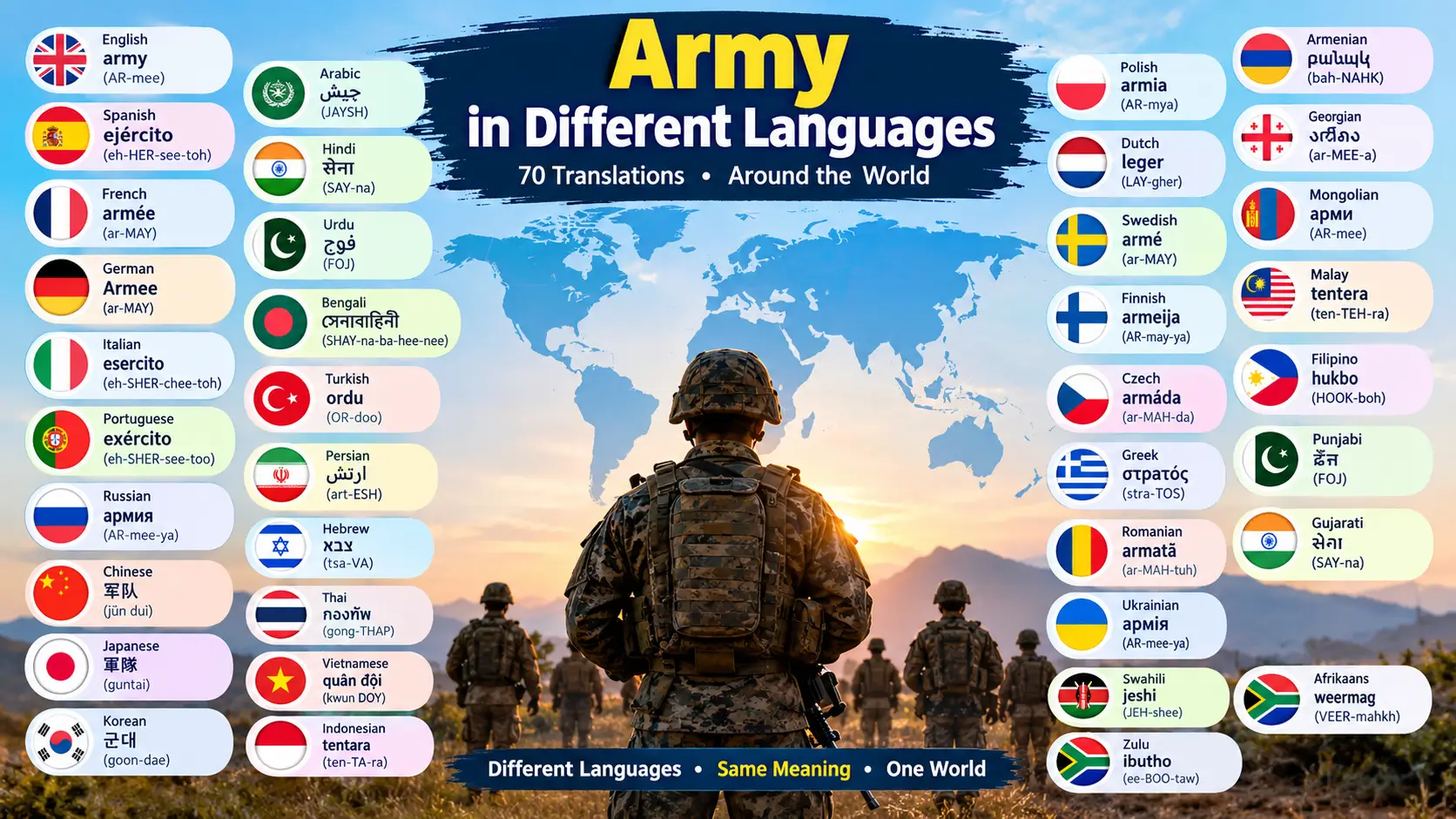
The table below provides 70 common translations of “army”. Where a language uses grammatical forms that change with context, the most natural general noun is provided.
| # | Language | Native phrase | Easy English pronunciation | Example sentence | English meaning |
|---|---|---|---|---|---|
| 1 | English | army | AR-mee | The army protects the country. | The military force protects the country. |
| 2 | Spanish | ejército | eh-HER-see-toh | El ejército protege al país. | The army protects the country. |
| 3 | French | armée | ar-MAY | L’armée protège le pays. | The army protects the country. |
| 4 | German | Armee | ar-MAY | Die Armee schützt das Land. | The army protects the country. |
| 5 | Italian | esercito | eh-SHER-chee-toh | L’esercito protegge il paese. | The army protects the country. |
| 6 | Portuguese | exército | eh-SHER-see-too | O exército protege o país. | The army protects the country. |
| 7 | Dutch | leger | LAY-gher | Het leger beschermt het land. | The army protects the country. |
| 8 | Swedish | armé | ar-MAY | Armén skyddar landet. | The army protects the country. |
| 9 | Norwegian | hær | hair | Hæren beskytter landet. | The army protects the country. |
| 10 | Danish | hær | hair | Hæren beskytter landet. | The army protects the country. |
| 11 | Finnish | armeija | AR-may-ya | Armeija suojelee maata. | The army protects the country. |
| 12 | Icelandic | her | hair | Herinn ver landið. | The army protects the country. |
| 13 | Irish | arm | arm | Cosnaíonn an t-arm an tír. | The army protects the country. |
| 14 | Welsh | byddin | BUTH-in | Mae’r fyddin yn amddiffyn y wlad. | The army protects the country. |
| 15 | Scottish Gaelic | arm | arm | Bidh an t-arm a’ dìon na dùthcha. | The army protects the country. |
| 16 | Polish | armia | AR-mya | Armia chroni kraj. | The army protects the country. |
| 17 | Czech | armáda | ar-MAH-da | Armáda chrání zemi. | The army protects the country. |
| 18 | Slovak | armáda | ar-MAH-da | Armáda chráni krajinu. | The army protects the country. |
| 19 | Slovenian | vojska | VOY-ska | Vojska ščiti državo. | The army protects the country. |
| 20 | Croatian | vojska | VOY-ska | Vojska štiti zemlju. | The army protects the country. |
| 21 | Serbian | војска | VOY-ska | Војска штити земљу. | The army protects the country. |
| 22 | Bosnian | vojska | VOY-ska | Vojska štiti zemlju. | The army protects the country. |
| 23 | Bulgarian | армия | AR-mee-ya | Армията защитава страната. | The army protects the country. |
| 24 | Macedonian | армија | AR-mee-ya | Армијата ја штити земјата. | The army protects the country. |
| 25 | Russian | армия | AR-mee-ya | Армия защищает страну. | The army protects the country. |
| 26 | Ukrainian | армія | AR-mee-ya | Армія захищає країну. | The army protects the country. |
| 27 | Belarusian | армія | AR-mee-ya | Армія абараняе краіну. | The army protects the country. |
| 28 | Lithuanian | kariuomenė | kar-yoo-oh-MEH-neh | Kariuomenė gina šalį. | The army defends the country. |
| 29 | Latvian | armija | AR-mee-ya | Armija aizsargā valsti. | The army protects the country. |
| 30 | Estonian | armee | AR-meh | Armee kaitseb riiki. | The army protects the country. |
| 31 | Romanian | armată | ar-MAH-tuh | Armata apără țara. | The army defends the country. |
| 32 | Hungarian | hadsereg | HOD-sheh-reg | A hadsereg védi az országot. | The army protects the country. |
| 33 | Albanian | ushtri | OOSH-tree | Ushtria mbron vendin. | The army protects the country. |
| 34 | Greek | στρατός | stra-TOS | Ο στρατός προστατεύει τη χώρα. | The army protects the country. |
| 35 | Turkish | ordu | OR-doo | Ordu ülkeyi korur. | The army protects the country. |
| 36 | Azerbaijani | ordu | OR-doo | Ordu ölkəni qoruyur. | The army protects the country. |
| 37 | Georgian | არმია | ar-MEE-a | არმია ქვეყანას იცავს. | The army protects the country. |
| 38 | Armenian | բանակ | bah-NAHK | Բանակը պաշտպանում է երկիրը։ | The army protects the country. |
| 39 | Persian | ارتش | art-ESH | ارتش از کشور محافظت میکند. | The army protects the country. |
| 40 | Arabic | جيش | JAYSH | الجيش يحمي البلاد. | The army protects the country. |
| 41 | Hebrew | צבא | tsa-VA | הצבא מגן על המדינה. | The army protects the country. |
| 42 | Hindi | सेना | SAY-na | सेना देश की रक्षा करती है। | The army protects the country. |
| 43 | Urdu | فوج | FOJ | فوج ملک کی حفاظت کرتی ہے۔ | The army protects the country. |
| 44 | Bengali | সেনাবাহিনী | SHAY-na-ba-hee-nee | সেনাবাহিনী দেশকে রক্ষা করে। | The army protects the country. |
| 45 | Punjabi | ਫੌਜ | FOJ | ਫੌਜ ਦੇਸ਼ ਦੀ ਰੱਖਿਆ ਕਰਦੀ ਹੈ। | The army protects the country. |
| 46 | Gujarati | સેના | SAY-na | સેના દેશનું રક્ષણ કરે છે. | The army protects the country. |
| 47 | Marathi | सैन्य | SAI-nya | सैन्य देशाचे रक्षण करते. | The army protects the country. |
| 48 | Nepali | सेना | SAY-na | सेनाले देशको रक्षा गर्छ। | The army protects the country. |
| 49 | Sinhala | හමුදාව | ha-moo-DA-wa | හමුදාව රට ආරක්ෂා කරයි. | The army protects the country. |
| 50 | Tamil | இராணுவம் | ee-RAA-noo-vam | இராணுவம் நாட்டைப் பாதுகாக்கிறது. | The army protects the country. |
| 51 | Telugu | సైన్యం | SAI-nyam | సైన్యం దేశాన్ని రక్షిస్తుంది. | The army protects the country. |
| 52 | Kannada | ಸೇನೆ | SAY-neh | ಸೇನೆ ದೇಶವನ್ನು ರಕ್ಷಿಸುತ್ತದೆ. | The army protects the country. |
| 53 | Malayalam | സൈന്യം | SAI-nyam | സൈന്യം രാജ്യത്തെ സംരക്ഷിക്കുന്നു. | The army protects the country. |
| 54 | Thai | กองทัพ | gong-THAP | กองทัพปกป้องประเทศ | The army protects the country. |
| 55 | Vietnamese | quân đội | kwun DOY | Quân đội bảo vệ đất nước. | The army protects the country. |
| 56 | Indonesian | tentara | ten-TA-ra | Tentara melindungi negara. | The army protects the country. |
| 57 | Malay | tentera | ten-TEH-ra | Tentera melindungi negara. | The army protects the country. |
| 58 | Filipino | hukbo | HOOK-boh | Pinoprotektahan ng hukbo ang bansa. | The army protects the country. |
| 59 | Chinese | 军队 | jūn duì | 军队保护国家。 | The army protects the country. |
| 60 | Japanese | 軍隊 | guntai | 軍隊が国を守ります。 | The army protects the country. |
| 61 | Korean | 군대 | goon-dae | 군대가 나라를 지킵니다. | The army protects the country. |
| 62 | Mongolian | арми | AR-mee | Арми улс орныг хамгаална. | The army protects the country. |
| 63 | Swahili | jeshi | JEH-shee | Jeshi linalinda nchi. | The army protects the country. |
| 64 | Amharic | ሠራዊት | seh-RAH-wit | ሠራዊቱ አገሪቱን ይጠብቃል። | The army protects the country. |
| 65 | Somali | ciidan | CHEE-dan | Ciidanku dalka wuu ilaaliyaa. | The army protects the country. |
| 66 | Hausa | sojoji | soh-JOH-jee | Sojoji suna kare ƙasa. | The soldiers protect the country. |
| 67 | Yoruba | ọmọ-ogun | aw-MAW-aw-goon | Ọmọ-ogun ń dáàbò bo orílẹ̀-èdè. | The army protects the country. |
| 68 | Zulu | ibutho | ee-BOO-taw | Ibutho livikela izwe. | The army protects the country. |
| 69 | Afrikaans | weermag | VEER-mahkh | Die weermag beskerm die land. | The army protects the country. |
| 70 | Malagasy | tafika | ta-FEE-ka | Miaro ny firenena ny tafika. | The army protects the country. |
How to Say Army in Different Languages
The translations above show that there is no single pattern for army in different languages. Some languages use a word closely related to the English term, while others use a completely different native expression.
For example, Spanish uses ejército, French uses armée, German uses Armee, and Italian uses esercito. In several Slavic languages, related forms such as armia, армия, and армія appear.
Asian languages also have their own distinct vocabulary. Hindi uses सेना, Urdu uses فوج, Chinese uses 军队, Japanese uses 軍隊, and Korean uses 군대.
Army Translations Around the World
The word “army” can describe a country’s organized land-based military force, but its exact meaning can depend on the language and context. Some translations may also be used more broadly for armed forces or military personnel.
For everyday language learning, it is helpful to study the word together with a sentence. This shows how the translation works naturally instead of treating it as an isolated vocabulary item.
Army Vocabulary for Language Learners
If you are learning military-related vocabulary, “army” is often connected with other useful words such as:
- soldier
- military
- officer
- defense
- country
- battlefield
- commander
- training
- base
- uniform
Learning these words together can make it easier to understand conversations, books, news reports, historical texts, and other material involving military subjects.
Why Learn the Word Army in Different Languages?
Learning army in all languages can be useful for several reasons. Students may encounter the term while studying history or international relations. Travelers and language learners may also see military vocabulary in newspapers, museums, documentaries, and public information.
For writers and translators, knowing the appropriate local word can also prevent awkward or overly literal translations.
Understanding Context Matters
A translation should always be considered in context. In some languages, a word may refer specifically to an army, while another expression may refer to the armed forces as a whole or to soldiers collectively.
This is why the example sentences in the table are important. They demonstrate how each term can function in a natural statement.
Frequently Asked Questions About Army Translations
1. How do you say “army” in different languages?
“Army” has different translations across languages. Examples include ejército in Spanish, armée in French, Armee in German, армия in Russian, सेना in Hindi, فوج in Urdu, 军队 in Chinese, and 軍隊 in Japanese.
2. What is the word for army in Spanish?
The Spanish word for army is ejército. It is commonly used to describe an organized military force.
3. How do you say army in Urdu?
In Urdu, army is فوج. It is pronounced approximately “foj” and is commonly used for the military or army depending on context.
4. What is army called in Hindi?
The Hindi word for army is सेना (senā). It is a common term for an organized military force.
5. What is army in Chinese and Japanese?
In Chinese, army can be expressed as 军队 (jūn duì). In Japanese, the word is 軍隊 (guntai). Both terms refer to an organized military force, although exact usage depends on context.
Conclusion
The word “army” has many different forms around the world, from ejército in Spanish and armée in French to सेना in Hindi, فوج in Urdu, 军队 in Chinese, and 軍隊 in Japanese. Exploring these 70 army translations is a useful way to expand vocabulary while learning how different languages describe military forces.
Whether you are searching for army in different languages, studying translations, or simply exploring words from around the world, learning each term with a practical example makes the vocabulary easier to understand and remember.

I am Scarlett Wilson, a passionate language writer who loves exploring different languages, words, meanings, translations, and useful phrases. I enjoy making language learning simple, clear, and interesting for everyone.