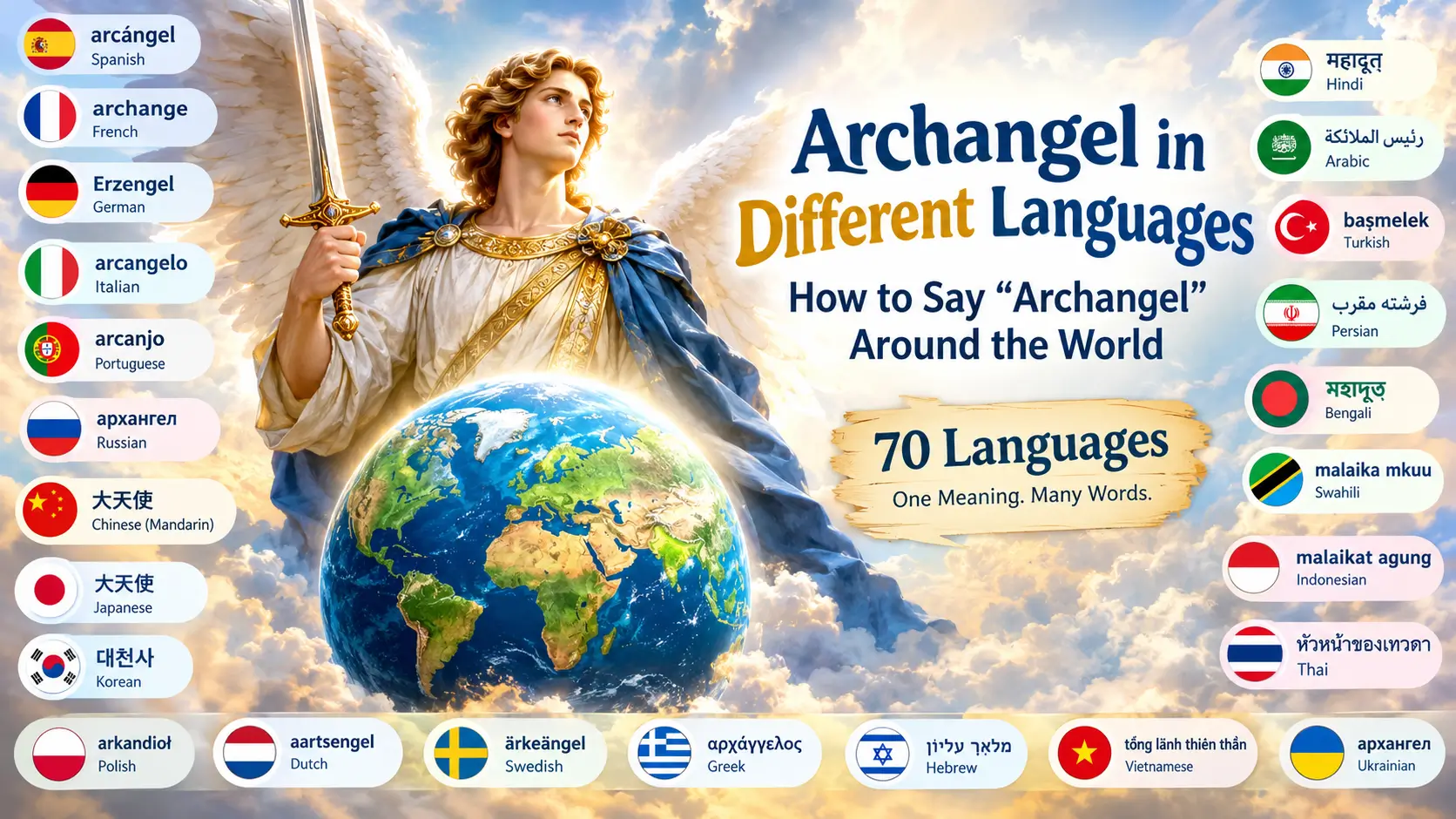
The word archangel refers to a high-ranking angel in many religious and spiritual traditions. Learning how to say archangel in different languages is useful for language learners, travelers, readers of religious texts, writers, and anyone interested in how spiritual vocabulary changes across cultures.
In some languages, the translation is a direct equivalent of “archangel,” while others use a phrase meaning “chief angel,” “great angel,” or “leader of the angels.” The table below gives archangel in all languages with the native expression, an easy English pronunciation, and a practical example.
Archangel in 70 Different Languages
| Language | Native phrase | Easy English pronunciation | Example sentence | English meaning |
|---|---|---|---|---|
| English | archangel | ar-kay-n-jel | The archangel appeared in the story. | The archangel appeared in the story. |
| Spanish | arcángel | ar-KAHN-hel | El arcángel apareció en la historia. | The archangel appeared in the story. |
| French | archange | ar-SHAHNZH | L’archange apparaît dans le récit. | The archangel appears in the story. |
| German | Erzengel | AIRTS-eng-el | Der Erzengel wird im Text erwähnt. | The archangel is mentioned in the text. |
| Italian | arcangelo | ar-KAN-jeh-lo | L’arcangelo appare nella storia. | The archangel appears in the story. |
| Portuguese | arcanjo | ar-KAHN-zhoo | O arcanjo aparece na história. | The archangel appears in the story. |
| Dutch | aartsengel | AARTS-eng-el | De aartsengel wordt in het verhaal genoemd. | The archangel is mentioned in the story. |
| Afrikaans | aartsengel | AARTS-eng-el | Die aartsengel verskyn in die verhaal. | The archangel appears in the story. |
| Swedish | ärkeängel | AIR-keh-eng-el | Ärkeängeln nämns i berättelsen. | The archangel is mentioned in the story. |
| Danish | ærkeengel | AIR-keh-eng-el | Ærkeenglen nævnes i fortællingen. | The archangel is mentioned in the story. |
| Norwegian | erkeengel | AIR-keh-eng-el | Erkeengelen nevnes i fortellingen. | The archangel is mentioned in the story. |
| Icelandic | erkiengill | AIR-kyeh-ing-itl | Erkiengillinn kemur fyrir í sögunni. | The archangel appears in the story. |
| Finnish | arkkienkeli | ARK-kee-en-keh-lee | Arkkienkeli mainitaan tekstissä. | The archangel is mentioned in the text. |
| Estonian | peaingel | PAY-ah-ing-el | Peaingel on loos tähtis tegelane. | The archangel is an important character in the story. |
| Latvian | erceņģelis | AIR-tseng-yel-is | Erceņģelis parādās stāstā. | The archangel appears in the story. |
| Lithuanian | arkangelas | ar-kan-GEH-las | Arkangelas minimas tekste. | The archangel is mentioned in the text. |
| Polish | archanioł | ar-KHA-nyow | Archanioł pojawia się w opowieści. | The archangel appears in the story. |
| Czech | archanděl | ar-KHAN-dyel | Archanděl je zmíněn v příběhu. | The archangel is mentioned in the story. |
| Slovak | archanjel | ar-KHAN-yel | Archanjel sa objavuje v príbehu. | The archangel appears in the story. |
| Slovenian | nadangel | nah-DAHN-gel | Nadangel je omenjen v zgodbi. | The archangel is mentioned in the story. |
| Croatian | arkanđeo | ar-kan-DJEH-oh | Arkanđeo se pojavljuje u priči. | The archangel appears in the story. |
| Serbian | arhanđeo | ar-han-DJEH-oh | Arhanđeo se pominje u priči. | The archangel is mentioned in the story. |
| Bosnian | arhanđeo | ar-han-DJEH-oh | Arhanđeo se spominje u priči. | The archangel is mentioned in the story. |
| Bulgarian | архангел | ar-KHAN-gel | Архангелът се споменава в историята. | The archangel is mentioned in the story. |
| Macedonian | архангел | ar-KHAN-gel | Архангелот се појавува во приказната. | The archangel appears in the story. |
| Russian | архангел | ar-KHAN-gel | Архангел появляется в рассказе. | The archangel appears in the story. |
| Ukrainian | архангел | ar-KHAN-hel | Архангел згадується в оповіданні. | The archangel is mentioned in the story. |
| Belarusian | архангел | ar-KHAN-gel | Архангел згадваецца ў гісторыі. | The archangel is mentioned in the story. |
| Romanian | arhanghel | ar-HAN-ghel | Arhanghelul apare în poveste. | The archangel appears in the story. |
| Hungarian | arkangyal | ar-KAHN-dyal | Az arkangyal megjelenik a történetben. | The archangel appears in the story. |
| Greek | αρχάγγελος | ar-KHAN-ge-los | Ο αρχάγγελος εμφανίζεται στην ιστορία. | The archangel appears in the story. |
| Albanian | kryeengjëll | kree-ENG-yel | Kryeengjëlli përmendet në tregim. | The archangel is mentioned in the story. |
| Armenian | հրեշտակապետ | hrehsh-ta-ka-PET | Հրեշտակապետը հիշատակվում է պատմության մեջ։ | The archangel is mentioned in the story. |
| Georgian | მთავარანგელოზი | mtav-ar-an-ge-LO-zi | მთავარანგელოზი მოთხრობაში ჩნდება. | The archangel appears in the story. |
| Turkish | başmelek | bash-meh-LEK | Başmelek hikâyede görünür. | The archangel appears in the story. |
| Azerbaijani | baş mələk | bash meh-LEK | Baş mələk hekayədə görünür. | The archangel appears in the story. |
| Kazakh | бас періште | bas peh-RISH-teh | Бас періште әңгімеде аталады. | The archangel is mentioned in the story. |
| Uzbek | bosh farishta | bosh fa-RISH-ta | Bosh farishta hikoyada tilga olinadi. | The archangel is mentioned in the story. |
| Kyrgyz | башкы периште | bash-KUH peh-RISH-teh | Башкы периште баянда айтылат. | The archangel is mentioned in the story. |
| Tajik | фариштаи арш | fa-rish-TA-ye arsh | Фариштаи арш дар ҳикоя ёд мешавад. | The archangel is mentioned in the story. |
| Persian | فرشته مقرب | feh-RESH-teh moh-QAR-reb | فرشته مقرب در داستان ظاهر میشود. | The archangel appears in the story. |
| Arabic | رئيس الملائكة | ra-EES al-ma-LA-ee-kah | رئيس الملائكة يظهر في القصة. | The archangel appears in the story. |
| Hebrew | מַלְאָךְ עֶלְיוֹן | mal-AKH el-YON | המלאך העליון מופיע בסיפור. | The archangel appears in the story. |
| Hindi | महादूत | ma-haa-DOOT | महादूत कहानी में दिखाई देता है। | The archangel appears in the story. |
| Urdu | مقرب فرشتہ | mu-QAR-rab far-ISH-ta | مقرب فرشتہ کہانی میں ظاہر ہوتا ہے۔ | The archangel appears in the story. |
| Bengali | মহাদূত | mo-ha-DOOT | মহাদূত গল্পে দেখা যায়। | The archangel appears in the story. |
| Punjabi | ਮਹਾਦੂਤ | ma-haa-DOOT | ਮਹਾਦੂਤ ਕਹਾਣੀ ਵਿੱਚ ਦਿਖਾਈ ਦਿੰਦਾ ਹੈ। | The archangel appears in the story. |
| Gujarati | મહાદૂત | ma-haa-DOOT | મહાદૂત વાર્તામાં દેખાય છે. | The archangel appears in the story. |
| Marathi | महादूत | ma-haa-DOOT | महादूत कथेत दिसतो. | The archangel appears in the story. |
| Nepali | प्रधान देवदूत | pra-DHAAN de-va-DOOT | प्रधान देवदूत कथामा देखिन्छ। | The archangel appears in the story. |
| Sinhala | අග්රදූතයා | ag-ra-DOO-ta-ya | අග්රදූතයා කතාවේ සඳහන් වේ. | The archangel is mentioned in the story. |
| Tamil | பிரதான தூதர் | pi-ra-DHA-na THOO-thar | பிரதான தூதர் கதையில் தோன்றுகிறார். | The archangel appears in the story. |
| Telugu | ప్రధాన దేవదూత | pra-DHA-na de-va-DOO-ta | ప్రధాన దేవదూత కథలో కనిపిస్తాడు. | The archangel appears in the story. |
| Kannada | ಪ್ರಧಾನ ದೇವದೂತ | pra-DHA-na de-va-DOO-ta | ಪ್ರಧಾನ ದೇವದೂತ ಕಥೆಯಲ್ಲಿ ಕಾಣಿಸಿಕೊಳ್ಳುತ್ತಾನೆ. | The archangel appears in the story. |
| Malayalam | പ്രധാന ദൂതൻ | pra-DHA-na DOO-than | പ്രധാന ദൂതൻ കഥയിൽ പ്രത്യക്ഷപ്പെടുന്നു. | The archangel appears in the story. |
| Indonesian | malaikat agung | ma-LAI-kat a-GOONG | Malaikat agung muncul dalam cerita. | The archangel appears in the story. |
| Malay | penghulu malaikat | peng-HOO-loo ma-LAI-kat | Penghulu malaikat disebut dalam cerita. | The archangel is mentioned in the story. |
| Filipino | arkanghel | ar-KANG-hel | Lumitaw ang arkanghel sa kuwento. | The archangel appeared in the story. |
| Vietnamese | tổng lãnh thiên thần | tong lanh tee-en than | Tổng lãnh thiên thần xuất hiện trong câu chuyện. | The archangel appears in the story. |
| Thai | หัวหน้าของเทวดา | hua-na khong the-wa-daa | หัวหน้าของเทวดาปรากฏในเรื่อง | The chief of the angels appears in the story. |
| Chinese (Mandarin) | 大天使 | dà tiānshǐ | 大天使出现在故事中。 | The archangel appears in the story. |
| Japanese | 大天使 | daitenshi | 大天使が物語に登場します。 | The archangel appears in the story. |
| Korean | 대천사 | dae-cheon-sa | 대천사가 이야기에서 등장합니다. | The archangel appears in the story. |
| Swahili | malaika mkuu | ma-LAI-ka M-KOO | Malaika mkuu anaonekana katika hadithi. | The archangel appears in the story. |
| Amharic | የመላእክት አለቃ | ye-me-la-ekt a-le-ka | የመላእክት አለቃ በታሪኩ ይጠቀሳል። | The archangel is mentioned in the story. |
| Hausa | shugaban mala’iku | shoo-BAHN ma-LAI-koo | Shugaban mala’iku ya bayyana a labarin. | The archangel appears in the story. |
| Yoruba | olórí àwọn áńgẹ́lì | oh-LAW-ree ah-WON an-GEH-lee | Olórí àwọn áńgẹ́lì farahan ninu itan. | The archangel appears in the story. |
| Somali | malaa’igta sare | ma-LAA-ig-ta SA-reh | Malaa’igta sare waxay ka muuqataa sheekada. | The archangel appears in the story. |
| Zulu | ingelosi enkulu | in-geh-LO-see en-KOO-loo | Ingelosi enkulu ivela endabeni. | The archangel appears in the story. |
| Irish | ard-aingeal | ard-ANG-el | Tá an t-ard-aingeal sa scéal. | The archangel is in the story. |
What Does “Archangel” Mean?
An archangel is generally understood as an angel of especially high rank or authority. The exact meaning can vary depending on the religious tradition, translation, and historical context in which the word is used.
The English word combines the idea of an angel with a prefix indicating high rank or leadership. This explains why many languages use forms that resemble the Greek-derived word, while others use expressions such as “great angel” or “chief of the angels.”
When searching for archangel translations, it is important to remember that a dictionary equivalent may not always carry exactly the same cultural or theological associations.
How to Say Archangel in Different Languages
The table shows several common patterns. European languages often use words closely related to the traditional Greek-derived form. For example, Spanish uses arcángel, Italian uses arcangelo, French uses archange, and German uses Erzengel.
Asian and Middle Eastern languages can express the concept differently. Mandarin uses 大天使, literally conveying the idea of a “great angel,” while Japanese uses 大天使 and Korean uses 대천사.
Other languages use descriptive expressions. Arabic, Persian, Urdu, and several Central and South Asian languages may use phrases that emphasize a high-ranking or specially appointed angel.
Archangel in All Languages: Understanding the Variations
There is not always one universal translation for religious vocabulary. A word can have a direct dictionary equivalent, a traditional religious equivalent, or a descriptive expression.
For example, “archangel” may be translated as:
- A direct borrowed or historically related term
- A word meaning “great angel”
- A phrase meaning “chief of the angels”
- A phrase describing a high-ranking angel
- A traditional theological expression
This is why comparing archangel in different languages can reveal more than simple vocabulary differences. It can also show how religious concepts developed within different linguistic traditions.
Archangel Translations in European Languages
European languages provide many closely related forms. Romance languages such as Spanish, French, Italian, Portuguese, and Romanian have forms that developed through Latin and Greek religious vocabulary.
Germanic languages often use compounds. German Erzengel, Dutch aartsengel, Swedish ärkeängel, Danish ærkeengel, Norwegian erkeengel, and Afrikaans aartsengel demonstrate this pattern.
Slavic languages also show strong similarities. Russian, Ukrainian, Belarusian, Bulgarian, and Macedonian use forms based on the same historical religious vocabulary, while Polish, Czech, Slovak, Croatian, Serbian, and Slovenian have their own related forms.
Archangel in Asian Languages
Asian languages often provide especially interesting examples of how religious terminology is adapted.
Mandarin Chinese uses 大天使, while Japanese uses 大天使 as well. Korean uses 대천사. These expressions communicate the idea of an especially high-ranking angel.
In South Asian languages, forms such as Hindi महादूत, Bengali মহাদূত, Punjabi ਮਹਾਦੂਤ, Gujarati મહાદૂત, and Marathi महादूत use vocabulary associated with a great or high-ranking messenger.
Indonesian commonly uses malaikat agung, while Malay uses penghulu malaikat, emphasizing the leadership or high status associated with the concept.
Archangel Around the World
The concept of an archangel appears in many cultures and religious traditions, but the vocabulary is not identical everywhere. Some languages preserve older theological terminology, while others create a phrase that explains the concept more directly.
This makes archangel around the world an interesting example of how translation is influenced by religion, history, culture, and everyday language.
For language learners, memorizing the phrase together with a short example sentence is often more useful than memorizing a translation alone.
Tips for Using “Archangel” in Another Language
When using an archangel translation in conversation or writing, consider the context first.
1. Religious context:
Use the established theological term when discussing scripture, worship, religious history, or theology.
2. General writing:
A standard dictionary translation is usually appropriate for articles, stories, and educational material.
3. Names of specific archangels:
If you are referring to a figure such as Michael or Gabriel, keep the person’s name consistent with the conventions of the target language.
4. Formal translation:
Check whether the target language normally uses a single word or a descriptive phrase.
5. Pronunciation:
Written pronunciation guides are useful for beginners, but pronunciation can vary by region and accent.
Why Learn “Archangel” in Different Languages?
Learning this word across languages can help with religious studies, multilingual reading, creative writing, translation, cultural research, and language learning.
It also provides a useful example of how one English word can have many linguistic forms while retaining a related central meaning.
If you are studying vocabulary systematically, learning the native phrase, pronunciation, and an example sentence together makes it easier to remember and use naturally.
Frequently Asked Questions
1. How do you say “archangel” in Spanish?
In Spanish, “archangel” is arcángel. It is pronounced approximately “ar-KAHN-hel.”
2. What is “archangel” in French?
The French word for “archangel” is archange. It is commonly pronounced approximately “ar-SHAHNZH.”
3. What is the Chinese word for archangel?
In Mandarin Chinese, “archangel” is 大天使 (dà tiānshǐ). The expression conveys the idea of a great or high-ranking angel.
4. How do you say “archangel” in Japanese?
In Japanese, “archangel” is 大天使 (daitenshi). It is commonly used for the concept of a high-ranking angel.
5. Is “archangel” translated the same way in every language?
No. Some languages use a direct equivalent, while others use expressions meaning “great angel,” “chief of the angels,” or another description of a high-ranking angel. Religious and cultural context can also influence the preferred translation.
Conclusion
Learning archangel in different languages is a simple way to explore vocabulary, religion, and cultural differences at the same time. From Spanish arcángel and German Erzengel to Mandarin 大天使, Japanese 大天使, Hindi महादूत, and Swahili malaika mkuu, the translations show how languages express the same broad concept in different ways.
Whether you are searching for archangel in all languages, studying archangel translations, or learning how to say archangel in different languages, this collection provides useful native forms, pronunciation guides, and practical examples for learners around the world.

I’m Jesse Crawford, a language enthusiast and writer passionate about exploring different languages. I create helpful content that makes words, meanings, translations, and language learning simple, useful, and enjoyable for everyone.