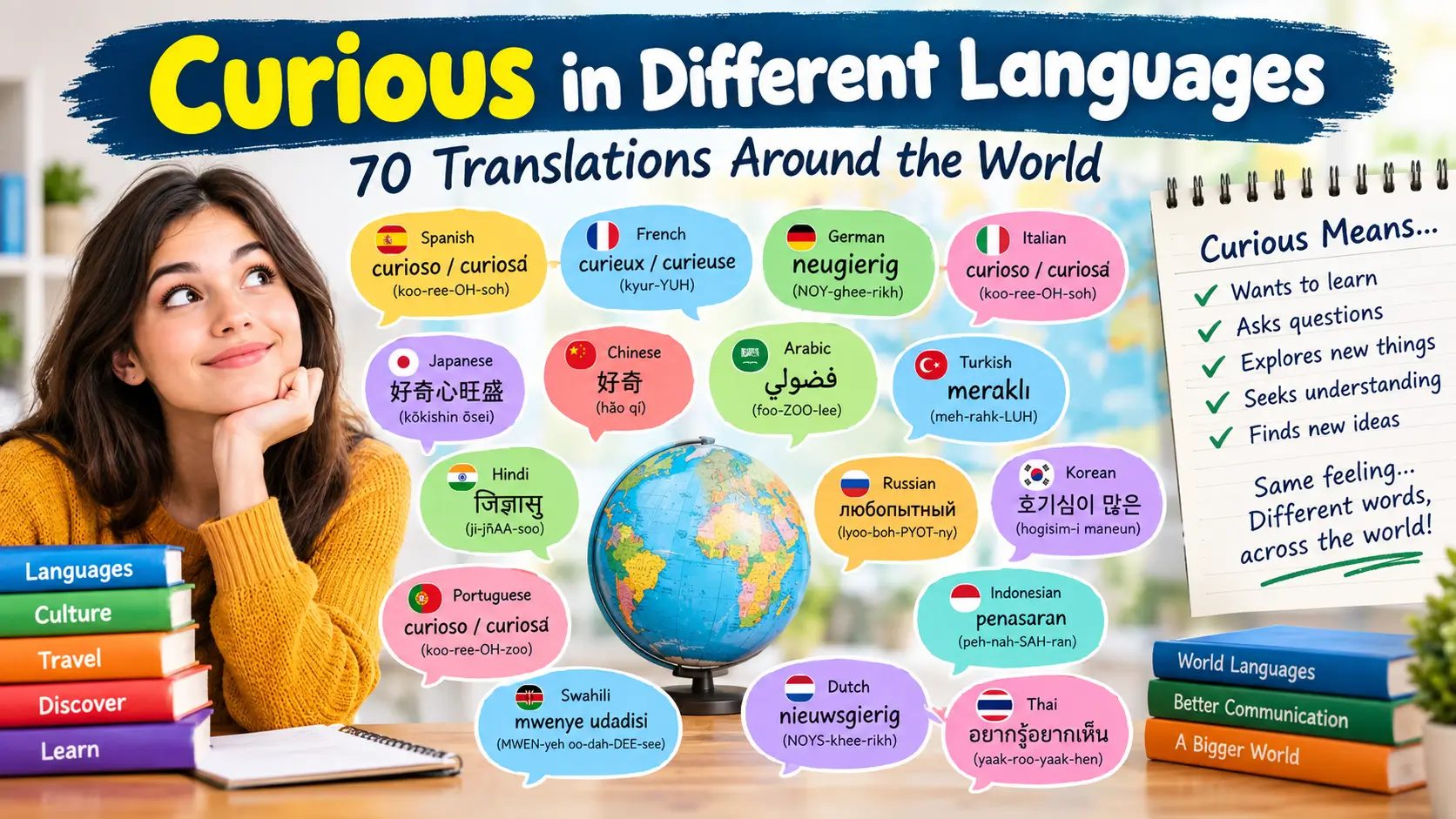
Learning how to say curious in different languages is a useful way to explore how people express interest, wonder, and a desire to learn. The word “curious” can describe someone who wants to know more, investigate something, or discover something new.
Below, you will find curious translations in 70 languages, including the native phrase, an easy English pronunciation, and a short real-life example. This guide makes it simple to understand how to say curious in different languages and how the word is naturally used around the world.
Curious in Different Languages
The exact form of “curious” can change depending on the gender, number, or grammatical structure of a language. The table uses a common, natural form wherever possible.
| # | Language | Native phrase | Easy English pronunciation | Example sentence | English meaning |
|---|---|---|---|---|---|
| 1 | Spanish | curioso / curiosa | koo-ree-OH-soh / koo-ree-OH-sah | Soy curioso por naturaleza. | I am naturally curious. |
| 2 | French | curieux / curieuse | kyur-YUH / kyur-YUHZ | Je suis curieux de savoir. | I am curious to know. |
| 3 | German | neugierig | NOY-ghee-rikh | Ich bin neugierig. | I am curious. |
| 4 | Italian | curioso / curiosa | koo-ree-OH-soh / koo-ree-OH-zah | Sono curioso di sapere. | I am curious to know. |
| 5 | Portuguese | curioso / curiosa | koo-ree-OH-zoo / koo-ree-OH-zah | Estou curioso para saber. | I am curious to know. |
| 6 | Dutch | nieuwsgierig | NOYS-khee-rikh | Ik ben nieuwsgierig. | I am curious. |
| 7 | Swedish | nyfiken | NYOO-feh-ken | Jag är nyfiken. | I am curious. |
| 8 | Norwegian | nysgjerrig | NYSH-yer-rig | Jeg er nysgjerrig. | I am curious. |
| 9 | Danish | nysgerrig | NYSH-ger-rig | Jeg er nysgerrig. | I am curious. |
| 10 | Finnish | utelias | OO-teh-lee-as | Olen utelias. | I am curious. |
| 11 | Icelandic | forvitinn | FOR-vee-tin | Ég er forvitinn. | I am curious. |
| 12 | Irish | fiosrach | FEE-sor-akh | Tá mé fiosrach. | I am curious. |
| 13 | Welsh | chwilfrydig | khwil-VRUD-ig | Rwy’n chwilfrydig. | I am curious. |
| 14 | Scottish Gaelic | fiosrach | FEE-uhs-rakh | Tha mi fiosrach. | I am curious. |
| 15 | Polish | ciekawy / ciekawa | chyeh-KAH-vih / chyeh-KAH-vah | Jestem ciekawy. | I am curious. |
| 16 | Czech | zvědavý / zvědavá | ZVYEH-dah-vee / ZVYEH-dah-vah | Jsem zvědavý. | I am curious. |
| 17 | Slovak | zvedavý / zvedavá | ZVEH-dah-vee / ZVEH-dah-vah | Som zvedavý. | I am curious. |
| 18 | Slovenian | radoveden / radovedna | rah-doh-VEH-den / rah-doh-VEHD-nah | Sem radoveden. | I am curious. |
| 19 | Croatian | znatiželjan / znatiželjna | znah-tee-ZHEL-yan / znah-tee-ZHEL-nyah | Ja sam znatiželjan. | I am curious. |
| 20 | Serbian | радознао / радознала | rahd-ohz-NAH-oh / rahd-ohz-NAH-lah | Ја сам радознао. | I am curious. |
| 21 | Bulgarian | любопитен / любопитна | lyoo-boh-PEE-ten / lyoo-boh-PEET-nah | Аз съм любопитен. | I am curious. |
| 22 | Macedonian | љубопитен / љубопитна | lyoo-BOH-pee-ten / lyoo-BOH-pee-tnah | Јас сум љубопитен. | I am curious. |
| 23 | Russian | любопытный / любопытная | lyoo-boh-PYOT-ny | Я любопытный. | I am curious. |
| 24 | Ukrainian | допитливий / допитлива | doh-pyt-LYH-vyi / doh-pyt-LYH-vah | Я допитливий. | I am curious. |
| 25 | Belarusian | цікаўны / цікавая | tsee-KOW-nee / tsee-KAH-vah-yah | Я цікаўны. | I am curious. |
| 26 | Lithuanian | smalsus / smalsi | SMAHL-soos / SMAHL-see | Esu smalsus. | I am curious. |
| 27 | Latvian | ziņkārīgs / ziņkārīga | zeeng-KAHR-igs / zeeng-KAHR-ee-gah | Es esmu ziņkārīgs. | I am curious. |
| 28 | Estonian | uudishimulik | OO-dee-shee-moo-lik | Ma olen uudishimulik. | I am curious. |
| 29 | Hungarian | kíváncsi | KEE-vahn-chee | Kíváncsi vagyok. | I am curious. |
| 30 | Romanian | curios / curioasă | koo-ree-OS / koo-ree-oh-AH-suh | Sunt curios. | I am curious. |
| 31 | Albanian | kurioz / kurioze | koo-ree-OZ / koo-ree-OH-zeh | Jam kurioz. | I am curious. |
| 32 | Greek | περίεργος / περίεργη | peh-REE-er-ghos / peh-REE-er-ghee | Είμαι περίεργος. | I am curious. |
| 33 | Turkish | meraklı | meh-rahk-LUH | Meraklıyım. | I am curious. |
| 34 | Maltese | kurjuż / kurjuża | koor-YOOZ / koor-YOO-zah | Jien kurjuż. | I am curious. |
| 35 | Arabic | فضولي / فضولية | foo-ZOO-lee / foo-ZOO-lee-yah | أنا فضولي. | I am curious. |
| 36 | Hebrew | סקרן / סקרנית | sak-RAN / sak-RA-neet | אני סקרן. | I am curious. |
| 37 | Persian | کنجکاو | konj-kah-VOH | من کنجکاوم. | I am curious. |
| 38 | Urdu | متجسس | muta-JASS-is | میں متجسس ہوں۔ | I am curious. |
| 39 | Hindi | जिज्ञासु | ji-jñAA-soo | मैं जिज्ञासु हूँ। | I am curious. |
| 40 | Bengali | কৌতূহলী | kow-too-HO-lee | আমি কৌতূহলী। | I am curious. |
| 41 | Punjabi | ਉਤਸੁਕ | ut-SOOK | ਮੈਂ ਉਤਸੁਕ ਹਾਂ। | I am curious. |
| 42 | Gujarati | જિજ્ઞાસુ | jij-NYAA-soo | હું જિજ્ઞાસુ છું. | I am curious. |
| 43 | Marathi | जिज्ञासू | jij-NYAA-soo | मी जिज्ञासू आहे. | I am curious. |
| 44 | Nepali | जिज्ञासु | jij-NYAA-soo | म जिज्ञासु छु। | I am curious. |
| 45 | Tamil | ஆர்வமுள்ள | aar-va-mul-la | நான் ஆர்வமுள்ளவன். | I am curious. |
| 46 | Telugu | ఆసక్తిగల | aas-ak-ti-ga-la | నేను ఆసక్తిగలవాడిని. | I am curious. |
| 47 | Kannada | ಕುತೂಹಲವುಳ್ಳ | koo-too-ha-la-vul-la | ನಾನು ಕುತೂಹಲವುಳ್ಳವನು. | I am curious. |
| 48 | Malayalam | കൗതുകമുള്ള | kow-thoo-ka-mul-la | ഞാൻ കൗതുകമുള്ളവനാണ്. | I am curious. |
| 49 | Sinhala | කුතුහලයෙන් යුතු | koo-too-ha-lay-en yoo-too | මම කුතුහලයෙන් යුතුයි. | I am curious. |
| 50 | Chinese (Mandarin) | 好奇 | hǎo qí | 我很好奇。 | I am very curious. |
| 51 | Japanese | 好奇心旺盛 | kōkishin ōsei | 私は好奇心旺盛です。 | I am very curious. |
| 52 | Korean | 호기심이 많은 | hogisim-i maneun | 저는 호기심이 많아요. | I am very curious. |
| 53 | Vietnamese | tò mò | toh moh | Tôi rất tò mò. | I am very curious. |
| 54 | Thai | อยากรู้อยากเห็น | yaak-roo-yaak-hen | ฉันอยากรู้อยากเห็น | I am curious. |
| 55 | Indonesian | penasaran | peh-nah-SAH-ran | Saya penasaran. | I am curious. |
| 56 | Malay | ingin tahu | IN-gin TAH-hoo | Saya ingin tahu. | I am curious. |
| 57 | Filipino | mausisa | ma-oo-SEE-sa | Mausisa ako. | I am curious. |
| 58 | Burmese | စူးစမ်းလိုသော | soo-zan-lo-daw | ကျွန်တော် စူးစမ်းလိုပါတယ်။ | I am curious. |
| 59 | Khmer | ចង់ដឹង | chong-dung | ខ្ញុំចង់ដឹង។ | I am curious. |
| 60 | Mongolian | сониуч | soh-nee-OOTCH | Би сониуч байна. | I am curious. |
| 61 | Georgian | ცნობისმოყვარე | tsno-bis-moq-va-reh | მე ცნობისმოყვარე ვარ. | I am curious. |
| 62 | Armenian | հետաքրքրասեր | het-ah-kree-rah-SER | Ես հետաքրքրասեր եմ։ | I am curious. |
| 63 | Azerbaijani | maraqlı | mah-RAHK-luh | Mən maraqlıyam. | I am curious. |
| 64 | Kazakh | қызыққұмар | kuh-zuk-KOO-mar | Мен қызыққұмармын. | I am curious. |
| 65 | Uzbek | qiziquvchan | kee-zee-koov-CHAN | Men qiziquvchanman. | I am curious. |
| 66 | Swahili | mwenye udadisi | MWEN-yeh oo-dah-DEE-see | Nina udadisi. | I am curious. |
| 67 | Afrikaans | nuuskierig | NOOS-kee-rikh | Ek is nuuskierig. | I am curious. |
| 68 | Zulu | onelukuluku | oh-neh-loo-koo-LOO-koo | Nginelukuluku. | I am curious. |
| 69 | Xhosa | nomdla | nom-DLAH | Ndinomdla. | I am curious. |
| 70 | Esperanto | scivolema | stsee-voh-LEH-mah | Mi estas scivolema. | I am curious. |
What Does “Curious” Mean?
The English word curious usually describes someone who wants to learn, discover, or understand something. For example, if someone asks many questions about a new subject, you can describe that person as curious.
It can also describe a strong interest in discovering information:
- I am curious about the new project.
- She is curious to know what happened.
- The curious child asked many questions.
In some contexts, “curious” can also mean unusual or strange, although the meaning related to wanting to know more is the most common in everyday conversation.
How to Say Curious in Different Languages
When learning how to say curious in different languages, it is important to remember that a direct translation does not always work exactly like the English adjective.
Some languages change the word according to gender. Others use a phrase that literally expresses “wanting to know” or “having curiosity.” This is why the examples above are useful alongside the individual translations.
For language learners, learning the phrase together with a sentence is often more practical than memorizing an isolated word.
Curious in All Languages: Common Usage
The idea of curiosity exists in everyday conversations around the world. You might use the word when talking about a person, a new place, an interesting story, a surprise, or something you do not understand.
For example:
- Are you curious about the answer?
- He is curious about other cultures.
- My daughter is curious about animals.
- I was curious to see what happened next.
These patterns can help you understand curious translations and use them more naturally.
Curious Around the World
The concept of being curious is expressed in many different ways. European languages often have adjective forms that directly describe a curious person, while some Asian and other languages may use expressions connected with wanting to know, interest, or curiosity.
This makes curious around the world an interesting language-learning topic. The table gives you a practical starting point for comparing these expressions across 70 languages.
Why Learn “Curious” in Different Languages?
Learning one useful adjective in several languages can improve vocabulary and make cultural communication easier.
Knowing curious in different languages can be especially helpful for:
- Travelers communicating with local people
- Students learning foreign languages
- Language teachers preparing vocabulary lessons
- Writers creating multilingual content
- People interested in world languages and cultures
- Anyone practicing everyday conversation
A single word can also reveal interesting differences in how languages describe emotions, personality traits, and human behavior.
Tips for Learning Curious Translations
Start with a few languages instead of trying to memorize all 70 at once. Choose languages that you are studying, planning to travel to, or frequently encounter.
Next, practice each word in a complete sentence. For example, learn the equivalent of “I am curious” rather than memorizing only the isolated adjective.
It is also useful to listen to native speakers because pronunciation, stress, and rhythm can differ considerably between languages.
Frequently Asked Questions
1. How do you say “curious” in different languages?
“Curious” has different translations depending on the language. Examples include curioso in Spanish and Italian, curieux in French, neugierig in German, meraklı in Turkish, 好奇 in Mandarin Chinese, and 호기심이 많은 in Korean.
2. What is the most common translation of curious?
There is no single universal translation because every language has its own grammar and vocabulary. Many languages have a direct adjective, while others commonly use a phrase expressing curiosity or a desire to know something.
3. How do you say “I am curious” in another language?
The translation depends on the language. For example, Spanish uses Soy curioso or Soy curiosa, French uses Je suis curieux or Je suis curieuse, and German uses Ich bin neugierig.
4. Is “curious” the same as “interested”?
They are related but not always identical. Interested usually means that you care about or enjoy a subject, while curious often emphasizes a desire to discover or learn more about something.
5. Why does the translation of “curious” change between languages?
Languages have different grammar systems. Some distinguish masculine and feminine forms, while others use different constructions depending on context. The natural translation can therefore be different from a simple word-for-word translation.
Conclusion
Learning curious in different languages is a simple way to expand your vocabulary while discovering how different cultures and languages express the idea of wanting to know more. With 70 translations, pronunciations, and practical examples, you can compare curious in all languages and find useful expressions for study, travel, and everyday conversation.
Whether you are searching for how to say curious in different languages, exploring curious translations, or learning about curious around the world, these examples provide a practical multilingual reference.

I’m Jesse Crawford, a language enthusiast and writer passionate about exploring different languages. I create helpful content that makes words, meanings, translations, and language learning simple, useful, and enjoyable for everyone.