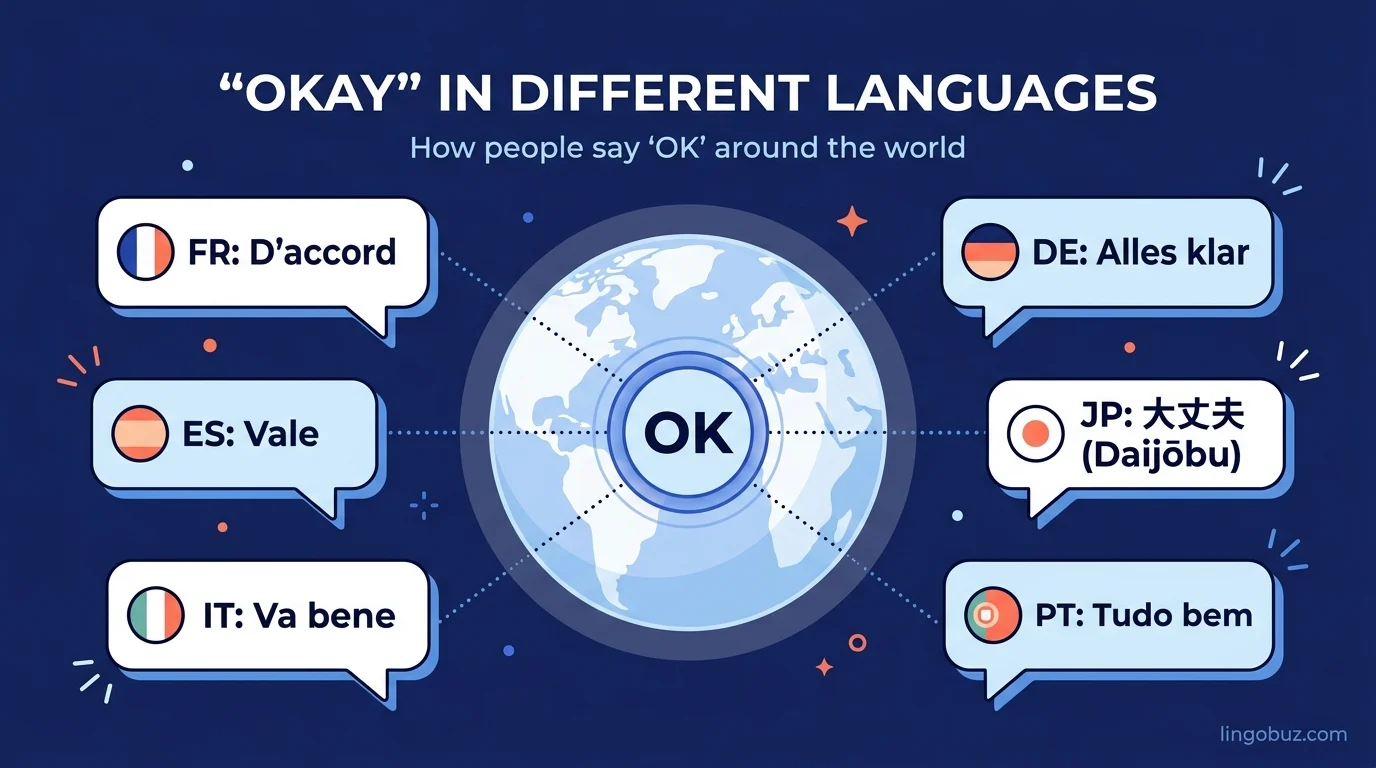
The word “okay” is used every day to show agreement, understanding, acceptance, or that something is fine. However, the way people say okay in different languages varies depending on the language, culture, and situation. Some languages use a direct equivalent, while others prefer expressions that mean “all right,” “fine,” or “I understand.”
In this guide, you will discover 70 ways to say okay around the world, complete with native phrases, easy English pronunciations, practical example sentences, and their English meanings. Whether you are learning a new language, traveling abroad, or chatting with international friends, these translations will help you communicate more naturally.
How Do You Say Okay in Different Languages?
The word “okay” has different translations around the world. For example, Spanish speakers commonly say “Está bien,” French speakers use “D’accord,” and German speakers often say “In Ordnung.” In some languages, people also use the internationally recognized word “OK.”
Here are eight quick examples to help you get started.
| Language | Native Phrase | Easy Pronunciation | Example Sentence | English Meaning |
|---|---|---|---|---|
| Spanish | Está bien | es-TAH byen | Está bien, vamos. | Okay, let’s go. |
| French | D’accord | dah-KOR | D’accord, je viens. | Okay, I’m coming. |
| German | In Ordnung | in OR-doong | In Ordnung, ich helfe dir. | Okay, I’ll help you. |
| Italian | Va bene | vah BEH-neh | Va bene, grazie. | Okay, thank you. |
| Portuguese | Tudo bem | TOO-doo beng | Tudo bem, podemos começar. | Okay, we can start. |
| Japanese | いいよ | ee-yoh | いいよ、行こう。 | Okay, let’s go. |
| Korean | 좋아요 | joh-ah-yoh | 좋아요, 시작해요. | Okay, let’s begin. |
| Arabic | حسنًا | HAS-an | حسنًا، سأذهب الآن. | Okay, I’ll go now. |
These expressions are useful starting points, but some have additional meanings depending on context. The following tables explore 70 languages in more detail.
1. South Asian Languages
South Asian languages have several common expressions for agreement and acceptance. The best choice depends on the language and whether the conversation is formal or informal.
| Language | Native Phrase | Easy Pronunciation | Example Sentence | English Meaning |
|---|---|---|---|---|
| Urdu | ٹھیک ہے | theek hai | ٹھیک ہے، میں آ رہا ہوں۔ | Okay, I am coming. |
| Hindi | ठीक है | theek hai | ठीक है, मैं आ रहा हूँ। | Okay, I am coming. |
| Bengali | ঠিক আছে | thik achhe | ঠিক আছে, আমি আসছি। | Okay, I am coming. |
| Punjabi | ਠੀਕ ਹੈ | theek hai | ਠੀਕ ਹੈ, ਮੈਂ ਆ ਰਿਹਾ ਹਾਂ। | Okay, I am coming. |
| Gujarati | ઠીક છે | theek chhe | ઠીક છે, હું આવું છું. | Okay, I am coming. |
| Marathi | ठीक आहे | theek aahe | ठीक आहे, मी येतो. | Okay, I am coming. |
2. East Asian Languages
In East Asia, expressions for okay can communicate agreement, permission, or understanding. Japanese and Korean, in particular, have different forms depending on politeness and context.
| Language | Native Phrase | Easy Pronunciation | Example Sentence | English Meaning |
|---|---|---|---|---|
| Chinese (Mandarin) | 好的 | hǎo de, how duh | 好的,我们走吧。 | Okay, let’s go. |
| Japanese | いいよ | ee-yoh | いいよ、行こう。 | Okay, let’s go. |
| Korean | 좋아요 | joh-ah-yoh | 좋아요, 시작해요。 | Okay, let’s begin. |
| Mongolian | За | zah | За, явцгаая. | Okay, let’s go. |
| Tibetan | ཡག་པོ་རེད། | yak-po ray | ཡག་པོ་རེད། ང་འགྲོ་གི་ཡིན། | Okay, I am going. |
3. Southeast Asian Languages
In Southeast Asia, everyday expressions for okay often overlap with words meaning good, fine, or acceptable. Tone and social context can affect how natural a phrase sounds.
| Language | Native Phrase | Easy Pronunciation | Example Sentence | English Meaning |
|---|---|---|---|---|
| Indonesian | Oke | oh-keh | Oke, saya akan datang. | Okay, I will come. |
| Malay | Baiklah | bye-eek-lah | Baiklah, kita pergi sekarang. | All right, let’s go now. |
| Filipino (Tagalog) | Sige | see-geh | Sige, kita berangkat. | Okay, let’s leave. |
| Vietnamese | Được | duhk | Được, chúng ta đi thôi. | Okay, let’s go. |
| Thai | ได้ | dai | ได้ เราไปกันเถอะ | Okay, let’s go. |
| Burmese | ကောင်းပြီ | kaung byi | ကောင်းပြီ၊ သွားကြစို့။ | Okay, let’s go. |
4. Middle Eastern Languages
Many Middle Eastern languages have expressions that mean okay, fine, or all right. Some phrases are more formal than others, and pronunciation can vary across dialects.
| Language | Native Phrase | Easy Pronunciation | Example Sentence | English Meaning |
|---|---|---|---|---|
| Arabic | حسنًا | HAS-an | حسنًا، سأذهب الآن. | Okay, I’ll go now. |
| Persian (Farsi) | باشه | baa-sheh | باشه، بعداً میبینمت. | Okay, I’ll see you later. |
| Hebrew | בסדר | beh-SEH-der | בסדר, אני בא. | Okay, I’m coming. |
| Turkish | Tamam | tah-MAHM | Tamam, gidiyoruz. | Okay, we’re leaving. |
| Kurdish (Kurmanji) | Baş e | bash eh | Baş e, em diçin. | Okay, we’re going. |
| Pashto | سمه ده | sa-ma da | سمه ده، زه ځم. | Okay, I’m going. |
5. Western European Languages
Western European languages have familiar expressions for okay that are useful in travel, work, and everyday conversation.
| Language | Native Phrase | Easy Pronunciation | Example Sentence | English Meaning |
|---|---|---|---|---|
| English | Okay | oh-KAY | Okay, I’ll see you tomorrow. | Okay, I’ll see you tomorrow. |
| French | D’accord | dah-KOR | D’accord, je viens. | Okay, I’m coming. |
| German | In Ordnung | in OR-doong | In Ordnung, ich helfe dir. | Okay, I’ll help you. |
| Dutch | Oké | oh-KAY | Oké, we gaan nu. | Okay, we’re going now. |
| Irish | Ceart go leor | kyart guh lyor | Ceart go leor, feicfidh mé thú amárach. | Okay, I’ll see you tomorrow. |
| Welsh | Iawn | yah-oon | Iawn, awn ni nawr. | Okay, let’s go now. |
6. Northern European Languages
Northern European languages often use short, practical expressions to confirm a plan or agree with another person.
| Language | Native Phrase | Easy Pronunciation | Example Sentence | English Meaning |
|---|---|---|---|---|
| Swedish | Okej | oh-KAY | Okej, vi ses imorgon. | Okay, see you tomorrow. |
| Norwegian | Greit | gryt | Greit, vi drar nå. | Okay, we’re leaving now. |
| Danish | Okay | oh-KAY | Okay, vi ses senere. | Okay, see you later. |
| Finnish | Selvä | SELL-vah | Selvä, nähdään huomenna. | Okay, see you tomorrow. |
| Icelandic | Allt í lagi | alt ee LAH-yee | Allt í lagi, ég kem á morgun. | Okay, I’ll come tomorrow. |
7. Southern European Languages
In Southern Europe, expressions such as va bene and está bien are common ways to agree or confirm that something is acceptable.
| Language | Native Phrase | Easy Pronunciation | Example Sentence | English Meaning |
|---|---|---|---|---|
| Italian | Va bene | vah BEH-neh | Va bene, grazie. | Okay, thank you. |
| Spanish | Está bien | es-TAH byen | Está bien, nos vemos mañana. | Okay, see you tomorrow. |
| Portuguese | Está bem | esh-TAH beng | Está bem, eu vou. | Okay, I’ll go. |
| Greek | Εντάξει | en-DAH-ksee | Εντάξει, θα έρθω αύριο. | Okay, I’ll come tomorrow. |
| Albanian | Në rregull | nuh rreh-GOOL | Në rregull, shihemi nesër. | Okay, see you tomorrow. |
| Catalan | D’acord | dah-KORD | D’acord, ens veiem demà. | Okay, see you tomorrow. |
8. Slavic and Eastern European Languages
These languages offer useful expressions for accepting plans, confirming instructions, or telling someone that everything is fine.
| Language | Native Phrase | Easy Pronunciation | Example Sentence | English Meaning |
|---|---|---|---|---|
| Russian | Хорошо | khuh-ruh-SHOH | Хорошо, я приду завтра. | Okay, I’ll come tomorrow. |
| Ukrainian | Добре | DOH-breh | Добре, я прийду завтра. | Okay, I’ll come tomorrow. |
| Polish | Dobrze | DOB-zheh | Dobrze, przyjdę jutro. | Okay, I’ll come tomorrow. |
| Czech | Dobře | DOH-bzheh | Dobře, přijdu zítra. | Okay, I’ll come tomorrow. |
| Slovak | Dobre | DOH-breh | Dobre, prídem zajtra. | Okay, I’ll come tomorrow. |
| Bulgarian | Добре | DOH-breh | Добре, ще дойда утре. | Okay, I’ll come tomorrow. |
9. More Eastern and Southeastern European Languages
These expressions are helpful for travelers and language learners who want to respond naturally in different parts of Eastern and Southeastern Europe.
| Language | Native Phrase | Easy Pronunciation | Example Sentence | English Meaning |
|---|---|---|---|---|
| Serbian | У реду | oo REH-doo | У реду, долазим сутра. | Okay, I’ll come tomorrow. |
| Croatian | U redu | oo REH-doo | U redu, vidimo se sutra. | Okay, see you tomorrow. |
| Bosnian | U redu | oo REH-doo | U redu, dolazim sutra. | Okay, I’ll come tomorrow. |
| Romanian | Bine | BEE-neh | Bine, ne vedem mâine. | Okay, see you tomorrow. |
| Hungarian | Rendben | REND-ben | Rendben, holnap találkozunk. | Okay, we’ll meet tomorrow. |
| Slovenian | V redu | vuh REH-doo | V redu, vidimo se jutri. | Okay, see you tomorrow. |
10. African Languages
Across Africa, expressions of agreement and acceptance vary widely. The following examples represent several distinct languages rather than a single shared regional expression.
| Language | Native Phrase | Easy Pronunciation | Example Sentence | English Meaning |
|---|---|---|---|---|
| Swahili | Sawa | SAH-wah | Sawa, tutaonana kesho. | Okay, we’ll see each other tomorrow. |
| Amharic | እሺ | uh-SHEE | እሺ፣ ነገ እንገናኛለን። | Okay, we’ll meet tomorrow. |
| Somali | Hagaag | hah-GAAG | Hagaag, berri ayaan imaanayaa. | Okay, I’ll come tomorrow. |
| Hausa | To | toh | To, zan zo gobe. | Okay, I’ll come tomorrow. |
| Yoruba | Ó dáa | aw dah | Ó dáa, màá wá lọ́la. | Okay, I’ll come tomorrow. |
| Zulu | Kulungile | koo-loong-EE-leh | Kulungile, sizobonana kusasa. | Okay, we’ll see each other tomorrow. |
11. Central Asian and Nearby Languages
Central Asia has a rich linguistic landscape shaped by Turkic, Iranian, and other language traditions. These expressions are useful for basic everyday communication.
| Language | Native Phrase | Easy Pronunciation | Example Sentence | English Meaning |
|---|---|---|---|---|
| Kazakh | Жарайды | zhah-RYE-duh | Жарайды, ертең кездесеміз. | Okay, we’ll meet tomorrow. |
| Uzbek | Mayli | my-LEE | Mayli, ertaga ko‘rishamiz. | Okay, we’ll see each other tomorrow. |
| Kyrgyz | Макул | mah-KOOL | Макул, эртең көрүшөбүз. | Okay, we’ll see each other tomorrow. |
| Tajik | Хуб | khoob | Хуб, пагоҳ вомехӯрем. | Okay, we’ll meet tomorrow. |
| Azerbaijani | Oldu | ol-DOO | Oldu, sabah görüşərik. | Okay, we’ll see each other tomorrow. |
12. Other Widely Spoken Languages
The following languages add more ways to express agreement, acceptance, and understanding across different linguistic communities.
| Language | Native Phrase | Easy Pronunciation | Example Sentence | English Meaning |
|---|---|---|---|---|
| Haitian Creole | Dakò | dah-KOH | Dakò, n a wè demen. | Okay, see you tomorrow. |
| Esperanto | Bone | BOH-neh | Bone, ni renkontiĝos morgaŭ. | Okay, we’ll meet tomorrow. |
| Latin | Bene | BEH-neh | Bene, cras conveniemus. | All right, we’ll meet tomorrow. |
| Luxembourgish | An der Rei | an dehr rye | An der Rei, mir gesinn eis muer. | Okay, we’ll see each other tomorrow. |
| Maltese | Tajjeb | TIE-yeb | Tajjeb, narawk għada. | Okay, I’ll see you tomorrow. |
How to Use Okay in Everyday Conversations
The best translation depends on what you want to communicate. English speakers use “okay” in several ways, and other languages may use different expressions for each situation.
1. To Agree With Someone
When you accept a suggestion or agree with a plan, choose an expression that clearly communicates agreement.
Examples:
- Spanish: Está bien. Meaning: Okay, that’s fine.
- Italian: Va bene. Meaning: All right.
- Japanese: いいよ. Meaning: Sure, that’s fine, in an informal context.
2. To Confirm That You Understand
If someone gives you instructions, a short acknowledgment may be enough.
Examples:
- German: In Ordnung. Meaning: All right.
- Mandarin Chinese: 好的. Meaning: Okay.
- Urdu: ٹھیک ہے. Meaning: All right.
3. To Accept a Suggestion
When someone invites you somewhere or proposes an activity, an informal expression may sound more natural.
Examples:
- Filipino: Sige. Meaning: Okay, let’s do it.
- Indonesian: Oke. Meaning: Okay.
- Russian: Хорошо. Meaning: All right.
Formal vs. Informal Ways to Say Okay
Not every expression for okay works equally well in professional and casual situations. Some are suitable for both, while others are more natural among friends.
| Language | Informal Expression | More Polite or Neutral Expression |
|---|---|---|
| Spanish | Vale, in Spain | Está bien |
| French | OK | D’accord |
| Japanese | いいよ | わかりました |
| Korean | 응, in casual conversation | 네 |
| German | Okay | In Ordnung |
| Italian | OK | Va bene |
The right choice depends on your relationship with the listener, the situation, and the meaning you intend to convey. In Japanese and Korean, for example, politeness levels are particularly important.
Common Translation and Pronunciation Mistakes
Learning how to say okay in different languages is easier when you understand the differences between similar expressions.
Confusing agreement with understanding: An expression meaning “I understand” does not always mean “I agree.” Choose words that fit your intended response.
Using informal language in formal situations: A casual expression can sound too familiar when speaking with a teacher, customer, or senior colleague.
Relying entirely on English pronunciation: Pronunciation guides are approximate. Sounds that are familiar in English may not exist in another language.
Assuming every translation is interchangeable: Words such as “fine,” “good,” “all right,” and “okay” overlap, but their meanings depend on context.
How to Pronounce Okay Correctly in Different Languages
To improve your pronunciation, learn the phrase as part of a complete sentence rather than memorizing the word alone.
- Read the native phrase carefully and notice its spelling and accents.
- Use the pronunciation guide as a starting point, not an exact phonetic transcription.
- Listen to native speakers when audio resources are available.
- Repeat the expression aloud in a realistic conversation.
- Practice both casual and polite versions when the language distinguishes them.
For example, Spanish está bien and Italian va bene have similar everyday meanings, but their sounds and rhythms are different.
Differences in How People Express Agreement Around the World
The English word “okay” is widely recognized, but it does not cover every situation in the same way across languages.
In some languages, a phrase that literally means “good” can communicate agreement. In others, the expression may mean “understood,” “permitted,” or “that’s enough.” Tone also matters. A short response can sound friendly, neutral, or impatient depending on the conversation.
When traveling or speaking with international friends, pay attention to how native speakers respond in the specific situation. Learning a few context-appropriate expressions is often more useful than memorizing one translation alone.
How to Remember Okay in Different Languages
You can remember these translations more easily by connecting each expression to a practical situation.
- Group by region: Practice a few related languages at a time.
- Use everyday examples: Connect each expression with making plans, accepting invitations, or confirming instructions.
- Create flashcards: Put the native phrase on one side and its pronunciation and meaning on the other.
- Practice aloud: Say the expression in a complete sentence.
- Review regularly: Revisit familiar expressions before adding new ones.
Start with languages you are most likely to use. Once you feel comfortable with a few common expressions, expand your vocabulary gradually.
Frequently Asked Questions
1. What is okay in different languages?
“Okay” has many equivalents around the world. Examples include está bien in Spanish, d’accord in French, va bene in Italian, 好的 in Mandarin Chinese, and ٹھیک ہے in Urdu.
2. How do you say okay in all languages?
There is no single universal translation list that covers every language and dialect. This article provides 70 languages with common expressions, pronunciations, example sentences, and English meanings.
3. Is the word OK understood internationally?
The spelling “OK” is widely recognized in many places, especially in informal communication. However, local expressions may sound more natural in certain conversations, and recognition is not guaranteed in every language or setting.
4. What is the difference between okay, fine, and all right?
These expressions often overlap, but they are not always interchangeable. “Okay” can express agreement or acknowledgment, “fine” can describe an acceptable condition, and “all right” can indicate agreement or reassurance.
5. What is the easiest way to learn okay in another language?
Start by learning the most common local expression, its pronunciation, and one practical example sentence. Listen to native speakers and practice using it in context so you understand when it sounds natural.
Conclusion
Learning how to say okay in different languages helps you agree with others, confirm plans, and communicate more naturally across cultures. From Spanish está bien to Japanese いいよ and Swahili sawa, each expression offers a useful way to respond in everyday situations. Practice the phrases most relevant to your needs, and remember that context and politeness matter as much as the translation itself.

I am Ricardo Hunter, Administrator at LingoBuz, passionate about languages, translations, and global communication. I help create useful, clear content that makes exploring different languages simple, enjoyable, and accessible.