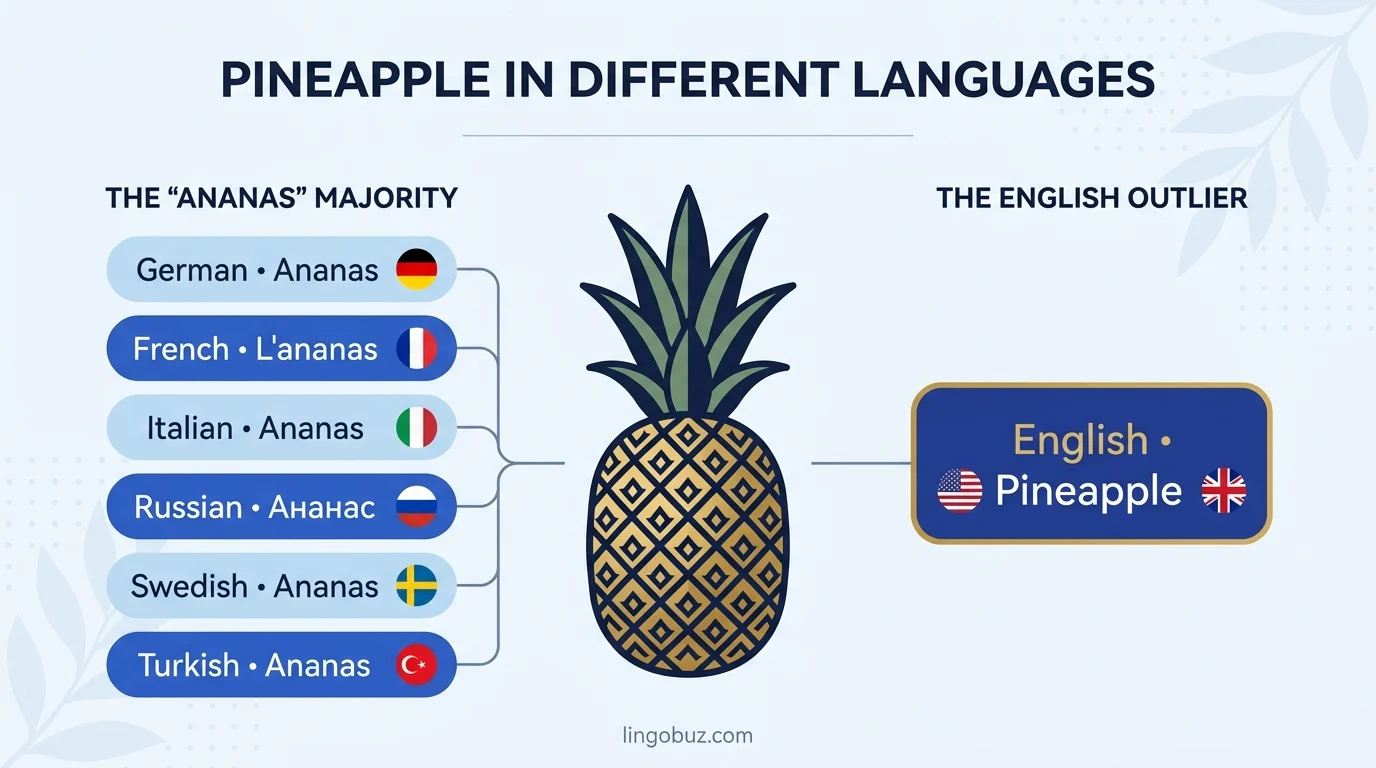
Pineapple is a sweet, tropical fruit enjoyed in many parts of the world, but its name changes from one language to another. Learning how to say pineapple in different languages is useful for travelers, language learners, food lovers, students, and anyone curious about words from other cultures. In English, the fruit is called pineapple, while Spanish speakers say piña and French speakers say ananas. Many other languages use similar forms of the word ananas, although pronunciation and spelling can differ. This guide includes 70 language translations, easy pronunciation guides, and practical example sentences to help you understand how people refer to this delicious fruit around the world.
How Do You Say Pineapple in Different Languages?
The word for pineapple varies across languages. Some use a form of ananas, while others have distinct names, such as piña in Spanish and abacaxi in Portuguese.
Here is a quick reference table with eight common pineapple translations.
| Language | Pineapple Translation | Easy Pronunciation |
|---|---|---|
| Spanish | Piña | PEE-nyah |
| French | Ananas | ah-nah-nahs |
| German | Ananas | AH-nah-nahs |
| Italian | Ananas | ah-NAH-nahs |
| Portuguese | Abacaxi | ah-bah-kah-SHEE |
| Hindi | अनानास | uh-NAH-nahs |
| Japanese | パイナップル | pie-nahp-puh-roo |
| Chinese (Mandarin) | 菠萝 | bwaw-law |
These translations refer to the fruit itself. The most suitable word may vary by region, particularly in languages with different regional names.
1. South Asian Languages
South Asia has many languages with distinct words for tropical fruits. Hindi and Urdu use forms related to ananas, while other languages may have their own spelling or pronunciation.
| Language | Native Phrase | Easy Pronunciation | Example Sentence | English Meaning |
|---|---|---|---|---|
| Hindi | अनानास | uh-NAH-nahs | मुझे अनानास पसंद है। | I like pineapple. |
| Urdu | انناس | uh-NAH-naas | مجھے انناس پسند ہے۔ | I like pineapple. |
| Bengali | আনারস | ah-nah-rosh | আমি আনারস পছন্দ করি। | I like pineapple. |
| Punjabi | ਅਨਾਨਾਸ | uh-NAH-naas | ਮੈਨੂੰ ਅਨਾਨਾਸ ਪਸੰਦ ਹੈ। | I like pineapple. |
| Gujarati | અનાનસ | uh-NAH-nus | મને અનાનસ ગમે છે. | I like pineapple. |
| Marathi | अननस | uh-nuh-nus | मला अननस आवडतो. | I like pineapple. |
| Tamil | அன்னாசிப்பழம் | un-naa-see-puh-zham | எனக்கு அன்னாசிப்பழம் பிடிக்கும். | I like pineapple. |
2. East Asian Languages
East Asian languages use a mix of borrowed fruit names and established local terms. Chinese also has regional variation, so the same fruit may be called by different words in different areas.
| Language | Native Phrase | Easy Pronunciation | Example Sentence | English Meaning |
|---|---|---|---|---|
| Chinese (Mandarin) | 菠萝 | bwaw-law | 我喜欢吃菠萝。 | I like eating pineapple. |
| Cantonese | 菠蘿 | baw-law | 我鍾意食菠蘿。 | I like eating pineapple. |
| Japanese | パイナップル | pie-nahp-puh-roo | パイナップルが好きです。 | I like pineapple. |
| Korean | 파인애플 | pah-in-eh-peul | 저는 파인애플을 좋아해요. | I like pineapple. |
| Mongolian | Хан боргоцой | khan bor-goh-tsoi | Би хан боргоцойд дуртай. | I like pineapple. |
| Tibetan | ཨ་ན་ནས། | ah-nah-nay | ང་ཨ་ན་ནས་ལ་དགའ། | I like pineapple. |
| Taiwanese Hokkien | 王梨 | ông-lâi | 我真愛食王梨。 | I really like eating pineapple. |
3. Southeast Asian Languages
Pineapple is familiar across Southeast Asia, where it appears in fruit dishes, desserts, drinks, and savory meals. Names differ by language, even between neighboring countries.
| Language | Native Phrase | Easy Pronunciation | Example Sentence | English Meaning |
|---|---|---|---|---|
| Indonesian | Nanas | nah-nahs | Saya suka nanas. | I like pineapple. |
| Malay | Nanas | nah-nahs | Saya suka nanas. | I like pineapple. |
| Thai | สับปะรด | sap-pah-rot | ฉันชอบสับปะรด | I like pineapple. |
| Vietnamese | Dứa | zɨə, approximately “zoo-uh” | Tôi thích dứa. | I like pineapple. |
| Filipino (Tagalog) | Pinya | PEEN-yah | Gusto ko ang pinya. | I like pineapple. |
| Khmer | ម្នាស់ | m’noah | ខ្ញុំចូលចិត្តម្នាស់។ | I like pineapple. |
| Lao | ໝາກນັດ | maak nat | ຂ້ອຍມັກໝາກນັດ. | I like pineapple. |
4. Western European Languages
Several Western European languages use forms of ananas. English and Spanish, by contrast, use the distinctive word pineapple and piña, respectively.
| Language | Native Phrase | Easy Pronunciation | Example Sentence | English Meaning |
|---|---|---|---|---|
| English | Pineapple | PINE-ap-uhl | I like pineapple. | I like pineapple. |
| French | Ananas | ah-nah-nahs | J’aime l’ananas. | I like pineapple. |
| German | Ananas | AH-nah-nahs | Ich mag Ananas. | I like pineapple. |
| Dutch | Ananas | AH-nah-nahs | Ik hou van ananas. | I like pineapple. |
| Luxembourgish | Ananas | ah-nah-nahs | Ech iessen gär Ananas. | I like eating pineapple. |
| West Frisian | Ananas | ah-nah-nahs | Ik fyn ananas lekker. | I find pineapple tasty. |
| Irish | Anann | AH-nun | Is maith liom anann. | I like pineapple. |
5. Northern European and Baltic Languages
Northern Europe includes languages with their own fruit names alongside words resembling ananas. The translations below show common forms used in everyday speech.
| Language | Native Phrase | Easy Pronunciation | Example Sentence | English Meaning |
|---|---|---|---|---|
| Swedish | Ananas | AH-nah-nahs | Jag tycker om ananas. | I like pineapple. |
| Danish | Ananas | AH-nah-nas | Jeg kan godt lide ananas. | I like pineapple. |
| Norwegian | Ananas | AH-nah-nahs | Jeg liker ananas. | I like pineapple. |
| Icelandic | Ananas | AH-nah-nas | Mér finnst ananas góður. | I like pineapple. |
| Finnish | Ananas | AH-nah-nahs | Pidän ananaksesta. | I like pineapple. |
| Estonian | Ananass | AH-nah-nahs | Mulle meeldib ananass. | I like pineapple. |
| Latvian | Ananass | AH-nah-nahs | Man garšo ananass. | I like pineapple. |
6. Southern European Languages
Southern European languages have a mixture of familiar international fruit names and distinctive regional vocabulary. Spanish uses piña, while Portuguese uses abacaxi in Brazil and commonly ananás in Portugal.
| Language | Native Phrase | Easy Pronunciation | Example Sentence | English Meaning |
|---|---|---|---|---|
| Spanish | Piña | PEE-nyah | Me gusta la piña. | I like pineapple. |
| Portuguese | Abacaxi | ah-bah-kah-SHEE | Eu gosto de abacaxi. | I like pineapple. |
| Italian | Ananas | ah-NAH-nahs | Mi piace l’ananas. | I like pineapple. |
| Catalan | Pinya | PEEN-yah | M’agrada la pinya. | I like pineapple. |
| Galician | Piña | PEE-nyah | Gústame a piña. | I like pineapple. |
| Basque | Anana | ah-NAH-nah | Anana gustatzen zait. | I like pineapple. |
| Greek | Ανανάς | ah-nah-NAHS | Μου αρέσει ο ανανάς. | I like pineapple. |
7. Slavic and Eastern European Languages
In Slavic languages, the names of fruits often have related spellings across borders. These examples show the commonly used forms for pineapple in several Eastern and Central European languages.
| Language | Native Phrase | Easy Pronunciation | Example Sentence | English Meaning |
|---|---|---|---|---|
| Russian | Ананас | ah-nah-NAHS | Я люблю ананас. | I like pineapple. |
| Ukrainian | Ананас | ah-nah-NAHS | Я люблю ананас. | I like pineapple. |
| Polish | Ananas | ah-NAH-nahs | Lubię ananasa. | I like pineapple. |
| Czech | Ananas | AH-nah-nahs | Mám rád ananas. | I like pineapple. |
| Slovak | Ananás | AH-nah-naas | Mám rád ananás. | I like pineapple. |
| Slovenian | Ananas | AH-nah-nahs | Rad imam ananas. | I like pineapple. |
| Croatian | Ananas | AH-nah-nahs | Volim ananas. | I like pineapple. |
8. Middle Eastern and Central Asian Languages
The Middle East and Central Asia contain languages from several different language families. Their words for pineapple include forms of ananas as well as locally established spellings.
| Language | Native Phrase | Easy Pronunciation | Example Sentence | English Meaning |
|---|---|---|---|---|
| Arabic | أناناس | ah-nah-NAAS | أنا أحب الأناناس. | I like pineapple. |
| Hebrew | אננס | ah-nah-NAHS | אני אוהב אננס. | I like pineapple. |
| Persian | آناناس | ah-nah-NAAS | من آناناس دوست دارم. | I like pineapple. |
| Turkish | Ananas | ah-nah-nahs | Ananası severim. | I like pineapple. |
| Kurdish (Kurmanji) | Ananas | ah-nah-nahs | Ez ji ananasê hez dikim. | I like pineapple. |
| Kazakh | Ананас | ah-nah-NAHS | Мен ананасты жақсы көремін. | I like pineapple. |
| Uzbek | Ananas | ah-nah-nahs | Men ananasni yaxshi ko’raman. | I like pineapple. |
9. African Languages
Africa is home to thousands of languages, and fruit names vary between communities. The following examples include widely used languages from different parts of the continent.
| Language | Native Phrase | Easy Pronunciation | Example Sentence | English Meaning |
|---|---|---|---|---|
| Swahili | Nanasi | nah-NAH-see | Ninapenda nanasi. | I like pineapple. |
| Afrikaans | Pynappel | PINE-ah-puhl | Ek hou van pynappel. | I like pineapple. |
| Amharic | አናናስ | ah-nah-NAHS | አናናስ እወዳለሁ። | I like pineapple. |
| Yoruba | Ọ̀gẹ̀dẹ̀ òyìnbó | aw-geh-deh aw-yin-baw | Mo fẹ́ràn ọ̀gẹ̀dẹ̀ òyìnbó. | I like pineapple. |
| Igbo | Painiapulu | pie-nee-ah-poo-loo | Painiapulu na-amasị m. | I like pineapple. |
| Hausa | Abarba | ah-bar-bah | Ina son abarba. | I like pineapple. |
| Zulu | Uphayinaphu | oo-pie-yah-nee-ah-poo | Ngiyawuthanda uphayinaphu. | I like pineapple. |
10. Languages of the Americas and Oceania
Across the Americas and the Pacific, pineapple names reflect local vocabulary, colonial language contact, and regional food traditions. Some forms are borrowed, while others are specific to individual languages.
| Language | Native Phrase | Easy Pronunciation | Example Sentence | English Meaning |
|---|---|---|---|---|
| Haitian Creole | Anana | ah-nah-nah | Mwen renmen anana. | I like pineapple. |
| Jamaican Patois | Pineapple | PINE-ap-uhl | Mi like pineapple. | I like pineapple. |
| Quechua | Ananas | ah-nah-nahs | Ananasta munani. | I like pineapple. |
| Guarani | Avakachi | ah-vah-kah-chee | Che aipotaiterei avakachi. | I really like pineapple. |
| Māori | Paināporo | pie-NAH-paw-raw | He pai ki ahau te paināporo. | I like pineapple. |
| Hawaiian | Hala kahiki | hah-lah kah-HEE-kee | Makemake au i ka hala kahiki. | I like pineapple. |
| Samoan | Fala | FAH-lah | Ou te fiafia i le fala. | I like pineapple. |
How to Use the Word Pineapple in Everyday Conversations
Learning the translation is a great first step, but using the word naturally in a sentence helps you remember it. Here are some practical situations where you might use the word pineapple.
- Shopping: Ask for a pineapple at a fruit market or grocery store.
- Ordering food: Tell a server that you would like pineapple on a pizza or in a fruit salad.
- Talking about food: Explain that you enjoy pineapple juice or fresh pineapple.
- Traveling: Recognize the local fruit name on menus, labels, and market signs.
- Learning vocabulary: Practice saying the fruit’s name aloud and using it in short sentences.
For example, in Spanish, you can say Me gusta la piña, meaning “I like pineapple.” In French, J’aime l’ananas expresses the same idea.
Why Is Pineapple Called Ananas in Many Languages?
The word ananas is used in many languages, including French, German, Italian, Russian, and Turkish. Its international spread is connected to the history of the fruit’s name, which entered European languages through contact with Indigenous languages of South America and subsequent trade.
English developed a different name. The word pineapple originally described a fruit that resembled a pine cone, and the name eventually became associated with the tropical fruit known today.
Spanish uses piña, and Portuguese commonly uses abacaxi in Brazil. These differences show how languages can develop different names for the same food.
What Is the Difference Between Pineapple, Piña, and Ananas?
Although all three terms refer to the same tropical fruit, their use depends on the language.
| Word | Language | Meaning |
|---|---|---|
| Pineapple | English | The tropical fruit |
| Piña | Spanish | Pineapple |
| Ananas | French, German, Italian, and many other languages | Pineapple |
| Abacaxi | Brazilian Portuguese | Pineapple |
| Ananás | European Portuguese | Pineapple |
| Nanas | Indonesian and Malay | Pineapple |
| Pinya | Filipino and Catalan | Pineapple |
When learning a new language, remember that similar spellings do not always mean identical pronunciation. Regional preferences can also affect which word people use.
How to Pronounce Pineapple Correctly in Different Languages
Pronunciation becomes easier when you break a word into smaller sounds. Start with the local word, listen to a native speaker if possible, and repeat it slowly before trying to speak at a natural speed.
Here are a few useful pronunciation tips:
- English, pineapple: Break it into three parts, pine, ap, and ple.
- Spanish, piña: The letter ñ sounds similar to the “ny” sound in “canyon.”
- French, ananas: The final pronunciation differs from English, so listen for the French vowel sounds.
- Portuguese, abacaxi: In Brazilian Portuguese, the final syllable sounds similar to “shee.”
- Japanese, パイナップル: Practice the syllables pai-na-ppu-ru, keeping the rhythm even.
English-style pronunciation guides are approximations. They help beginners get started, but they cannot fully represent every sound, accent, or tone in another language.
Common Mistakes When Learning Pineapple Translations
A few simple habits can help you avoid common translation mistakes.
- Confusing the fruit with a pine cone: The English word has a historical connection to pine cones, but today it refers to the tropical fruit.
- Assuming similar words sound identical: Ananas may look almost the same in several languages, but its pronunciation can differ.
- Ignoring regional vocabulary: Portuguese speakers in Brazil commonly use abacaxi, while ananás is common in Portugal.
- Using an incorrect pronunciation guide: Romanized spellings are only approximations, especially for tonal languages such as Mandarin.
- Translating sentences word for word: Natural grammar differs between languages. Learn the full phrase instead of replacing each English word individually.
Easy Ways to Remember Pineapple in Different Languages
You do not need to memorize all 70 translations at once. A few practical techniques can help you retain the vocabulary.
- Group similar words: Start with languages that use ananas or a related form.
- Practice by region: Learn a few South Asian, European, or East Asian words at a time.
- Use food labels: Write the native word on a flashcard with a picture of a pineapple.
- Create short sentences: Practice phrases such as “I like pineapple” and “I bought a pineapple.”
- Review regularly: Repeat familiar words after a day, a few days, and a week.
The goal is to remember both the word and how it fits into an everyday sentence.
Frequently Asked Questions
1. How do you say pineapple in different languages?
Pineapple has different names around the world. Examples include piña in Spanish, ananas in French and German, abacaxi in Brazilian Portuguese, nanas in Indonesian, and パイナップル in Japanese.
2. What is pineapple called in most European languages?
Many European languages use ananas or a similar form. Examples include French, German, Italian, Dutch, Swedish, and Russian. English and Spanish use the distinctive terms pineapple and piña.
3. How do you say pineapple in Hindi and Urdu?
In Hindi, pineapple is अनानास (ananas). In Urdu, it is انناس (ananas). Both words are pronounced approximately as uh-NAH-nahs.
4. Why is pineapple called piña in Spanish?
Piña is the established Spanish word for pineapple. It is related to the fruit’s resemblance to a pine cone, and it differs from ananas, the term used in many other European languages.
5. What is the difference between ananas and abacaxi?
Both words mean pineapple. Ananas is used in many languages and is common in European Portuguese, while abacaxi is the usual term in Brazilian Portuguese.
Conclusion
Learning pineapple in different languages reveals how one familiar fruit can have many names across cultures. From piña in Spanish to ananas in French and nanas in Indonesian, these translations provide a practical starting point for expanding your vocabulary. Practice the native words with short sentences, pay attention to pronunciation, and remember that regional differences can affect everyday usage.

I am Ava Jones, a language enthusiast and author passionate about exploring different languages, sharing useful phrases, explaining meanings, and helping readers communicate confidently across cultures and countries.