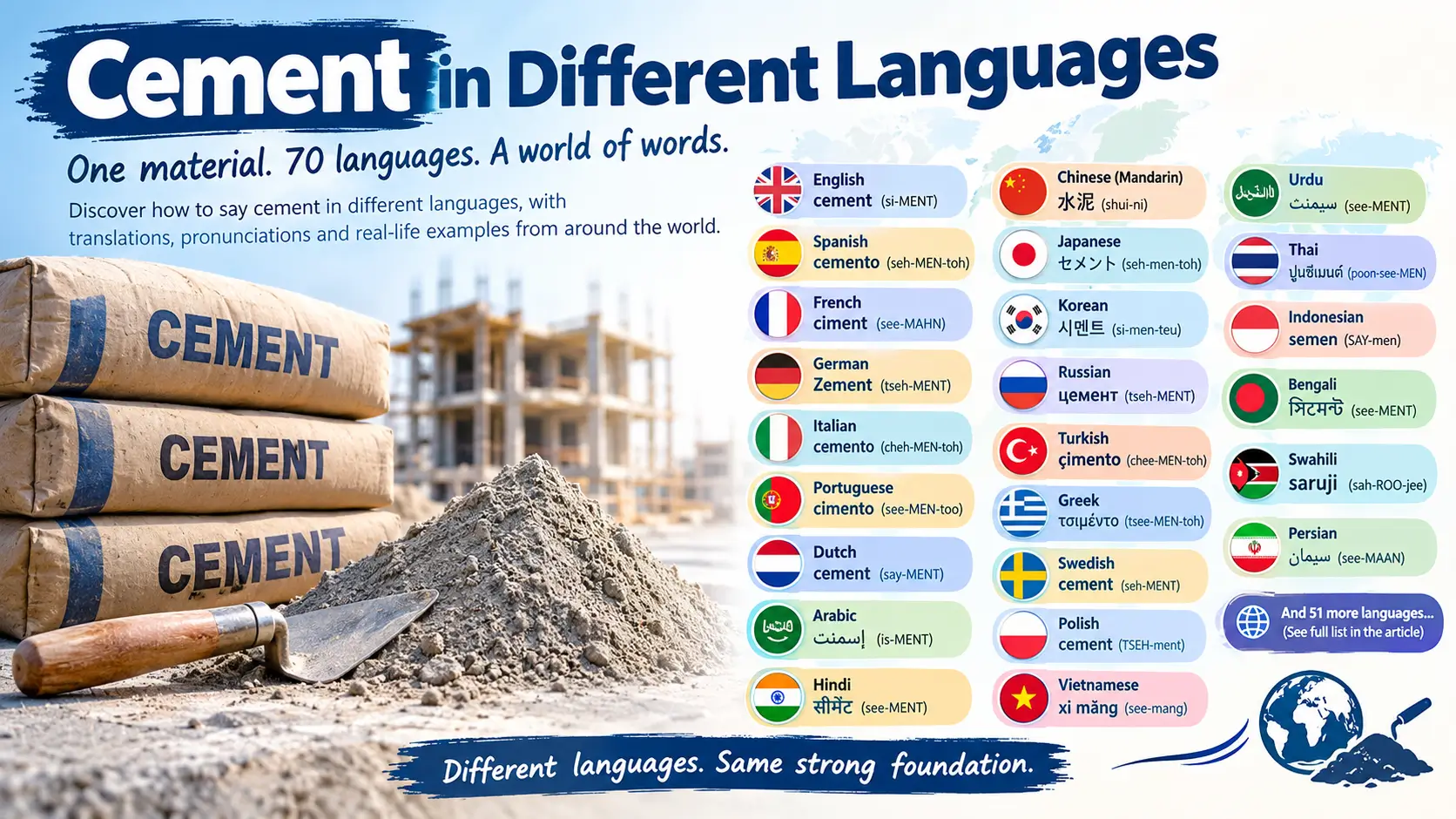
Cement is one of the most widely used construction materials in the world. It plays an important role in making concrete, mortar, plaster, and other building materials. If you are learning languages, traveling, working in construction, or simply curious about international vocabulary, knowing how to say cement in different languages can be surprisingly useful.
The word may look or sound similar across several languages, especially in European languages, but its pronunciation and spelling can vary. Some languages also use a word that is closely related to their historical or regional vocabulary.
Below, you will find cement in all languages in one easy-to-read table. Each entry includes the native translation, a simple English pronunciation, a short example sentence, and the English meaning of that sentence.
Cement in Different Languages
| # | Language | Native Word/Phrase | Easy English Pronunciation | Example Sentence | English Meaning |
|---|---|---|---|---|---|
| 1 | English | cement | si-MENT | We need more cement for the wall. | We need more cement for the wall. |
| 2 | Spanish | cemento | seh-MEN-toh | El cemento está seco. | The cement is dry. |
| 3 | French | ciment | see-MAHN | Le ciment est prêt. | The cement is ready. |
| 4 | German | Zement | tseh-MENT | Der Zement ist trocken. | The cement is dry. |
| 5 | Italian | cemento | cheh-MEN-toh | Il cemento è pronto. | The cement is ready. |
| 6 | Portuguese | cimento | see-MEN-too | O cimento está seco. | The cement is dry. |
| 7 | Dutch | cement | say-MENT | Het cement is sterk. | The cement is strong. |
| 8 | Afrikaans | sement | seh-MENT | Die sement is droog. | The cement is dry. |
| 9 | Swedish | cement | seh-MENT | Cementen är torr. | The cement is dry. |
| 10 | Danish | cement | seh-MENT | Cementen er klar. | The cement is ready. |
| 11 | Norwegian | sement | seh-MENT | Sementen er tørr. | The cement is dry. |
| 12 | Finnish | sementti | seh-MENT-tee | Sementti on valmis. | The cement is ready. |
| 13 | Icelandic | sement | SEH-ment | Sementið er þurrt. | The cement is dry. |
| 14 | Irish | stroighin | STROH-in | Tá an stroighin réidh. | The cement is ready. |
| 15 | Welsh | sment | sment | Mae’r sment yn sych. | The cement is dry. |
| 16 | Scottish Gaelic | saimeant | SAH-ment | Tha an saimeant tioram. | The cement is dry. |
| 17 | Polish | cement | TSEH-ment | Cement jest suchy. | The cement is dry. |
| 18 | Czech | cement | TSEH-ment | Cement je suchý. | The cement is dry. |
| 19 | Slovak | cement | TSEH-ment | Cement je pripravený. | The cement is ready. |
| 20 | Slovenian | cement | TSEH-ment | Cement je suh. | The cement is dry. |
| 21 | Croatian | cement | TSEH-ment | Cement je suh. | The cement is dry. |
| 22 | Serbian | цемент | TSEH-ment | Цемент је сув. | The cement is dry. |
| 23 | Bosnian | cement | TSEH-ment | Cement je spreman. | The cement is ready. |
| 24 | Bulgarian | цимент | TSEE-ment | Циментът е сух. | The cement is dry. |
| 25 | Macedonian | цемент | TSEH-ment | Цементот е сув. | The cement is dry. |
| 26 | Russian | цемент | tseh-MYENT | Цемент готов. | The cement is ready. |
| 27 | Ukrainian | цемент | tseh-MENT | Цемент сухий. | The cement is dry. |
| 28 | Belarusian | цэмент | tseh-MENT | Цэмент сухі. | The cement is dry. |
| 29 | Lithuanian | cementas | seh-MEN-tas | Cementas yra sausas. | The cement is dry. |
| 30 | Latvian | cements | TSEH-ments | Cements ir sauss. | The cement is dry. |
| 31 | Estonian | tsement | TSEH-ment | Tsement on kuiv. | The cement is dry. |
| 32 | Hungarian | cement | TSEH-ment | A cement száraz. | The cement is dry. |
| 33 | Romanian | ciment | chee-MENT | Cimentul este uscat. | The cement is dry. |
| 34 | Albanian | çimento | chee-MEN-toh | Çimentoja është e thatë. | The cement is dry. |
| 35 | Greek | τσιμέντο | tsee-MEN-toh | Το τσιμέντο είναι στεγνό. | The cement is dry. |
| 36 | Turkish | çimento | chee-MEN-toh | Çimento kuru. | The cement is dry. |
| 37 | Maltese | siment | see-MENT | Is-siment huwa niexef. | The cement is dry. |
| 38 | Esperanto | cemento | tseh-MEN-toh | La cemento estas seka. | The cement is dry. |
| 39 | Latin | caementum | kai-MEN-toom | Caementum paratum est. | The cement is ready. |
| 40 | Arabic | إسمنت | is-MENT | الإسمنت جاف. | The cement is dry. |
| 41 | Hebrew | מלט | MEH-let | המלט יבש. | The cement is dry. |
| 42 | Persian | سیمان | see-MAAN | سیمان خشک است. | The cement is dry. |
| 43 | Urdu | سیمنٹ | see-MENT | سیمنٹ خشک ہے۔ | The cement is dry. |
| 44 | Hindi | सीमेंट | see-MENT | सीमेंट सूखा है। | The cement is dry. |
| 45 | Bengali | সিমেন্ট | see-MENT | সিমেন্ট শুকনো। | The cement is dry. |
| 46 | Punjabi | ਸੀਮਿੰਟ | see-MINT | ਸੀਮਿੰਟ ਸੁੱਕਾ ਹੈ। | The cement is dry. |
| 47 | Gujarati | સિમેન્ટ | see-MENT | સિમેન્ટ સૂકું છે. | The cement is dry. |
| 48 | Marathi | सिमेंट | see-MENT | सिमेंट कोरडे आहे. | The cement is dry. |
| 49 | Nepali | सिमेन्ट | see-MENT | सिमेन्ट सुक्खा छ। | The cement is dry. |
| 50 | Sinhala | සිමෙන්ති | see-MEN-thee | සිමෙන්ති වියළියි. | The cement is dry. |
| 51 | Tamil | சிமெண்டு | see-MEN-doo | சிமெண்டு உலர்ந்துள்ளது. | The cement is dry. |
| 52 | Telugu | సిమెంట్ | see-MENT | సిమెంట్ పొడిగా ఉంది. | The cement is dry. |
| 53 | Kannada | ಸಿಮೆಂಟ್ | see-MENT | ಸಿಮೆಂಟ್ ಒಣಗಿದೆ. | The cement is dry. |
| 54 | Malayalam | സിമന്റ് | see-MENT | സിമന്റ് ഉണങ്ങിയിരിക്കുന്നു. | The cement is dry. |
| 55 | Odia | ସିମେଣ୍ଟ | see-MENT | ସିମେଣ୍ଟ ଶୁଖିଲା ଅଛି। | The cement is dry. |
| 56 | Assamese | চিমেণ্ট | see-MENT | চিমেণ্ট শুকান। | The cement is dry. |
| 57 | Thai | ปูนซีเมนต์ | poon-see-MEN | ปูนซีเมนต์แห้งแล้ว | The cement is already dry. |
| 58 | Vietnamese | xi măng | see-mang | Xi măng đã khô. | The cement is dry. |
| 59 | Indonesian | semen | SAY-men | Semen itu sudah kering. | The cement is already dry. |
| 60 | Malay | simen | SEE-men | Simen itu sudah kering. | The cement is already dry. |
| 61 | Filipino | semento | seh-MEN-toh | Tuyo na ang semento. | The cement is already dry. |
| 62 | Chinese (Mandarin) | 水泥 | shui-ni | 水泥已经干了。 | The cement is already dry. |
| 63 | Japanese | セメント | seh-men-toh | セメントは乾いています。 | The cement is dry. |
| 64 | Korean | 시멘트 | si-men-teu | 시멘트가 말랐어요. | The cement has dried. |
| 65 | Mongolian | цемент | tseh-MENT | Цемент хатсан байна. | The cement has dried. |
| 66 | Georgian | ცემენტი | tseh-MEN-tee | ცემენტი მშრალია. | The cement is dry. |
| 67 | Armenian | ցեմենտ | tseh-MENT | Ցեմենտը չոր է։ | The cement is dry. |
| 68 | Azerbaijani | sement | seh-MENT | Sement qurudur. | The cement is dry. |
| 69 | Kazakh | цемент | tseh-MENT | Цемент құрғақ. | The cement is dry. |
| 70 | Swahili | saruji | sah-ROO-jee | Saruji imekauka. | The cement has dried. |
How to Say Cement in Different Languages
The word cement has interesting variations around the world. In many European languages, the word resembles the English form because the vocabulary has a common historical connection. Examples include Spanish cemento, Italian cemento, German Zement, Dutch cement, and Romanian ciment.
In South Asian languages, the English-derived form is also common. Hindi, Urdu, Bengali, Gujarati, Marathi, Nepali, Tamil, Telugu, Kannada, and several other languages use forms closely related to the English word.
Other languages use distinctly different terms. For example, Mandarin Chinese uses 水泥, while Japanese uses セメント and Swahili uses saruji.
Cement Translations Around the World
Cement is an important construction material in nearly every region of the world. Because construction vocabulary is frequently shared between technical professionals, some cement translations are similar across neighboring countries.
However, pronunciation can still differ even when spelling looks almost identical. This is especially important for travelers, translators, students, and people working on international construction projects.
When learning cement translations, it is useful to remember both the written form and the pronunciation. A word that looks familiar may sound quite different in another language.
Why Learn Cement in Different Languages?
Learning construction terms in multiple languages can be useful in several situations.
Construction and Engineering
Construction workers, engineers, architects, contractors, and suppliers may communicate with international teams. Knowing basic material names can make everyday communication easier.
Travel and Communication
If you are traveling in a country where construction work is common, knowing the local word for cement can help you understand signs, conversations, or instructions.
Language Learning
Everyday nouns are excellent vocabulary-building tools. Learning a practical word such as cement can help you recognize related construction vocabulary in a new language.
Translation and Localization
Translators may encounter cement-related terms in technical manuals, product descriptions, building instructions, and construction documents. Understanding the standard local term is important for accurate communication.
Cement Vocabulary You May Also Want to Learn
Once you know how to say cement, you can expand your construction vocabulary with related words such as:
- Concrete
- Mortar
- Sand
- Gravel
- Brick
- Stone
- Wall
- Floor
- Building
- Construction
- Foundation
- Plaster
- Cement mixer
- Cement bag
- Reinforced concrete
These terms are particularly useful when discussing construction, renovation, engineering, or building materials.
Cement vs. Concrete
Cement and concrete are related, but they are not exactly the same thing.
Cement is a binding material used as an ingredient in concrete and mortar. Concrete is a composite construction material generally made using cement, water, and aggregates such as sand and gravel.
This distinction matters when translating construction terminology because different languages may have separate words for cement and concrete.
Common Uses of Cement
Cement is widely used in construction. It can be found in materials and applications such as:
- Concrete production
- Mortar
- Foundations
- Walls
- Floors
- Roads
- Bridges
- Buildings
- Pavements
- Structural components
- Repair work
Its versatility is one reason cement vocabulary appears frequently in technical and everyday conversations about construction.
Tips for Remembering Cement Translations
A simple way to remember cement in all languages is to group languages by region.
For example, several European languages use forms that closely resemble the English word. South Asian languages often use transliterated versions of “cement,” while some Asian and African languages have more distinctive native terms.
You can also practice each word in a short sentence. Learning vocabulary in context usually makes it easier to remember than memorizing isolated translations.
Frequently Asked Questions
1. What is cement called in different languages?
Cement has different names around the world. Examples include cemento in Spanish and Italian, ciment in French and Romanian, Zement in German, سیمان in Persian, सीमेंट in Hindi, 水泥 in Mandarin Chinese, and saruji in Swahili.
2. How do you say cement in Spanish?
In Spanish, cement is cemento. It is commonly used when referring to cement as a construction material.
3. What is the word for cement in Hindi and Urdu?
In Hindi, cement is सीमेंट, while in Urdu it is سیمنٹ. Both forms are closely related to the English word and are widely understood.
4. Is cement the same as concrete?
No. Cement is a binding ingredient, while concrete is a construction material made using cement together with water and aggregates. The two terms should not be treated as exact synonyms.
5. What is cement called in Mandarin Chinese?
In Mandarin Chinese, cement is 水泥. The term is commonly used in construction and building-related contexts.
Conclusion
Learning cement in different languages is a useful way to expand practical vocabulary and understand construction terminology around the world. While many languages use words that resemble “cement,” others have completely different terms, making international vocabulary especially interesting.
From cemento in Spanish and Italian to 水泥 in Mandarin Chinese and saruji in Swahili, these 70 translations show how one everyday construction term can take many forms across different languages.
Whether you are studying languages, working in construction, translating technical material, or simply exploring words from around the world, these cement translations provide a useful starting point.

I’m Jesse Crawford, a language enthusiast and writer passionate about exploring different languages. I create helpful content that makes words, meanings, translations, and language learning simple, useful, and enjoyable for everyone.