A cell phone is one of the most common pieces of technology in everyday life. Whether you are traveling, learning a new language, chatting with international friends, or simply expanding your vocabulary, knowing how to say “cell phone” in other languages can be useful.
The term can vary considerably around the world. Some languages use a direct equivalent of “mobile phone,” while others use a word closer to “telephone” or “portable phone.” This guide gives you cell phone translations in 70 languages, along with pronunciation and practical examples.
Cell Phone in All Languages
Below is a simple guide to how to say cell phone in different languages. The examples are short and designed to show how each phrase can naturally be used in everyday conversation.
| # | Language | Native phrase | Easy English pronunciation | Example sentence | English meaning |
|---|---|---|---|---|---|
| 1 | English | cell phone | sel fohn | My cell phone is charging. | My cell phone is charging. |
| 2 | Spanish | teléfono celular | teh-LEH-foh-noh seh-loo-LAHR | Mi teléfono celular está cargando. | My cell phone is charging. |
| 3 | French | téléphone portable | tay-lay-FOHN por-TAH-bl | Mon téléphone portable est en charge. | My cell phone is charging. |
| 4 | German | Handy | HEN-dee | Mein Handy lädt. | My cell phone is charging. |
| 5 | Italian | cellulare | chel-loo-LAH-reh | Il mio cellulare è in carica. | My cell phone is charging. |
| 6 | Portuguese | celular | seh-loo-LAHR | Meu celular está carregando. | My cell phone is charging. |
| 7 | Dutch | mobiele telefoon | moh-BEE-leh tay-lay-FOHN | Mijn mobiele telefoon wordt opgeladen. | My cell phone is charging. |
| 8 | Swedish | mobiltelefon | moo-BEEL-teh-leh-fohn | Min mobiltelefon laddas. | My cell phone is charging. |
| 9 | Norwegian | mobiltelefon | moo-BEEL-teh-leh-fohn | Mobiltelefonen min lades. | My cell phone is charging. |
| 10 | Danish | mobiltelefon | moh-BEEL-teh-leh-fohn | Min mobiltelefon oplades. | My cell phone is charging. |
| 11 | Finnish | matkapuhelin | MAHT-kah-poo-heh-lin | Matkapuhelimeni latautuu. | My cell phone is charging. |
| 12 | Icelandic | farsími | FAR-see-mee | Farsíminn minn er í hleðslu. | My cell phone is charging. |
| 13 | Irish | fón póca | fohn POH-kah | Tá mo fhón póca á mhuirearú. | My cell phone is charging. |
| 14 | Welsh | ffôn symudol | fohn suh-MEE-dol | Mae fy ffôn symudol yn gwefru. | My cell phone is charging. |
| 15 | Scottish Gaelic | fòn-làimhe | fohn LAH-vuh | Tha am fòn-làimhe agam a’ cur cosgais. | My cell phone is charging. |
| 16 | Polish | telefon komórkowy | teh-LEH-fohn koh-MOOR-koh-vih | Mój telefon komórkowy się ładuje. | My cell phone is charging. |
| 17 | Czech | mobilní telefon | MOH-beel-nee teh-leh-fohn | Můj mobilní telefon se nabíjí. | My cell phone is charging. |
| 18 | Slovak | mobilný telefón | MOH-beel-nee teh-leh-fohn | Môj mobilný telefón sa nabíja. | My cell phone is charging. |
| 19 | Slovenian | mobilni telefon | moh-BEEL-nee teh-leh-fohn | Moj mobilni telefon se polni. | My cell phone is charging. |
| 20 | Croatian | mobitel | MOH-bee-tel | Moj mobitel se puni. | My cell phone is charging. |
| 21 | Serbian | mobilni telefon | MOH-beel-nee teh-leh-fohn | Moj mobilni telefon se puni. | My cell phone is charging. |
| 22 | Bosnian | mobitel | MOH-bee-tel | Moj mobitel se puni. | My cell phone is charging. |
| 23 | Bulgarian | мобилен телефон | moh-BEE-len teh-leh-FOHN | Моят мобилен телефон се зарежда. | My cell phone is charging. |
| 24 | Macedonian | мобилен телефон | moh-BEE-len teh-leh-FOHN | Мојот мобилен телефон се полни. | My cell phone is charging. |
| 25 | Russian | мобильный телефон | moh-BEEL-ny teh-leh-FOHN | Мой мобильный телефон заряжается. | My cell phone is charging. |
| 26 | Ukrainian | мобільний телефон | moh-BEEL-ny teh-leh-FOHN | Мій мобільний телефон заряджається. | My cell phone is charging. |
| 27 | Belarusian | мабільны тэлефон | mah-BEEL-ny teh-leh-FOHN | Мой мабільны тэлефон зараджаецца. | My cell phone is charging. |
| 28 | Lithuanian | mobilusis telefonas | moh-beh-LOO-sis teh-leh-FOH-nas | Mano mobilusis telefonas kraunasi. | My cell phone is charging. |
| 29 | Latvian | mobilais tālrunis | moh-bee-LAIS TAHL-roo-nis | Mans mobilais tālrunis lādējas. | My cell phone is charging. |
| 30 | Estonian | mobiiltelefon | moh-BEEL-teh-leh-fohn | Mu mobiiltelefon laeb. | My cell phone is charging. |
| 31 | Hungarian | mobiltelefon | MOH-beel-teh-leh-fohn | A mobiltelefonom töltődik. | My cell phone is charging. |
| 32 | Romanian | telefon mobil | teh-leh-FOHN moh-BEEL | Telefonul meu mobil se încarcă. | My cell phone is charging. |
| 33 | Greek | κινητό τηλέφωνο | kee-nee-TOH tee-LEH-foh-noh | Το κινητό μου φορτίζει. | My cell phone is charging. |
| 34 | Albanian | telefon celular | teh-leh-FOHN seh-loo-LAHR | Telefoni im celular po karikohet. | My cell phone is charging. |
| 35 | Turkish | cep telefonu | chep teh-leh-foh-NOO | Cep telefonum şarj oluyor. | My cell phone is charging. |
| 36 | Azerbaijani | mobil telefon | moh-BEEL teh-leh-FOHN | Mobil telefonum şarj olur. | My cell phone is charging. |
| 37 | Armenian | բջջային հեռախոս | buh-jah-YEEN heh-rah-KHOS | Իմ բջջային հեռախոսը լիցքավորվում է։ | My cell phone is charging. |
| 38 | Georgian | მობილური ტელეფონი | moh-bee-LOO-ree teh-leh-FOH-nee | ჩემი მობილური ტელეფონი იტენება. | My cell phone is charging. |
| 39 | Arabic | هاتف محمول | HAA-tif mah-MOOL | هاتفي المحمول قيد الشحن. | My cell phone is charging. |
| 40 | Hebrew | טלפון סלולרי | teh-LEH-fohn seh-loo-LAH-ree | הטלפון הסלולרי שלי נטען. | My cell phone is charging. |
| 41 | Persian | تلفن همراه | teh-LEH-fen-e ham-RAH | تلفن همراهم در حال شارژ است. | My cell phone is charging. |
| 42 | Hindi | मोबाइल फ़ोन | MOH-byle fohn | मेरा मोबाइल फ़ोन चार्ज हो रहा है। | My cell phone is charging. |
| 43 | Urdu | موبائل فون | MOH-bile fohn | میرا موبائل فون چارج ہو رہا ہے۔ | My cell phone is charging. |
| 44 | Bengali | মোবাইল ফোন | MOH-byle fohn | আমার মোবাইল ফোন চার্জ হচ্ছে। | My cell phone is charging. |
| 45 | Punjabi | ਮੋਬਾਈਲ ਫ਼ੋਨ | moh-BYLE fohn | ਮੇਰਾ ਮੋਬਾਈਲ ਫ਼ੋਨ ਚਾਰਜ ਹੋ ਰਿਹਾ ਹੈ। | My cell phone is charging. |
| 46 | Gujarati | મોબાઇલ ફોન | MOH-byle fohn | મારો મોબાઇલ ફોન ચાર્જ થઈ રહ્યો છે. | My cell phone is charging. |
| 47 | Marathi | मोबाईल फोन | MOH-byle fohn | माझा मोबाईल फोन चार्ज होत आहे. | My cell phone is charging. |
| 48 | Nepali | मोबाइल फोन | MOH-byle fohn | मेरो मोबाइल फोन चार्ज हुँदैछ। | My cell phone is charging. |
| 49 | Sinhala | ජංගම දුරකථනය | JANG-gah-ma doo-rah-kah-tha-nah-ya | මගේ ජංගම දුරකථනය ආරෝපණය වෙමින් පවතී. | My cell phone is charging. |
| 50 | Tamil | கைபேசி | kai-PAY-see | என் கைபேசி சார்ஜ் ஆகிறது. | My cell phone is charging. |
| 51 | Telugu | మొబైల్ ఫోన్ | MOH-byle fohn | నా మొబైల్ ఫోన్ ఛార్జ్ అవుతోంది. | My cell phone is charging. |
| 52 | Kannada | ಮೊಬೈಲ್ ಫೋನ್ | MOH-byle fohn | ನನ್ನ ಮೊಬೈಲ್ ಫೋನ್ ಚಾರ್ಜ್ ಆಗುತ್ತಿದೆ. | My cell phone is charging. |
| 53 | Malayalam | മൊബൈൽ ഫോൺ | MOH-byle fohn | എന്റെ മൊബൈൽ ഫോൺ ചാർജ് ചെയ്യുകയാണ്. | My cell phone is charging. |
| 54 | Thai | โทรศัพท์มือถือ | toh-rah-SAP meu-TEU | โทรศัพท์มือถือของฉันกำลังชาร์จ | My cell phone is charging. |
| 55 | Vietnamese | điện thoại di động | dee-en THOAI zee DONG | Điện thoại di động của tôi đang sạc. | My cell phone is charging. |
| 56 | Indonesian | ponsel | PON-sel | Ponsel saya sedang diisi daya. | My cell phone is charging. |
| 57 | Malay | telefon bimbit | teh-leh-FOHN BEEM-bit | Telefon bimbit saya sedang dicas. | My cell phone is charging. |
| 58 | Filipino | cellphone | SEL-fohn | Naka-charge ang cellphone ko. | My cell phone is charging. |
| 59 | Chinese (Mandarin) | 手机 | shǒu jī | 我的手机正在充电。 | My cell phone is charging. |
| 60 | Japanese | 携帯電話 | keitai denwa | 私の携帯電話は充電中です。 | My cell phone is charging. |
| 61 | Korean | 휴대전화 | hyu-dae-jeon-hwa | 제 휴대전화가 충전 중이에요. | My cell phone is charging. |
| 62 | Mongolian | гар утас | gar oo-tas | Миний гар утас цэнэглэгдэж байна. | My cell phone is charging. |
| 63 | Kazakh | ұялы телефон | oo-YAH-ly teh-leh-FOHN | Менің ұялы телефоным қуатталып жатыр. | My cell phone is charging. |
| 64 | Uzbek | mobil telefon | moh-BEEL teh-leh-FOHN | Mobil telefonim quvvat olayapti. | My cell phone is charging. |
| 65 | Swahili | simu ya mkononi | SEE-moo yah mko-NOH-nee | Simu yangu ya mkononi inachaji. | My cell phone is charging. |
| 66 | Afrikaans | selfoon | SEL-fohn | My selfoon laai. | My cell phone is charging. |
| 67 | Amharic | ሞባይል ስልክ | moh-BYLE silk | ሞባይል ስልኬ እየተሞላ ነው። | My cell phone is charging. |
| 68 | Zulu | umakhalekhukhwini | oo-mah-kah-leh-khoo-KHWIN-ee | Umakhalekhukhwini wami uyashaja. | My cell phone is charging. |
| 69 | Haitian Creole | telefòn selilè | teh-leh-FOHN seh-lee-LEH | Telefòn selilè mwen ap chaje. | My cell phone is charging. |
| 70 | Malagasy | finday | feen-DIE | Mi-charge ny findaiko. | My cell phone is charging. |
What Is the Difference Between “Cell Phone” and “Mobile Phone”?
“Cell phone” and “mobile phone” generally describe the same device. The preferred expression depends on the region.
In the United States and Canada, cell phone is especially common. In the United Kingdom, Australia, and many other English-speaking regions, mobile phone is more common.
Other languages may also have multiple everyday terms. For example, German speakers commonly use Handy, while French uses téléphone portable. In several Asian languages, the equivalent literally refers to a portable or handheld telephone.
How to Say Cell Phone in Different Languages
Learning the local term can make everyday communication easier when traveling or studying another language. If you need to ask whether someone has a cell phone, understand a conversation about technology, or describe your device, knowing the local vocabulary is useful.
The translations above include both formal terms and commonly used everyday expressions where appropriate. Some languages have regional alternatives, so the exact wording you hear may differ depending on the country.
Cell Phone Translations Around the World
The idea of a portable telephone is expressed in interesting ways across languages.
European languages frequently use combinations meaning mobile telephone, portable telephone, or simply mobile. In South Asia, terms based on “mobile” or “phone” are extremely common in everyday speech. East Asian languages often have established native expressions referring to a handheld or portable telephone.
These differences make cell phone around the world an interesting example of how technology becomes part of local vocabulary.
Common Cell Phone Vocabulary
Once you know the basic translation, learning a few related words can help you communicate more naturally.
- Cell phone / mobile phone — the device itself
- Smartphone — an advanced mobile phone with apps and internet access
- Phone number — the number used to contact someone
- Charger — a device used to recharge a phone
- Battery — the power source inside a phone
- Screen — the display of the phone
- Call — a voice conversation made through the phone
- Text message — a written message sent to another phone
- Mobile data — internet access provided through a cellular network
- Phone case — a protective cover for the phone
Why Learn Cell Phone in Different Languages?
Technology vocabulary is particularly useful for international communication because phones are part of everyday life almost everywhere.
Knowing the local word for cell phone can help you:
- Communicate while traveling
- Understand conversations about technology
- Learn practical vocabulary faster
- Talk with international friends
- Navigate stores and service centers
- Improve your conversational language skills
- Recognize phone-related words when reading or listening
Frequently Asked Questions
1. What is “cell phone” in different languages?
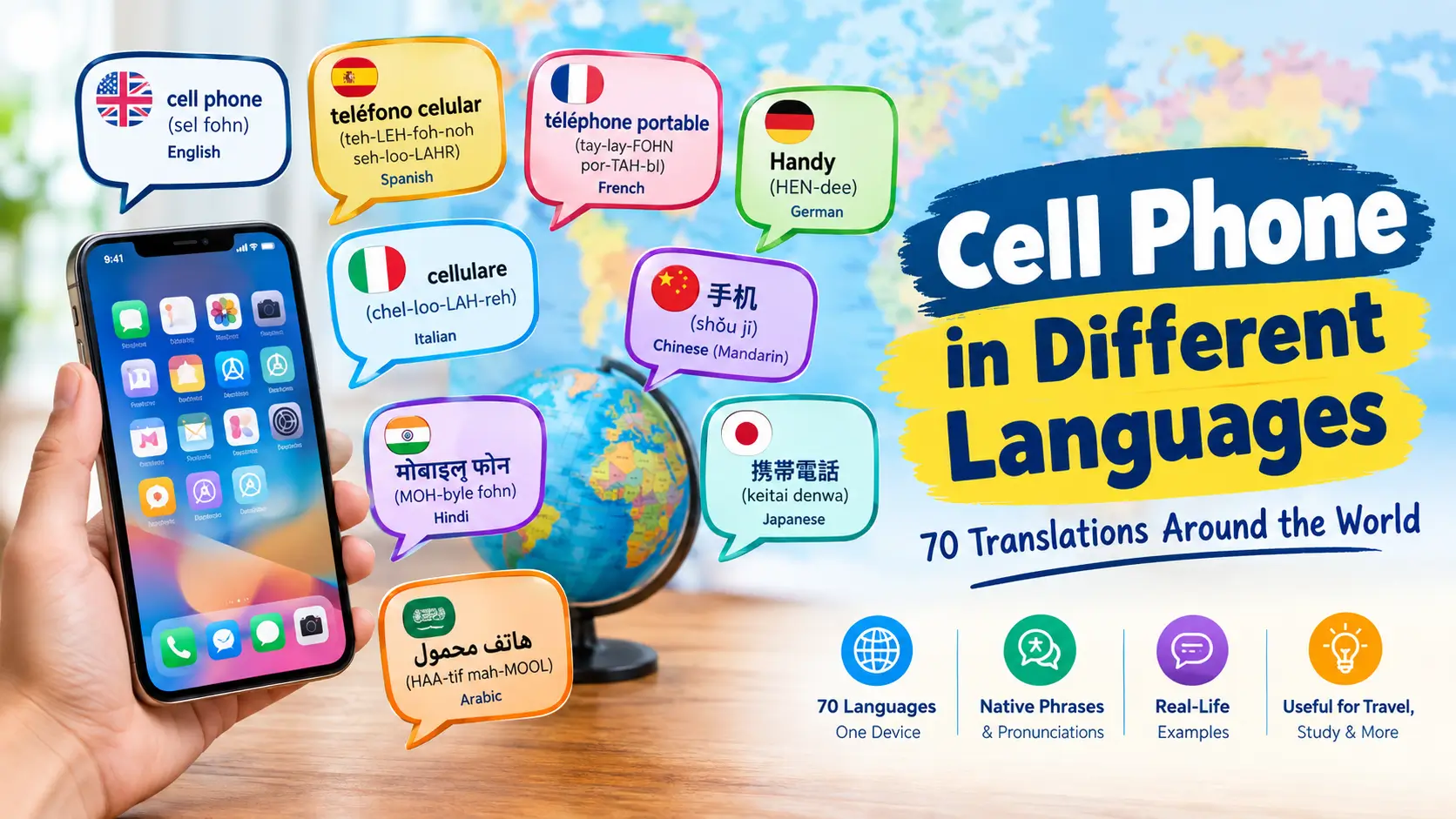
“Cell phone” has different translations depending on the language. Examples include teléfono celular in Spanish, téléphone portable in French, Handy in German, celulare in Italian, 携帯電話 in Japanese, and 手机 in Mandarin Chinese.
2. How do you say cell phone in Spanish?
In Spanish, cell phone is commonly translated as teléfono celular. In some Spanish-speaking regions, móvil or teléfono móvil is also widely used.
3. What is the difference between cell phone and mobile phone?
They refer to the same type of device. Cell phone is particularly common in American English, while mobile phone is more common in British English and many other varieties of English.
4. How do you say cell phone in French?
The common French expression is téléphone portable. It literally describes a portable telephone and is the standard everyday term for a mobile phone.
5. What is cell phone in Japanese and Chinese?
In Japanese, cell phone is commonly 携帯電話. In Mandarin Chinese, the everyday term is 手机. Both are widely understood in their respective languages.
Conclusion
Learning how to say cell phone in different languages is a practical way to build useful vocabulary for travel, conversation, and language study. From Handy in German to 手机 in Mandarin and 携帯電話 in Japanese, these 70 translations show how languages describe the same everyday technology in different ways.
Whether you are looking for cell phone in all languages, studying cell phone translations, or wondering how to say cell phone in different languages, this list provides a useful starting point for exploring technology vocabulary around the world.

I am Ava Jones, a language enthusiast and author passionate about exploring different languages, sharing useful phrases, explaining meanings, and helping readers communicate confidently across cultures and countries.