The word “cut” is a common English word with several meanings. It can describe the action of using a sharp object to divide something, such as cutting paper, food, or hair. It can also refer to reducing something, making an incision, or stopping part of something.
If you are learning a new language, traveling, writing, or simply curious about world languages, knowing how to say “cut” in different languages can be useful. Because the word can function as a verb or noun, translations may vary depending on context.
Below, you will find cut translations in 70 different languages, with native phrases, easy pronunciations, and short examples to show how each expression can be used naturally.
Cut in Different Languages
The following table answers the common question: How do you say “cut” in different languages? The examples primarily use “cut” as a verb meaning to divide or slice something.
| # | Language | “Cut” in Native Language | Easy English Pronunciation | Example Sentence | English Meaning |
|---|---|---|---|---|---|
| 1 | Spanish | cortar | kor-TAR | Necesito cortar el papel. | I need to cut the paper. |
| 2 | French | couper | koo-PAY | Je vais couper le pain. | I am going to cut the bread. |
| 3 | German | schneiden | SHNY-dun | Ich muss das Papier schneiden. | I need to cut the paper. |
| 4 | Italian | tagliare | tal-YAH-reh | Devo tagliare il pane. | I need to cut the bread. |
| 5 | Portuguese | cortar | kor-TAR | Vou cortar o bolo. | I will cut the cake. |
| 6 | Dutch | snijden | SNY-dun | Ik moet het brood snijden. | I need to cut the bread. |
| 7 | Swedish | skära | SHARE-ah | Jag ska skära brödet. | I am going to cut the bread. |
| 8 | Norwegian | kutte | KOO-teh | Jeg skal kutte brødet. | I am going to cut the bread. |
| 9 | Danish | skære | SKAIR-eh | Jeg skal skære brødet. | I am going to cut the bread. |
| 10 | Finnish | leikata | LAY-kah-tah | Haluan leikata paperin. | I want to cut the paper. |
| 11 | Icelandic | skera | SKEH-ra | Ég þarf að skera brauðið. | I need to cut the bread. |
| 12 | Irish | gearr | gyar | Gearr an t-arán. | Cut the bread. |
| 13 | Welsh | torri | TOR-ree | Mae angen torri’r papur. | The paper needs to be cut. |
| 14 | Scottish Gaelic | gearradh | GYAR-uh | Tha feum air gearradh. | It needs cutting. |
| 15 | Latin | secare | seh-KAH-reh | Secare panem volo. | I want to cut the bread. |
| 16 | Greek | κόβω | KOH-voh | Θέλω να κόψω το ψωμί. | I want to cut the bread. |
| 17 | Russian | резать | REH-zat | Я буду резать хлеб. | I will cut the bread. |
| 18 | Ukrainian | різати | REE-zah-ty | Я буду різати хліб. | I will cut the bread. |
| 19 | Polish | ciąć | chyonch | Muszę ciąć papier. | I need to cut the paper. |
| 20 | Czech | řezat | RZHEH-zaht | Musím řezat papír. | I need to cut the paper. |
| 21 | Slovak | rezať | REH-zaht | Musím rezať papier. | I need to cut the paper. |
| 22 | Slovenian | rezati | reh-ZAH-tee | Moram rezati papir. | I have to cut the paper. |
| 23 | Croatian | rezati | reh-ZAH-tee | Moram rezati kruh. | I have to cut the bread. |
| 24 | Serbian | сећи | SEH-chee | Морам сећи хлеб. | I have to cut the bread. |
| 25 | Bulgarian | режа | REH-zhah | Трябва да режа хляба. | I need to cut the bread. |
| 26 | Macedonian | сече | SEH-cheh | Треба да сечам леб. | I need to cut bread. |
| 27 | Romanian | tăia | tah-YAH | Trebuie să tai pâinea. | I need to cut the bread. |
| 28 | Hungarian | vágni | VAAG-nee | Fel kell vágnom a kenyeret. | I need to cut the bread. |
| 29 | Albanian | pres | pres | Duhet ta pres bukën. | I need to cut the bread. |
| 30 | Lithuanian | pjauti | PYOW-tee | Turiu pjauti duoną. | I have to cut the bread. |
| 31 | Latvian | griezt | GRYEHST | Man jāgriež maize. | I have to cut the bread. |
| 32 | Estonian | lõikama | LOY-kah-mah | Ma tahan paberit lõigata. | I want to cut paper. |
| 33 | Maltese | jaqta’ | YAK-tah | Irrid naqta’ il-ħobż. | I want to cut the bread. |
| 34 | Turkish | kesmek | KES-mek | Ekmeği kesmeliyim. | I should cut the bread. |
| 35 | Azerbaijani | kəsmək | KES-mek | Çörəyi kəsməliyəm. | I need to cut the bread. |
| 36 | Kazakh | кесу | keh-SOO | Мен нанды кесемін. | I cut the bread. |
| 37 | Uzbek | kesmoq | kes-MOK | Men nonni kesaman. | I cut the bread. |
| 38 | Kyrgyz | кесүү | keh-SOO | Мен нан кесем. | I cut bread. |
| 39 | Tajik | буридан | boo-ree-DAN | Ман нонро мебурам. | I cut the bread. |
| 40 | Persian | بریدن | bo-ree-DAN | باید نان را ببرم. | I need to cut the bread. |
| 41 | Arabic | يقطع | YAK-ta | أريد أن أقطع الخبز. | I want to cut the bread. |
| 42 | Hebrew | לחתוך | lah-KH-TOHKH | אני רוצה לחתוך את הלחם. | I want to cut the bread. |
| 43 | Hindi | काटना | KAAT-na | मुझे रोटी काटनी है। | I need to cut the bread. |
| 44 | Urdu | کاٹنا | KAAT-na | مجھے روٹی کاٹنی ہے۔ | I need to cut the bread. |
| 45 | Bengali | কাটা | KAA-ta | আমাকে রুটি কাটতে হবে। | I need to cut the bread. |
| 46 | Punjabi | ਕੱਟਣਾ | KAT-na | ਮੈਨੂੰ ਰੋਟੀ ਕੱਟਣੀ ਹੈ। | I need to cut the bread. |
| 47 | Gujarati | કાપવું | KAA-pvoo | મારે રોટલી કાપવી છે. | I need to cut the bread. |
| 48 | Marathi | कापणे | KAA-pah-nay | मला भाकरी कापायची आहे. | I need to cut the flatbread. |
| 49 | Nepali | काट्नु | KAAT-noo | मैले रोटी काट्नुपर्छ। | I have to cut the bread. |
| 50 | Sinhala | කපනවා | ka-PA-na-va | මට පාන් කපන්න ඕනේ. | I need to cut the bread. |
| 51 | Tamil | வெட்ட | VET-ta | நான் ரொட்டியை வெட்ட வேண்டும். | I need to cut the bread. |
| 52 | Telugu | కోయడం | KOY-a-dam | నేను రొట్టెను కోయాలి. | I need to cut the bread. |
| 53 | Kannada | ಕತ್ತರಿಸು | KAT-ta-ri-soo | ನಾನು ರೊಟ್ಟಿಯನ್ನು ಕತ್ತರಿಸಬೇಕು. | I need to cut the bread. |
| 54 | Malayalam | മുറിക്കുക | moo-ri-koo-ka | എനിക്ക് റൊട്ടി മുറിക്കണം. | I need to cut the bread. |
| 55 | Thai | ตัด | tat | ฉันต้องตัดขนมปัง | I need to cut the bread. |
| 56 | Lao | ຕັດ | tat | ຂ້ອຍຕ້ອງຕັດເຂົ້າຈີ່. | I need to cut the bread. |
| 57 | Khmer | កាត់ | kat | ខ្ញុំត្រូវកាត់នំប៉័ង។ | I need to cut the bread. |
| 58 | Vietnamese | cắt | kaht | Tôi cần cắt bánh mì. | I need to cut the bread. |
| 59 | Indonesian | memotong | meh-MOH-tong | Saya perlu memotong roti. | I need to cut the bread. |
| 60 | Malay | memotong | meh-MOH-tong | Saya perlu memotong roti. | I need to cut the bread. |
| 61 | Tagalog | putol | poo-TOL | Kailangan kong putulin ang papel. | I need to cut the paper. |
| 62 | Chinese (Mandarin) | 切 | qiē | 我需要切面包。 | I need to cut the bread. |
| 63 | Japanese | 切る | kiru | パンを切る必要があります。 | I need to cut the bread. |
| 64 | Korean | 자르다 | ja-reu-da | 빵을 잘라야 해요. | I need to cut the bread. |
| 65 | Mongolian | зүсэх | ZOO-sekh | Би талх зүсэх хэрэгтэй. | I need to cut the bread. |
| 66 | Georgian | გაჭრა | gah-chrah | პურის გაჭრა მჭირდება. | I need to cut the bread. |
| 67 | Armenian | կտրել | kuht-REL | Ես պետք է կտրեմ հացը։ | I need to cut the bread. |
| 68 | Swahili | kukata | koo-KAH-tah | Ninahitaji kukata mkate. | I need to cut the bread. |
| 69 | Zulu | ukusika | oo-koo-SEE-kah | Ngidinga ukusika isinkwa. | I need to cut the bread. |
| 70 | Afrikaans | sny | SNAI | Ek moet die brood sny. | I need to cut the bread. |
What Does “Cut” Mean?
In English, cut is a highly flexible word. Its most basic meaning is to use a sharp object to divide or separate something.
For example:
- Cut the paper.
- Cut the vegetables.
- Cut the cake.
- Cut your hair.
- Cut the rope.
The word can also describe reducing something, such as cut the price, or removing part of something, as in cut a paragraph from an article.
Because of these different meanings, the correct translation may change according to the sentence.
How to Say “Cut” in Different Languages
When learning how to say cut in different languages, it is useful to learn the word together with a complete sentence. A dictionary translation alone may not show how the word changes according to grammar.
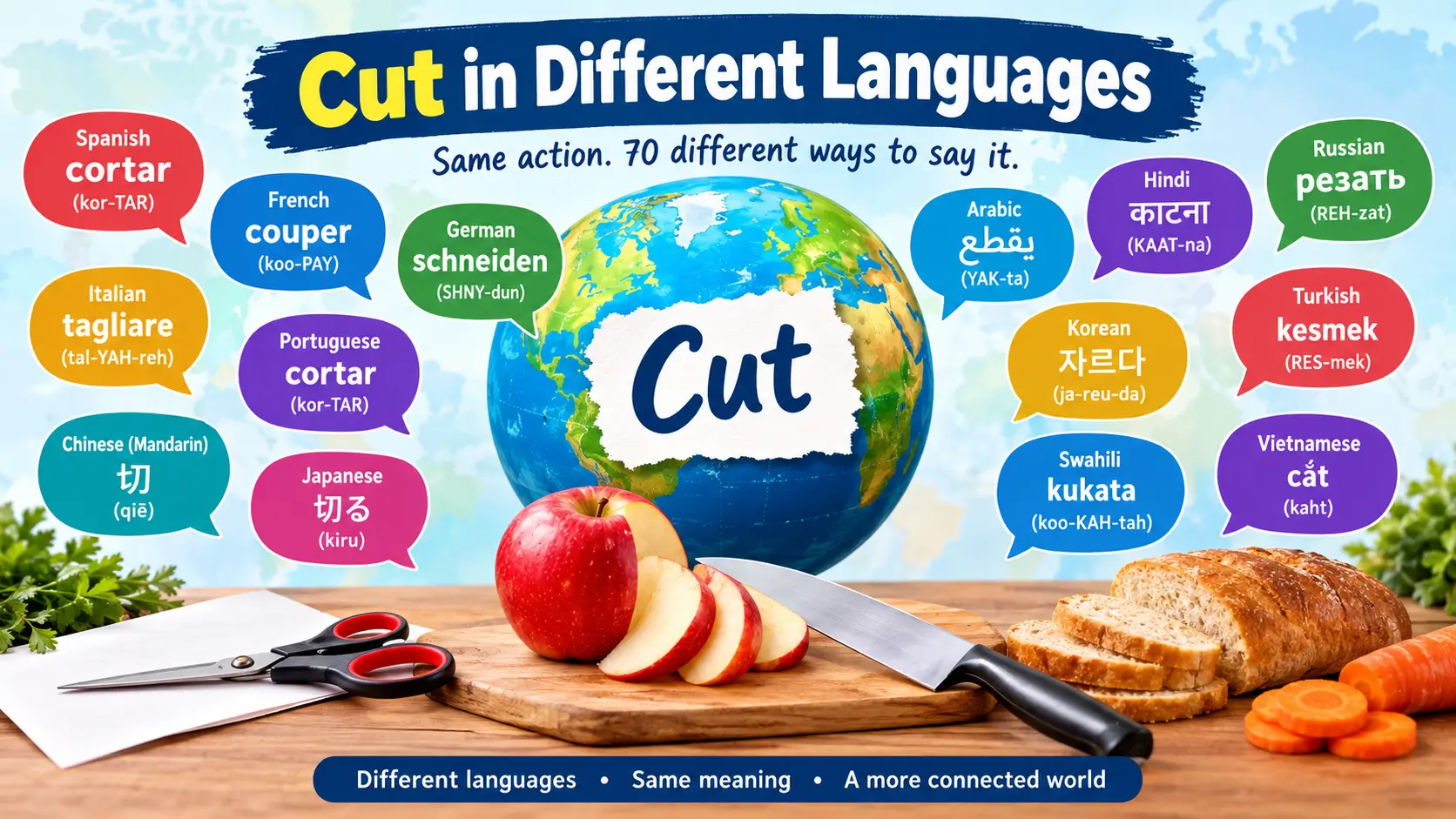
For example, Spanish uses cortar, French uses couper, German uses schneiden, and Italian uses tagliare. These are dictionary forms of the verb, while the form used in an actual sentence can change depending on the subject and tense.
This is why the example sentences in the table are important for language learners.
“Cut” in European Languages
European languages offer many interesting variations of the word.
In Romance languages, you can see similarities between Spanish cortar, Portuguese cortar, French couper, Italian tagliare, and Romanian tăia.
Germanic languages use very different-looking forms. German has schneiden, Dutch has snijden, while Swedish uses skära and Danish uses skære.
Slavic languages also have related patterns. Russian uses резать, Ukrainian uses різати, Polish uses ciąć, and Czech uses řezat.
“Cut” in Asian Languages
Asian languages often have completely different structures from English.
Mandarin Chinese uses 切 for cutting or slicing. Japanese uses 切る, while Korean uses 자르다.
In South Asian languages, Hindi and Urdu use काटना and کاٹنا, respectively. Bengali uses কাটা, Punjabi uses ਕੱਟਣਾ, and Gujarati uses કાપવું.
These differences show why direct word-for-word translation does not always work perfectly between languages.
“Cut” Around the World
The idea of cutting is universal. People use words for cutting when talking about food preparation, crafts, gardening, haircuts, construction, clothing, and many other everyday activities.
For example, you may need to know how to say “cut” when ordering food abroad, describing a haircut, giving instructions, or learning a new language.
The cut in all languages examples above provide a practical starting point for recognizing this useful action word around the world.
Common Uses of the Word “Cut”
The English word cut can appear in many expressions.
Cut something with a knife
This is one of the most literal uses.
Example: Cut the apple with a knife.
Cut your hair
Here, “cut” describes trimming or changing the length of hair.
Example: I need to cut my hair.
Cut the price
In this expression, “cut” means to reduce something.
Example: The store cut the price by 20 percent.
Cut the paper
This means dividing or shaping paper with scissors or another tool.
Example: Please cut the paper into two pieces.
Cut a cake
This means dividing a cake into pieces.
Example: She cut the cake for the guests.
Why Context Matters When Translating “Cut”
A single English word does not always have one perfect equivalent in another language.
For instance, “cut” can mean slice, sever, trim, reduce, remove, or edit, depending on context. A translator should therefore consider the complete sentence before choosing the appropriate word.
For language learners, this is an important lesson: learning vocabulary in context usually produces better results than memorizing isolated words.
Tips for Learning “Cut” in a New Language
Start by memorizing the basic dictionary form. Then practice it with simple sentences involving familiar objects.
Try sentences such as:
- Cut the bread.
- Cut the paper.
- Cut the apple.
- Cut the cake.
- I need to cut this.
- Can you cut it?
You can then learn past, present, and future forms as your language skills improve.
It is also helpful to listen to native speakers because pronunciation can vary significantly between languages and regions.
Frequently Asked Questions
1. How do you say “cut” in different languages?
“Cut” has different translations depending on the language. Examples include cortar in Spanish, couper in French, schneiden in German, tagliare in Italian, कटना in Hindi, کاٹنا in Urdu, 切 in Mandarin Chinese, and 切る in Japanese.
2. What is the word for “cut” in Spanish?
The Spanish verb for “to cut” is cortar. For example, “I need to cut the paper” can be expressed using the appropriate form of this verb.
3. How do you say “cut” in Hindi and Urdu?
In Hindi, the common verb is काटना (kaatna). In Urdu, it is کاٹنا (kaatna). Both can be used for the general action of cutting.
4. Is “cut” the same in every language?
No. Languages use different words and grammatical forms for the concept of cutting. Some languages may also use different verbs depending on whether you are slicing, chopping, trimming, or cutting something apart.
5. Why are example sentences important for “cut” translations?
Example sentences show how the word works naturally in a particular language. They also help learners understand grammar, word order, and the appropriate context instead of memorizing a translation in isolation.
Conclusion
Learning cut in different languages is a simple but useful way to expand your everyday vocabulary. The word appears frequently when talking about food, paper, hair, tools, crafts, and many other activities.
With 70 translations, pronunciations, and real-life examples, this guide gives you a practical overview of cut translations around the world. Remember that context matters, so use the example sentences as a guide when learning how the word works naturally in each language.

I am Ricardo Hunter, Administrator at LingoBuz, passionate about languages, translations, and global communication. I help create useful, clear content that makes exploring different languages simple, enjoyable, and accessible.