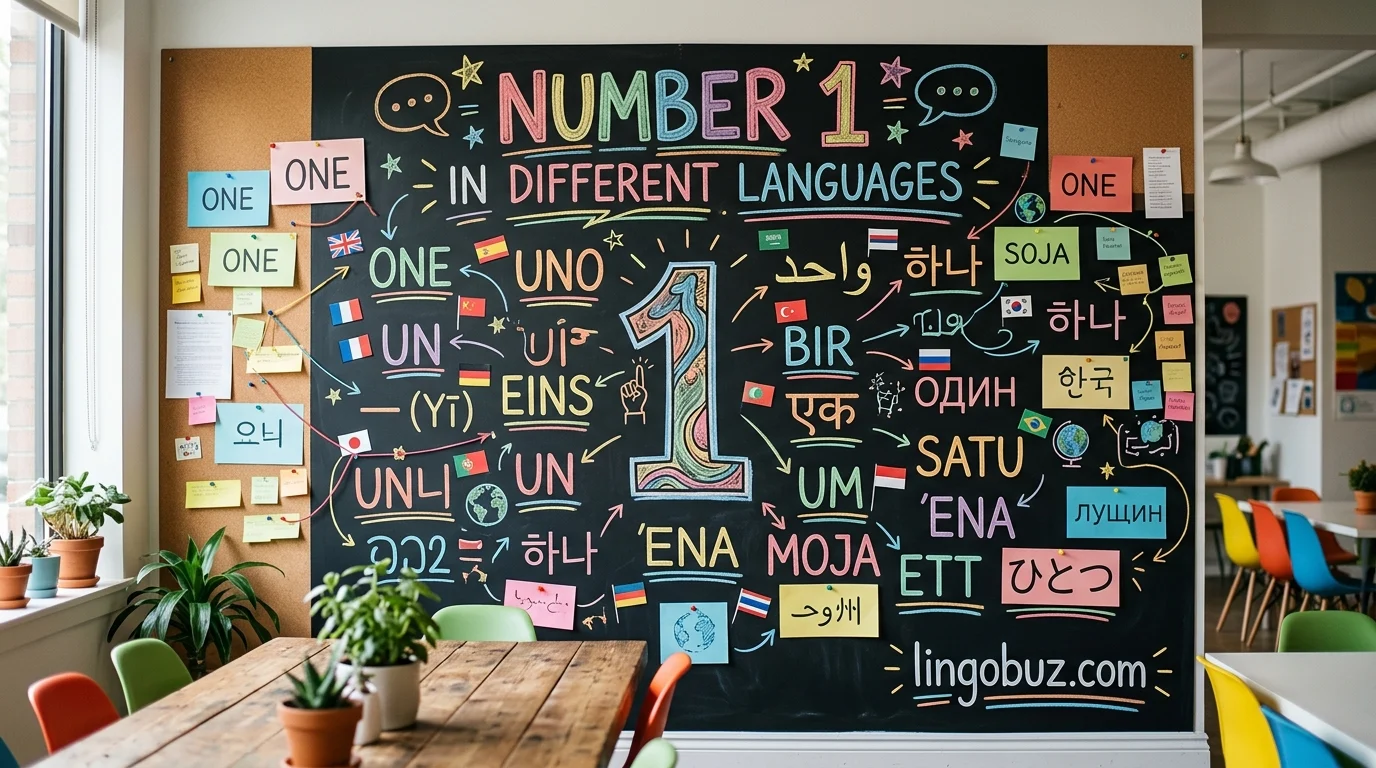
The number 1 is the starting point of counting and one of the most important numbers in everyday communication. Whether you are learning a new language, studying numbers, traveling abroad, or exploring different cultures, knowing how to say number 1 in different languages is a useful first step. From uno in Spanish to un in French and 一 in Chinese, the word for one varies across the world. This guide includes 70 languages, native words, easy pronunciation guides, and practical example sentences to help you learn how to count in different languages.
How Do You Say Number 1 in Different Languages?
The number 1 is called uno in Spanish, un in French, eins in German, uno in Italian, um in Portuguese, (ichi) in Japanese, and (yī) in Mandarin Chinese.
The written numeral 1 is widely recognized around the world, but the spoken word and writing systems differ by language.
Here are eight quick examples.
| Language | Number 1 | Easy Pronunciation | Example Sentence | English Meaning |
|---|---|---|---|---|
| Spanish | Uno | OO-noh | Tengo un libro. | I have one book. |
| French | Un | uhn | J’ai un livre. | I have one book. |
| German | Eins | ayns | Ich habe ein Buch. | I have one book. |
| Italian | Uno | OO-noh | Ho un libro. | I have one book. |
| Portuguese | Um | oong | Tenho um livro. | I have one book. |
| Hindi | एक | ek | मेरे पास एक किताब है। | I have one book. |
| Japanese | 一 | ichi | 本が一冊あります。 | I have one book. |
| Chinese (Mandarin) | 一 | yī | 我有一本书。 | I have one book. |
70 Ways to Say Number 1 in Different Languages
The following tables organize 70 unique languages into regional and linguistic groups. Each entry includes the native word for the number one, an approximate English pronunciation, an example sentence, and its English meaning.
In some languages, the word for “one” changes according to grammatical gender, the noun being counted, or the counting system. The examples use common forms in context.
1. South Asian Languages
These languages are spoken across South Asia and have their own words and scripts for the number one.
| Language | Native Word | Easy Pronunciation | Example Sentence | English Meaning |
|---|---|---|---|---|
| Urdu | ایک | ek | میرے پاس ایک کتاب ہے۔ | I have one book. |
| Hindi | एक | ek | मेरे पास एक किताब है। | I have one book. |
| Bengali | এক | ek | আমার একটি বই আছে। | I have one book. |
| Punjabi | ਇੱਕ | ikk | ਮੇਰੇ ਕੋਲ ਇੱਕ ਕਿਤਾਬ ਹੈ। | I have one book. |
| Gujarati | એક | ek | મારી પાસે એક પુસ્તક છે. | I have one book. |
| Marathi | एक | ek | माझ्याकडे एक पुस्तक आहे. | I have one book. |
2. East Asian Languages
East Asian languages use distinct writing systems, and the pronunciation of one varies considerably.
| Language | Native Word | Easy Pronunciation | Example Sentence | English Meaning |
|---|---|---|---|---|
| Chinese (Mandarin) | 一 | yī | 我有一本书。 | I have one book. |
| Japanese | 一 | ichi | 本が一冊あります。 | I have one book. |
| Korean | 하나 | ha-na | 사과 하나 주세요. | Please give me one apple. |
| Mongolian | нэг | neg | Надад нэг ном байна. | I have one book. |
3. Southeast Asian Languages
Learn the number one in several languages from Southeast Asia, useful for counting and everyday transactions.
| Language | Native Word | Easy Pronunciation | Example Sentence | English Meaning |
|---|---|---|---|---|
| Indonesian | Satu | SAH-too | Saya punya satu buku. | I have one book. |
| Malay | Satu | SAH-too | Saya ada satu buku. | I have one book. |
| Filipino (Tagalog) | Isa | EE-sah | May isa akong libro. | I have one book. |
| Vietnamese | Một | moht | Tôi có một quyển sách. | I have one book. |
| Thai | หนึ่ง | neung | ฉันมีหนังสือหนึ่งเล่ม | I have one book. |
| Burmese | တစ် | tit | ကျွန်တော့်မှာ စာအုပ်တစ်အုပ်ရှိတယ်။ | I have one book. |
| Khmer | មួយ | muoy | ខ្ញុំមានសៀវភៅមួយក្បាល។ | I have one book. |
4. Middle Eastern Languages
These languages use different alphabets and pronunciation systems for counting from one upward.
| Language | Native Word | Easy Pronunciation | Example Sentence | English Meaning |
|---|---|---|---|---|
| Arabic | واحد | waa-hid | لدي كتاب واحد. | I have one book. |
| Persian (Farsi) | یک | yek | من یک کتاب دارم. | I have one book. |
| Hebrew | אחד | e-khad | יש לי ספר אחד. | I have one book. |
| Turkish | Bir | beer | Bir kitabım var. | I have one book. |
| Kurdish (Kurmanji) | Yek | yek | Min pirtûkek heye. | I have one book. |
5. Western European Languages
Several Western European languages have historical connections, but their spoken words for one differ.
| Language | Native Word | Easy Pronunciation | Example Sentence | English Meaning |
|---|---|---|---|---|
| English | One | wun | I have one book. | I have one book. |
| French | Un | uhn | J’ai un livre. | I have one book. |
| German | Eins | ayns | Ich habe ein Buch. | I have one book. |
| Dutch | Eén | ayn | Ik heb één boek. | I have one book. |
| Luxembourgish | Eent | aynt | Ech hunn ee Buch. | I have one book. |
| Frisian | Ien | een | Ik haw ien boek. | I have one book. |
6. Northern European Languages
The following languages include Germanic and Finnic languages spoken across Northern Europe.
| Language | Native Word | Easy Pronunciation | Example Sentence | English Meaning |
|---|---|---|---|---|
| Swedish | Ett | et | Jag har en bok. | I have one book. |
| Norwegian | Én | ayn | Jeg har én bok. | I have one book. |
| Danish | En | en | Jeg har en bog. | I have one book. |
| Icelandic | Einn | aytn | Ég á eina bók. | I have one book. |
| Finnish | Yksi | UHK-see | Minulla on yksi kirja. | I have one book. |
| Estonian | Üks | yks | Mul on üks raamat. | I have one book. |
7. Southern European Languages
These languages have different forms of the number one, sometimes depending on the gender of the noun.
| Language | Native Word | Easy Pronunciation | Example Sentence | English Meaning |
|---|---|---|---|---|
| Spanish | Uno | OO-noh | Tengo un libro. | I have one book. |
| Portuguese | Um | oong | Tenho um livro. | I have one book. |
| Italian | Uno | OO-noh | Ho un libro. | I have one book. |
| Greek | Ένα | EH-na | Έχω ένα βιβλίο. | I have one book. |
| Catalan | Un | oon | Tinc un llibre. | I have one book. |
| Galician | Un | oon | Teño un libro. | I have one book. |
8. Slavic and Eastern European Languages
The number one in Slavic languages often has masculine, feminine, and neuter forms, depending on how it is used.
| Language | Native Word | Easy Pronunciation | Example Sentence | English Meaning |
|---|---|---|---|---|
| Russian | Один | ah-DEEN | У меня одна книга. | I have one book. |
| Ukrainian | Один | oh-DEEN | У мене одна книга. | I have one book. |
| Polish | Jeden | YEH-den | Mam jedną książkę. | I have one book. |
| Czech | Jeden | YEH-den | Mám jednu knihu. | I have one book. |
| Slovak | Jeden | YEH-den | Mám jednu knihu. | I have one book. |
| Bulgarian | Един | eh-DEEN | Имам една книга. | I have one book. |
| Serbian | Један | YEH-dan | Имам једну књигу. | I have one book. |
| Croatian | Jedan | YEH-dan | Imam jednu knjigu. | I have one book. |
9. Central Asian and Caucasian Languages
These languages represent a variety of linguistic families across Central Asia and the Caucasus.
| Language | Native Word | Easy Pronunciation | Example Sentence | English Meaning |
|---|---|---|---|---|
| Kazakh | Бір | beer | Менде бір кітап бар. | I have one book. |
| Uzbek | Bir | beer | Menda bir kitob bor. | I have one book. |
| Kyrgyz | Бир | beer | Менде бир китеп бар. | I have one book. |
| Azerbaijani | Bir | beer | Mənim bir kitabım var. | I have one book. |
| Georgian | ერთი | er-ti | მე ერთი წიგნი მაქვს. | I have one book. |
| Armenian | Մեկ | mek | Ես մեկ գիրք ունեմ։ | I have one book. |
10. African Languages
Africa has enormous linguistic diversity. These examples include languages from Eastern, Southern, and Western Africa.
| Language | Native Word | Easy Pronunciation | Example Sentence | English Meaning |
|---|---|---|---|---|
| Swahili | Moja | MOH-jah | Nina kitabu kimoja. | I have one book. |
| Zulu | Kunye | koo-nyeh | Nginebhuku elilodwa. | I have one book. |
| Xhosa | Nye | nyeh | Ndineencwadi enye. | I have one book. |
| Yoruba | Ọ̀kan | aw-kahn | Mo ní ìwé kan. | I have one book. |
| Igbo | Otu | oh-too | Enwere m otu akwụkwọ. | I have one book. |
| Hausa | Ɗaya | dah-yah | Ina da littafi ɗaya. | I have one book. |
| Amharic | አንድ | ahnd | አንድ መጽሐፍ አለኝ። | I have one book. |
11. Other European and Regional Languages
These languages add more examples from the Celtic, Romance, and other European language families.
| Language | Native Word | Easy Pronunciation | Example Sentence | English Meaning |
|---|---|---|---|---|
| Irish | Aon | ayn | Tá leabhar amháin agam. | I have one book. |
| Welsh | Un | een | Mae gen i un llyfr. | I have one book. |
| Scottish Gaelic | Aon | oon | Tha aon leabhar agam. | I have one book. |
| Basque | Bat | baht | Liburu bat daukat. | I have one book. |
| Albanian | Një | nyeh | Kam një libër. | I have one book. |
| Romanian | Unu | OO-noo | Am o carte. | I have one book. |
12. Additional South Asian Languages
These final entries complete the collection with more languages from the Indian subcontinent.
| Language | Native Word | Easy Pronunciation | Example Sentence | English Meaning |
|---|---|---|---|---|
| Nepali | एक | ek | मसँग एउटा किताब छ। | I have one book. |
| Sinhala | එක | eh-ka | මට එක පොතක් තියෙනවා. | I have one book. |
| Tamil | ஒன்று | on-dru | என்னிடம் ஒரு புத்தகம் உள்ளது. | I have one book. |
| Telugu | ఒకటి | oh-ka-tee | నా దగ్గర ఒక పుస్తకం ఉంది. | I have one book. |
| Kannada | ಒಂದು | on-du | ನನ್ನ ಬಳಿ ಒಂದು ಪುಸ್ತಕವಿದೆ. | I have one book. |
| Malayalam | ഒന്ന് | onn | എനിക്ക് ഒരു പുസ്തകമുണ്ട്. | I have one book. |
| Odia | ଏକ | eh-ka | ମୋ ପାଖରେ ଗୋଟିଏ ବହି ଅଛି। | I have one book. |
How to Use the Number One in Everyday Conversations
Knowing the word for one is useful when shopping, counting objects, ordering food, or sharing basic information.
Here are a few practical examples:
- Counting objects: I have one pen.
- Ordering food: One coffee, please.
- Giving directions: Take the first street.
- Sharing information: I have one question.
- Shopping: I would like one apple.
Remember that some languages change the word for one based on the noun or grammatical gender. Learning a complete sentence helps you use the number correctly.
Why Does the Word for One Change Across Languages?
Languages develop through different histories, sound systems, and grammatical structures. As a result, the number one can sound very different from one language to another.
For example, Spanish uno, Italian uno, and Portuguese um share historical roots, while Japanese ichi and Mandarin Chinese yī have different pronunciations.
Some languages also use special counting systems. Japanese, for instance, uses different counters depending on what is being counted. The numeral stays the same, but the surrounding expression changes.
How to Pronounce Number One Correctly
English pronunciation guides are useful starting points, but they cannot capture every sound in another language.
To improve your pronunciation:
- Learn the native spelling of the number.
- Read the pronunciation guide aloud.
- Listen to native speakers counting from one to ten.
- Repeat the number in a complete sentence.
- Practice sounds and tones that do not occur in your own language.
For example, Mandarin Chinese uses tones, while Finnish yksi contains sounds that may be unfamiliar to English speakers.
How to Learn Numbers in Different Languages
If you want to remember the number one in several languages, use a simple study routine.
- Start with five languages: Learn five words before adding more.
- Use flashcards: Write the language on one side and the number on the other.
- Practice counting: Learn numbers one through ten in each language.
- Use real objects: Count books, pens, or fruit aloud.
- Review regularly: Repeat the words in short sessions.
Once you learn the number one, continue with two, three, and the remaining numbers to build a useful counting vocabulary.
Frequently Asked Questions
1. How do you say number 1 in different languages?
The number one is uno in Spanish, un in French, eins in German, um in Portuguese, ichi in Japanese, yī in Mandarin Chinese, and ek in Hindi and Urdu.
2. How do you write number 1 in different languages?
The numeral 1 is used in many countries, but some languages also have traditional numeral systems or distinctive number words. For example, one is written as 一 in Chinese and Japanese, and as १ in the Devanagari numeral system used for Hindi.
3. What is the difference between “one” and “first”?
“One” is a cardinal number used for counting quantity, such as one book. “First” is an ordinal number used for position or order, such as first place. Their translations are usually different.
4. Which languages use similar words for number one?
Several European languages have related forms, including Spanish uno, Italian uno, and Portuguese um. Russian один and Ukrainian один are also similar. These similarities often reflect shared linguistic history.
5. How can I learn to count to ten in different languages?
Start by learning the numbers one through ten in one language. Practice speaking, writing, and recognizing each number, then use flashcards and regular repetition to reinforce your memory.
Conclusion
Learning number 1 in different languages is a practical introduction to world languages and counting systems. From uno in Spanish to ichi in Japanese and bir in Turkish, each word offers a simple way to begin exploring another language. Practice the words with everyday examples, then build your skills by learning numbers two through ten.

I’m Jesse Crawford, a language enthusiast and writer passionate about exploring different languages. I create helpful content that makes words, meanings, translations, and language learning simple, useful, and enjoyable for everyone.