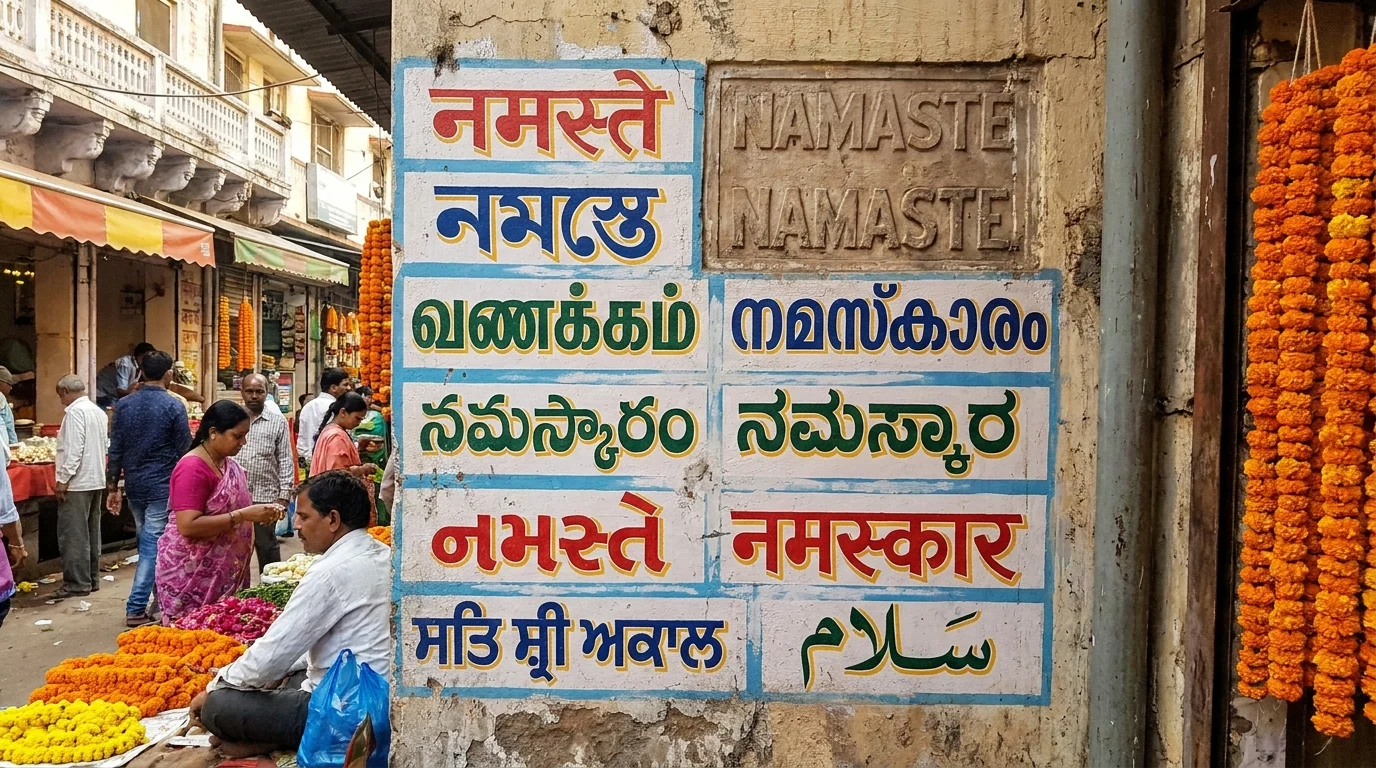
Namaste is a traditional greeting that many people associate with India, yoga, and South Asian culture. But how do people say hello in different languages around the world?
While namaste in different languages can refer to translations of the greeting itself, it is also useful to learn the natural ways people greet one another in everyday conversation. Spanish speakers commonly say hola, French speakers say bonjour, and Japanese speakers say こんにちは (konnichiwa).
This guide explores 70 languages with native greetings, easy pronunciation guides, example sentences, and English meanings to help you greet people respectfully and confidently.
How Do You Say Namaste in Different Languages?
Namaste is written as नमस्ते in Devanagari and is commonly used as a respectful greeting in Hindi and several South Asian settings. It is often associated with a gesture of bringing the palms together, although usage varies by context.
In other languages, people generally use their own customary greetings rather than translating namaste literally.
| Language | Common Greeting | Easy Pronunciation |
|---|---|---|
| Hindi | नमस्ते | nuh-muh-stay |
| Urdu | آداب | aa-daab |
| Bengali | নমস্কার | nomoshkar |
| Spanish | Hola | OH-lah |
| French | Bonjour | bon-ZHOOR |
| German | Hallo | HAH-loh |
| Japanese | こんにちは | kon-nee-chee-wah |
| Chinese (Mandarin) | 你好 | nee-how |
Namaste and Greetings in South Asian Languages
South Asia has a rich variety of greetings shaped by language, community, and social context. Namaste is widely recognized, but other greetings may be more appropriate in particular regions or situations.
| Language | Native Greeting | Easy Pronunciation | Example Sentence | English Meaning |
|---|---|---|---|---|
| Hindi | नमस्ते | nuh-muh-stay | नमस्ते, आप कैसे हैं? | Hello, how are you? |
| Urdu | آداب | aa-daab | آداب، آپ کیسے ہیں؟ | Greetings, how are you? |
| Bengali | নমস্কার | nomosh-kar | নমস্কার, আপনি কেমন আছেন? | Hello, how are you? |
| Punjabi | ਸਤ ਸ੍ਰੀ ਅਕਾਲ | sat sri akaal | ਸਤ ਸ੍ਰੀ ਅਕਾਲ, ਤੁਸੀਂ ਕਿਵੇਂ ਹੋ? | Hello, how are you? |
| Gujarati | નમસ્તે | nuh-muh-stay | નમસ્તે, તમે કેમ છો? | Hello, how are you? |
| Marathi | नमस्कार | nuh-muh-skaar | नमस्कार, तुम्ही कसे आहात? | Hello, how are you? |
| Nepali | नमस्ते | nuh-muh-stay | नमस्ते, तपाईंलाई कस्तो छ? | Hello, how are you? |
| Sinhala | ආයුබෝවන් | aa-yu-bo-wan | ආයුබෝවන්, ඔබට කොහොමද? | Hello, how are you? |
Namaste and Greetings in East Asian Languages
East Asian languages have their own conventional greetings. Some are associated with a particular time of day, while others are used more generally.
| Language | Native Greeting | Easy Pronunciation | Example Sentence | English Meaning |
|---|---|---|---|---|
| Chinese (Mandarin) | 你好 | nee-how | 你好,你好吗? | Hello, how are you? |
| Japanese | こんにちは | kon-nee-chee-wah | こんにちは、お元気ですか? | Hello, how are you? |
| Korean | 안녕하세요 | an-nyeong-ha-se-yo | 안녕하세요, 잘 지내세요? | Hello, how are you? |
| Mongolian | Сайн байна уу | sain bai-na uu | Сайн байна уу, та сайн уу? | Hello, are you well? |
| Tibetan | བཀྲ་ཤིས་བདེ་ལེགས། | tash-i de-lek | བཀྲ་ཤིས་བདེ་ལེགས། | Hello, greetings. |
Namaste and Greetings in Southeast Asian Languages
Southeast Asian greetings often reflect local customs and different levels of formality. Learning the standard greeting is a helpful first step when meeting people in the region.
| Language | Native Greeting | Easy Pronunciation | Example Sentence | English Meaning |
|---|---|---|---|---|
| Indonesian | Halo | hah-loh | Halo, apa kabar? | Hello, how are you? |
| Malay | Helo | heh-loh | Helo, apa khabar? | Hello, how are you? |
| Filipino (Tagalog) | Kumusta | koo-moos-tah | Kumusta ka? | How are you? |
| Vietnamese | Xin chào | sin chow | Xin chào, bạn khỏe không? | Hello, how are you? |
| Thai | สวัสดี | sa-wat-dee | สวัสดี คุณสบายดีไหม | Hello, how are you? |
| Burmese | မင်္ဂလာပါ | min-ga-la-ba | မင်္ဂလာပါ၊ နေကောင်းလား။ | Hello, how are you? |
| Khmer | ជំរាបសួរ | chum-ree-up-sua | ជំរាបសួរ អ្នកសុខសប្បាយទេ? | Hello, how are you? |
| Lao | ສະບາຍດີ | sa-bai-dee | ສະບາຍດີ, ສະບາຍດີບໍ? | Hello, how are you? |
Namaste and Greetings in Western European Languages
Western European languages include greetings used in everyday conversation, at work, and when meeting someone for the first time.
| Language | Native Greeting | Easy Pronunciation | Example Sentence | English Meaning |
|---|---|---|---|---|
| English | Hello | heh-loh | Hello, how are you? | Hello, how are you? |
| French | Bonjour | bon-zhoor | Bonjour, comment allez-vous ? | Hello, how are you? |
| German | Hallo | hah-loh | Hallo, wie geht es dir? | Hello, how are you? |
| Dutch | Hallo | hah-loh | Hallo, hoe gaat het? | Hello, how are you? |
| Spanish | Hola | oh-lah | Hola, ¿cómo estás? | Hello, how are you? |
| Portuguese | Olá | oh-lah | Olá, tudo bem? | Hello, how are you? |
| Catalan | Hola | oh-lah | Hola, com estàs? | Hello, how are you? |
Namaste and Greetings in Northern European Languages
Greetings in Northern Europe range from informal hellos to more traditional expressions. The examples below are common ways to start a conversation.
| Language | Native Greeting | Easy Pronunciation | Example Sentence | English Meaning |
|---|---|---|---|---|
| Swedish | Hej | hey | Hej, hur mår du? | Hello, how are you? |
| Norwegian | Hei | hey | Hei, hvordan har du det? | Hello, how are you? |
| Danish | Hej | hi | Hej, hvordan har du det? | Hello, how are you? |
| Finnish | Hei | hay | Hei, mitä kuuluu? | Hello, how are you? |
| Icelandic | Halló | ha-loh | Halló, hvernig hefurðu það? | Hello, how are you? |
| Estonian | Tere | teh-reh | Tere, kuidas läheb? | Hello, how are you? |
| Latvian | Sveiki | svay-kee | Sveiki, kā jums klājas? | Hello, how are you? |
Namaste and Greetings in Southern European Languages
Southern European languages have greetings that can change depending on the time of day, familiarity, and formality.
| Language | Native Greeting | Easy Pronunciation | Example Sentence | English Meaning |
|---|---|---|---|---|
| Italian | Ciao | chow | Ciao, come stai? | Hello, how are you? |
| Romanian | Bună | BOO-nuh | Bună, ce mai faci? | Hello, how are you? |
| Greek | Γεια σας | ya sas | Γεια σας, τι κάνετε; | Hello, how are you? |
| Albanian | Përshëndetje | pur-shun-DEH-tyeh | Përshëndetje, si jeni? | Hello, how are you? |
| Basque | Kaixo | kai-sho | Kaixo, zer moduz? | Hello, how are you? |
| Galician | Ola | OH-lah | Ola, como estás? | Hello, how are you? |
Namaste and Greetings in Slavic and Eastern European Languages
These greetings are useful for travelers and language learners exploring Eastern Europe. Some have formal and informal versions.
| Language | Native Greeting | Easy Pronunciation | Example Sentence | English Meaning |
|---|---|---|---|---|
| Russian | Здравствуйте | ZDRAST-vooy-tye | Здравствуйте, как дела? | Hello, how are you? |
| Ukrainian | Добрий день | DOH-bryi den | Добрий день, як справи? | Good day, how are you? |
| Polish | Cześć | cheshch | Cześć, jak się masz? | Hi, how are you? |
| Czech | Dobrý den | DOH-bree den | Dobrý den, jak se máte? | Hello, how are you? |
| Slovak | Dobrý deň | DOH-bree dyehn | Dobrý deň, ako sa máte? | Hello, how are you? |
| Bulgarian | Здравейте | zdrah-VAY-teh | Здравейте, как сте? | Hello, how are you? |
| Serbian | Здраво | ZDRAH-voh | Здраво, како сте? | Hello, how are you? |
| Croatian | Bok | bok | Bok, kako si? | Hi, how are you? |
Namaste and Greetings in Middle Eastern Languages
Greetings across the Middle East often carry cultural significance. Some expressions are widely used in formal situations, while others are common among friends and family.
| Language | Native Greeting | Easy Pronunciation | Example Sentence | English Meaning |
|---|---|---|---|---|
| Arabic | مرحبًا | mar-ha-ban | مرحبًا، كيف حالك؟ | Hello, how are you? |
| Persian (Farsi) | سلام | sa-laam | سلام، حال شما چطور است؟ | Hello, how are you? |
| Hebrew | שלום | sha-lom | שלום, מה שלומך? | Hello, how are you? |
| Turkish | Merhaba | mehr-ha-ba | Merhaba, nasılsınız? | Hello, how are you? |
| Kurdish (Kurmanji) | Silav | see-lav | Silav, tu çawa yî? | Hello, how are you? |
| Armenian | Բարև | ba-rev | Բարև, ինչպե՞ս եք։ | Hello, how are you? |
Namaste and Greetings in African Languages
Africa is home to many languages and greeting traditions. These examples introduce several common ways to say hello across different communities.
| Language | Native Greeting | Easy Pronunciation | Example Sentence | English Meaning |
|---|---|---|---|---|
| Swahili | Hujambo | hoo-JAHM-boh | Hujambo, habari yako? | Hello, how are you? |
| Afrikaans | Hallo | hah-loh | Hallo, hoe gaan dit? | Hello, how are you? |
| Zulu | Sawubona | sah-woo-BOH-nah | Sawubona, unjani? | Hello, how are you? |
| Xhosa | Molo | moh-loh | Molo, unjani? | Hello, how are you? |
| Yoruba | Ẹ káàbọ̀ | eh kah-ah-baw | Ẹ káàbọ̀, ṣé àlàáfíà ni? | Welcome, are you well? |
| Igbo | Ndewo | n-deh-woh | Ndewo, kedu? | Hello, how are you? |
| Hausa | Sannu | sahn-noo | Sannu, ya kake? | Hello, how are you? |
| Somali | Salaan | sah-laan | Salaan, sidee tahay? | Hello, how are you? |
Namaste and Greetings in Central Asian Languages
Central Asian languages include greetings from Turkic and Persian-related linguistic traditions. The following expressions can help you start a polite conversation.
| Language | Native Greeting | Easy Pronunciation | Example Sentence | English Meaning |
|---|---|---|---|---|
| Kazakh | Сәлеметсіз бе | sa-leh-met-siz beh | Сәлеметсіз бе, қалайсыз? | Hello, how are you? |
| Kyrgyz | Саламатсызбы | sa-la-mat-siz-bih | Саламатсызбы, кандайсыз? | Hello, how are you? |
| Uzbek | Salom | sa-lom | Salom, yaxshimisiz? | Hello, how are you? |
| Tajik | Салом | sa-lom | Салом, шумо чӣ хелед? | Hello, how are you? |
| Turkmen | Salam | sa-lam | Salam, ýagdaýyňyz nähili? | Hello, how are you? |
Namaste and Greetings in Other World Languages
These additional greetings offer examples from Celtic languages and constructed or creole languages.
| Language | Native Greeting | Easy Pronunciation | Example Sentence | English Meaning |
|---|---|---|---|---|
| Irish | Dia dhuit | dee-ah ghwitch | Dia dhuit, conas atá tú? | Hello, how are you? |
| Welsh | Helo | heh-loh | Helo, sut wyt ti? | Hello, how are you? |
| Scottish Gaelic | Halò | ha-loh | Halò, ciamar a tha thu? | Hello, how are you? |
| Esperanto | Saluton | sah-LOO-ton | Saluton, kiel vi fartas? | Hello, how are you? |
| Latin | Salve | SAHL-weh | Salve, quomodo vales? | Hello, how are you? |
| Haitian Creole | Bonjou | bon-zhoo | Bonjou, kijan ou ye? | Hello, how are you? |
What Does Namaste Mean?
Namaste is a respectful greeting originating from Sanskrit and widely used in Hindi and other South Asian contexts. It is written as नमस्ते in Devanagari.
The word is commonly understood as a respectful salutation, often explained through the idea of bowing or offering respect. In everyday use, it can mean “hello” or serve as a polite greeting when meeting or acknowledging someone.
Namaste is also associated with a gesture called añjali mudrā, in which the palms are brought together, often near the chest. The gesture and word can be used together, but practices differ across settings.
Is Namaste the Same as Hello?
Namaste and hello can serve similar purposes, but they are not identical in cultural meaning or usage.
- Namaste: A respectful greeting associated with South Asian traditions and often accompanied by a palms-together gesture.
- Hello: A general English greeting used in casual and formal situations.
- Bonjour: A French greeting commonly used during the day.
- Hola: A common Spanish greeting suitable for many everyday situations.
- Konnichiwa: A standard Japanese greeting generally used during the daytime.
The best greeting depends on the language, situation, and relationship between speakers. A direct translation may communicate the basic idea, but a customary local greeting often sounds more natural.
How to Use Namaste in Everyday Conversations
Namaste can be used in a variety of social situations, particularly when a respectful greeting is appropriate.
- When meeting someone: Say “Namaste” as a polite way to greet another person.
- In a formal setting: It may be appropriate when greeting elders, teachers, guests, or other people you wish to address respectfully.
- During yoga classes: Teachers may use namaste as a greeting or closing expression, depending on their practice.
- When visiting South Asia: Follow the customs of the people and community you are visiting rather than assuming that everyone uses the same greeting.
- When learning languages: Practice the greeting alongside the local expression for “How are you?”
Namaste is widely recognized, but it is not the everyday greeting used by everyone in every part of South Asia.
Formal and Informal Greetings Around the World
Some languages use different greetings depending on whether you are speaking to a friend, a stranger, or someone you wish to address politely.
- French: Salut is informal, while bonjour is a common general greeting.
- Spanish: Hola works in many situations, while buenos días is a polite morning greeting.
- German: Hallo is common in casual conversation, while Guten Tag is more formal.
- Japanese: こんにちは is a common daytime greeting, while more formal language may be needed in professional situations.
- Hindi: नमस्ते is a broadly useful respectful greeting.
- Arabic: مرحبًا is a common hello, while السلام عليكم is another widely used greeting with religious and cultural significance.
When in doubt, choose a polite greeting and observe how local speakers address one another.
Tips for Learning Greetings in Different Languages
Learning greetings is a simple way to begin exploring a new language. These techniques can help you remember the words and use them confidently.
- Start with a few languages: Learn five greetings at a time instead of memorizing all 70 immediately.
- Practice pronunciation aloud: Repeat each greeting slowly, then at a natural pace.
- Learn complete expressions: Pair “hello” with “How are you?” to practice a short conversation.
- Use flashcards: Put the native greeting on one side and its pronunciation and meaning on the other.
- Listen to native speakers: Audio examples help you learn sounds that English spelling cannot represent accurately.
- Understand cultural context: Notice when a greeting is formal, informal, time-specific, or connected to a local custom.
Consistent practice helps you remember greetings and choose expressions that suit different social situations.
Frequently Asked Questions
How do you say namaste in different languages?
Namaste is commonly written as नमस्ते in Hindi. Equivalent everyday greetings include hola in Spanish, bonjour in French, hello in English, and konnichiwa in Japanese. These are customary greetings rather than exact translations of namaste’s cultural meaning.
What is the literal meaning of namaste?
Namaste is commonly understood as a respectful salutation associated with bowing or showing respect. Its interpretation is often explained through its Sanskrit roots, although simple everyday use generally corresponds to a polite greeting.
Is namaste used only in India?
No. Namaste is used in India and is also recognized in Nepal and other South Asian contexts. Its use varies by language, community, and situation, and it is not the only greeting used in these regions.
Can you use namaste to say goodbye?
Namaste is primarily a greeting, but it may also be used when parting in some contexts. The customary farewell depends on the language, region, and situation.
What is the difference between namaste and hello?
Hello is a general English greeting, while namaste is a traditional South Asian salutation with cultural associations of respect. They can serve similar purposes, but they do not carry exactly the same cultural meaning.
Conclusion
Learning namaste in different languages is a useful way to explore greetings, pronunciation, and cultural differences around the world. From नमस्ते and नमस्कार to hola, bonjour, and konnichiwa, each expression offers a way to begin a conversation. Practice the native spellings, learn when each greeting is appropriate, and use respectful expressions when meeting people from different linguistic backgrounds.

I am Ricardo Hunter, Administrator at LingoBuz, passionate about languages, translations, and global communication. I help create useful, clear content that makes exploring different languages simple, enjoyable, and accessible.