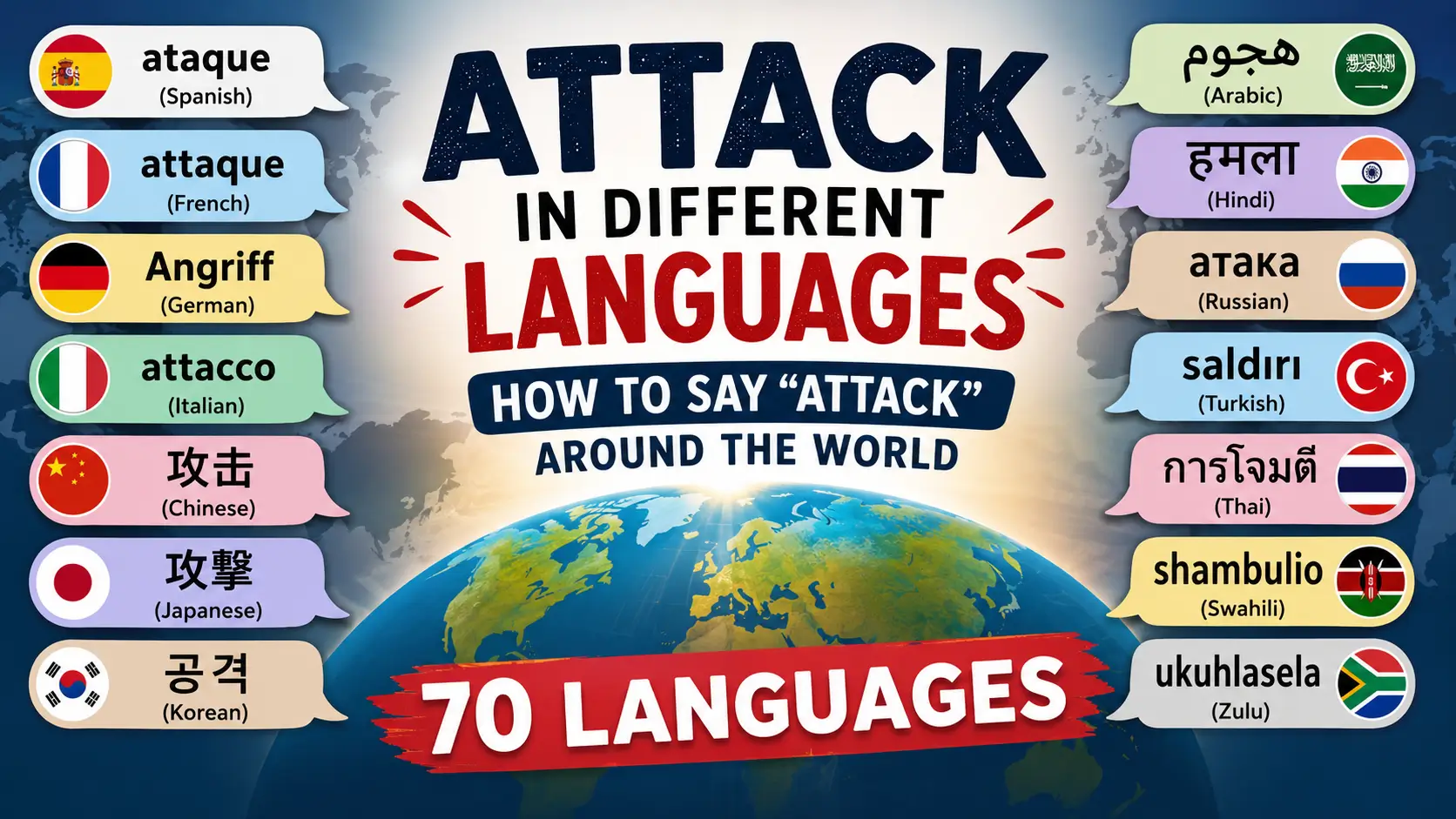
Learning how to say “attack” in different languages is useful for travelers, language learners, translators, students, writers, and anyone interested in global communication. The word can describe a physical assault, a military action, a sudden attempt to harm someone, or even a figurative action such as an attack on an idea or argument.
Below, you will find attack translations in 70 languages, including the native phrase, an easy English pronunciation, and a short example sentence with its English meaning. This makes it easier to understand not only the word itself but also how it can be used naturally.
Whether you are searching for “attack in all languages,” “how to say attack in different languages,” or simply exploring the word attack around the world, this guide provides a convenient reference.
Attack in Different Languages: 70 Translations
| # | Language | Native phrase | Easy English pronunciation | Example sentence | English meaning |
|---|---|---|---|---|---|
| 1 | English | attack | uh-TAK | The attack happened at night. | The attack happened at night. |
| 2 | Spanish | ataque | ah-TAH-keh | El ataque ocurrió de noche. | The attack happened at night. |
| 3 | French | attaque | ah-TAK | L’attaque a eu lieu la nuit. | The attack happened at night. |
| 4 | German | Angriff | AHN-griff | Der Angriff geschah in der Nacht. | The attack happened at night. |
| 5 | Italian | attacco | ah-TAK-koh | L’attacco è avvenuto di notte. | The attack happened at night. |
| 6 | Portuguese | ataque | ah-TAH-kee | O ataque aconteceu à noite. | The attack happened at night. |
| 7 | Dutch | aanval | AHN-vahl | De aanval gebeurde ‘s nachts. | The attack happened at night. |
| 8 | Swedish | attack | ah-TAK | Attacken hände på natten. | The attack happened at night. |
| 9 | Norwegian | angrep | AHN-grehp | Angrepet skjedde om natten. | The attack happened at night. |
| 10 | Danish | angreb | AHN-grehb | Angrebet skete om natten. | The attack happened at night. |
| 11 | Finnish | hyökkäys | HUH-yk-kays | Hyökkäys tapahtui yöllä. | The attack happened at night. |
| 12 | Icelandic | árás | OW-r-ows | Árásin gerðist um nóttina. | The attack happened at night. |
| 13 | Irish | ionsaí | IN-shee | Tharla an t-ionsaí san oíche. | The attack happened at night. |
| 14 | Scottish Gaelic | ionnsaigh | IN-sigh | Thachair an ionnsaigh air an oidhche. | The attack happened at night. |
| 15 | Welsh | ymosodiad | uh-moh-SOH-dee-ad | Digwyddodd yr ymosodiad yn y nos. | The attack happened at night. |
| 16 | Polish | atak | AH-tak | Atak wydarzył się w nocy. | The attack happened at night. |
| 17 | Czech | útok | OO-tok | K útoku došlo v noci. | The attack happened at night. |
| 18 | Slovak | útok | OO-tok | K útoku došlo v noci. | The attack happened at night. |
| 19 | Slovenian | napad | nah-PAHD | Napad se je zgodil ponoči. | The attack happened at night. |
| 20 | Croatian | napad | NAH-pahd | Napad se dogodio noću. | The attack happened at night. |
| 21 | Serbian | напад | NAH-pahd | Напад се догодио ноћу. | The attack happened at night. |
| 22 | Bosnian | napad | NAH-pahd | Napad se dogodio noću. | The attack happened at night. |
| 23 | Bulgarian | атака | ah-TAH-kah | Атаката се случи през нощта. | The attack happened at night. |
| 24 | Macedonian | напад | NAH-pahd | Нападот се случи ноќе. | The attack happened at night. |
| 25 | Russian | атака | ah-TAH-kah | Атака произошла ночью. | The attack happened at night. |
| 26 | Ukrainian | атака | ah-TAH-kah | Атака сталася вночі. | The attack happened at night. |
| 27 | Belarusian | атака | ah-TAH-kah | Атака адбылася ўначы. | The attack happened at night. |
| 28 | Lithuanian | puolimas | poh-LEE-mas | Puolimas įvyko naktį. | The attack happened at night. |
| 29 | Latvian | uzbrukums | ooz-BROOK-oohms | Uzbrukums notika naktī. | The attack happened at night. |
| 30 | Estonian | rünnak | RUHN-nahk | Rünnak toimus öösel. | The attack happened at night. |
| 31 | Romanian | atac | ah-TAHK | Atacul a avut loc noaptea. | The attack happened at night. |
| 32 | Hungarian | támadás | TAH-mah-dahsh | A támadás éjjel történt. | The attack happened at night. |
| 33 | Greek | επίθεση | eh-PEE-thee-see | Η επίθεση έγινε τη νύχτα. | The attack happened at night. |
| 34 | Albanian | sulm | soolm | Sulmi ndodhi natën. | The attack happened at night. |
| 35 | Armenian | հարձակում | hart-sa-KOOM | Հարձակումը տեղի ունեցավ գիշերը։ | The attack happened at night. |
| 36 | Georgian | თავდასხმა | tahv-dah-SKH-mah | თავდასხმა ღამით მოხდა. | The attack happened at night. |
| 37 | Turkish | saldırı | sahld-uh-RUH | Saldırı gece gerçekleşti. | The attack happened at night. |
| 38 | Azerbaijani | hücum | hoo-JOOM | Hücum gecə baş verdi. | The attack happened at night. |
| 39 | Persian | حمله | ham-LEH | حمله شب اتفاق افتاد. | The attack happened at night. |
| 40 | Arabic | هجوم | hoo-JOOM | حدث الهجوم في الليل. | The attack happened at night. |
| 41 | Hebrew | התקפה | hah-tah-PAH | ההתקפה התרחשה בלילה. | The attack happened at night. |
| 42 | Hindi | हमला | HUM-la | हमला रात में हुआ। | The attack happened at night. |
| 43 | Urdu | حملہ | HUM-la | حملہ رات کو ہوا۔ | The attack happened at night. |
| 44 | Bengali | আক্রমণ | AH-kro-mon | আক্রমণটি রাতে ঘটেছিল। | The attack happened at night. |
| 45 | Punjabi | ਹਮਲਾ | HUM-la | ਹਮਲਾ ਰਾਤ ਨੂੰ ਹੋਇਆ। | The attack happened at night. |
| 46 | Gujarati | હુમલો | HOOM-loh | હુમલો રાત્રે થયો હતો. | The attack happened at night. |
| 47 | Marathi | हल्ला | HAL-la | हल्ला रात्री झाला. | The attack happened at night. |
| 48 | Nepali | आक्रमण | ah-kra-MAN | आक्रमण राति भयो। | The attack happened at night. |
| 49 | Sinhala | ප්රහාරය | pra-HAH-ra-ya | ප්රහාරය රාත්රියේ සිදු විය. | The attack happened at night. |
| 50 | Tamil | தாக்குதல் | TAAK-ku-thal | தாக்குதல் இரவில் நடந்தது. | The attack happened at night. |
| 51 | Telugu | దాడి | DAA-dee | దాడి రాత్రి జరిగింది. | The attack happened at night. |
| 52 | Kannada | ದಾಳಿ | DAA-lee | ದಾಳಿ ರಾತ್ರಿ ನಡೆಯಿತು. | The attack happened at night. |
| 53 | Malayalam | ആക്രമണം | aa-KRA-ma-nam | ആക്രമണം രാത്രിയിൽ നടന്നു. | The attack happened at night. |
| 54 | Thai | การโจมตี | gaan johm-TEE | การโจมตีเกิดขึ้นในตอนกลางคืน | The attack happened at night. |
| 55 | Vietnamese | cuộc tấn công | kwook tuhn kohng | Cuộc tấn công xảy ra vào ban đêm. | The attack happened at night. |
| 56 | Indonesian | serangan | seh-RAH-ngahn | Serangan terjadi pada malam hari. | The attack happened at night. |
| 57 | Malay | serangan | seh-RAH-ngahn | Serangan itu berlaku pada waktu malam. | The attack happened at night. |
| 58 | Filipino | pag-atake | pahg-ah-TA-keh | Nangyari ang pag-atake sa gabi. | The attack happened at night. |
| 59 | Chinese | 攻击 | gōngjī | 袭击发生在晚上。 | The attack happened at night. |
| 60 | Japanese | 攻撃 | kōgeki | 攻撃は夜に起きました。 | The attack happened at night. |
| 61 | Korean | 공격 | gong-gyeok | 공격은 밤에 일어났습니다. | The attack happened at night. |
| 62 | Mongolian | халдлага | khald-LAH-gah | Халдлага шөнө болсон. | The attack happened at night. |
| 63 | Kazakh | шабуыл | shah-BUHL | Шабуыл түнде болды. | The attack happened at night. |
| 64 | Uzbek | hujum | hoo-JOOM | Hujum tunda sodir bo‘ldi. | The attack happened at night. |
| 65 | Swahili | shambulio | sham-boo-LEE-oh | Shambulio lilitokea usiku. | The attack happened at night. |
| 66 | Afrikaans | aanval | AHN-fahl | Die aanval het snags gebeur. | The attack happened at night. |
| 67 | Amharic | ጥቃት | ti-KAAT | ጥቃቱ በሌሊት ተከሰተ። | The attack happened at night. |
| 68 | Somali | weerar | WAY-rar | Weerarku wuxuu dhacay habeenkii. | The attack happened at night. |
| 69 | Yoruba | ikọlu | ee-KOH-loo | Ikọlu naa ṣẹlẹ ni alẹ. | The attack happened at night. |
| 70 | Zulu | ukuhlasela | oo-koo-hlah-SEH-lah | Ukuhlasela kwenzeka ebusuku. | The attack happened at night. |
What Does “Attack” Mean?
The English word attack has several meanings depending on context.
As a noun, it can refer to an act of trying to hurt, defeat, or damage someone or something. For example, “The city suffered an attack.”
As a verb, attack means to act aggressively against a person, place, group, or object. For example, “The soldiers attacked the position.”
The word can also have non-physical meanings. Someone can “attack an argument” by strongly criticizing its logic or evidence. In medicine, words such as “heart attack” and “asthma attack” use the same English word but have specialized meanings.
How to Say Attack in Different Languages
The translations above show that attack does not always have one exact equivalent in every language.
For example, Spanish uses ataque, French uses attaque, German commonly uses Angriff, and Turkish uses saldırı. In several South Asian languages, words such as Hindi हमला and Urdu حملہ are commonly used for an attack.
Asian languages may use very different structures. Japanese uses 攻撃 (kōgeki), Chinese uses 攻击 (gōngjī), and Korean uses 공격 (gong-gyeok).
Attack Translations Around the World
The word can change depending on whether you mean a military attack, physical assault, verbal attack, cyberattack, or medical attack.
For example:
- Military attack: an organized action against an opposing force.
- Physical attack: an attempt to physically harm another person.
- Verbal attack: strong or aggressive criticism.
- Cyberattack: a malicious digital attack against a computer system or network.
- Medical attack: a sudden episode associated with a health condition.
This is why context is important when choosing the right attack translation.
Common Phrases With “Attack”
English uses “attack” in many common expressions. Understanding these phrases can make translation easier.
Physical attack
A physical attack involves an attempt to harm someone physically.
Example: “The police investigated the reported physical attack.”
Military attack
A military attack usually refers to an organized action involving armed forces.
Example: “The army prepared for a possible attack.”
Verbal attack
A verbal attack means harsh or aggressive criticism directed at someone.
Example: “The speaker faced a verbal attack during the debate.”
Cyberattack
A cyberattack is an attack carried out through computers, networks, or digital systems.
Example: “The company strengthened its security after the cyberattack.”
Surprise attack
A surprise attack happens unexpectedly, often before the target has time to prepare.
Example: “The surprise attack caught the group off guard.”
Why Learn “Attack” in Different Languages?
Learning vocabulary such as attack in different languages can improve your understanding of international news, books, films, history, travel conversations, and multilingual communication.
It is also useful for language learners because the word appears frequently in discussions about history, politics, sports, cybersecurity, literature, and everyday descriptions of conflict.
Knowing the surrounding context is just as important as memorizing the translation. A direct dictionary translation may not always be the most natural word for every situation.
Tips for Using “Attack” Correctly
When translating attack, first identify what kind of attack is being discussed.
Ask yourself:
- Is it physical?
- Is it military?
- Is it verbal?
- Is it digital?
- Is it medical?
- Is “attack” being used metaphorically?
Then check whether the target language uses a different word or grammatical form for that specific context.
This approach produces more natural attack translations than simply replacing the English word with a dictionary equivalent.
Frequently Asked Questions
1. How do you say “attack” in different languages?
“Attack” has different translations around the world. Examples include ataque in Spanish, attaque in French, Angriff in German, attacco in Italian, 攻撃 in Japanese, 攻击 in Chinese, 공격 in Korean, and هجوم in Arabic.
2. What is “attack” in all languages?
There is no single universal translation for “attack.” The 70-language table above provides commonly used equivalents across European, Asian, Middle Eastern, and African languages.
3. What is the most common translation of “attack”?
The most appropriate translation depends on the language and context. In some languages, the same word can cover several meanings, while others may use different words for military, physical, verbal, or digital attacks.
4. Is “attack” a noun or a verb?
“Attack” can be both a noun and a verb in English. As a noun, it describes an aggressive action or event. As a verb, it describes the act of aggressively acting against someone or something.
5. Why can attack translations differ by context?
Languages often distinguish between different types of attacks. A military attack, physical assault, cyberattack, and medical attack may require different words or expressions depending on the language.
Conclusion
Learning attack in different languages is a useful way to expand your vocabulary and understand how different cultures express ideas about conflict, aggression, criticism, and sudden events.
The 70 translations in this guide provide a practical starting point for understanding how to say attack in different languages. For accurate communication, always consider the context before choosing a translation, especially when the word refers to a specific type of attack.

I am Ricardo Hunter, Administrator at LingoBuz, passionate about languages, translations, and global communication. I help create useful, clear content that makes exploring different languages simple, enjoyable, and accessible.