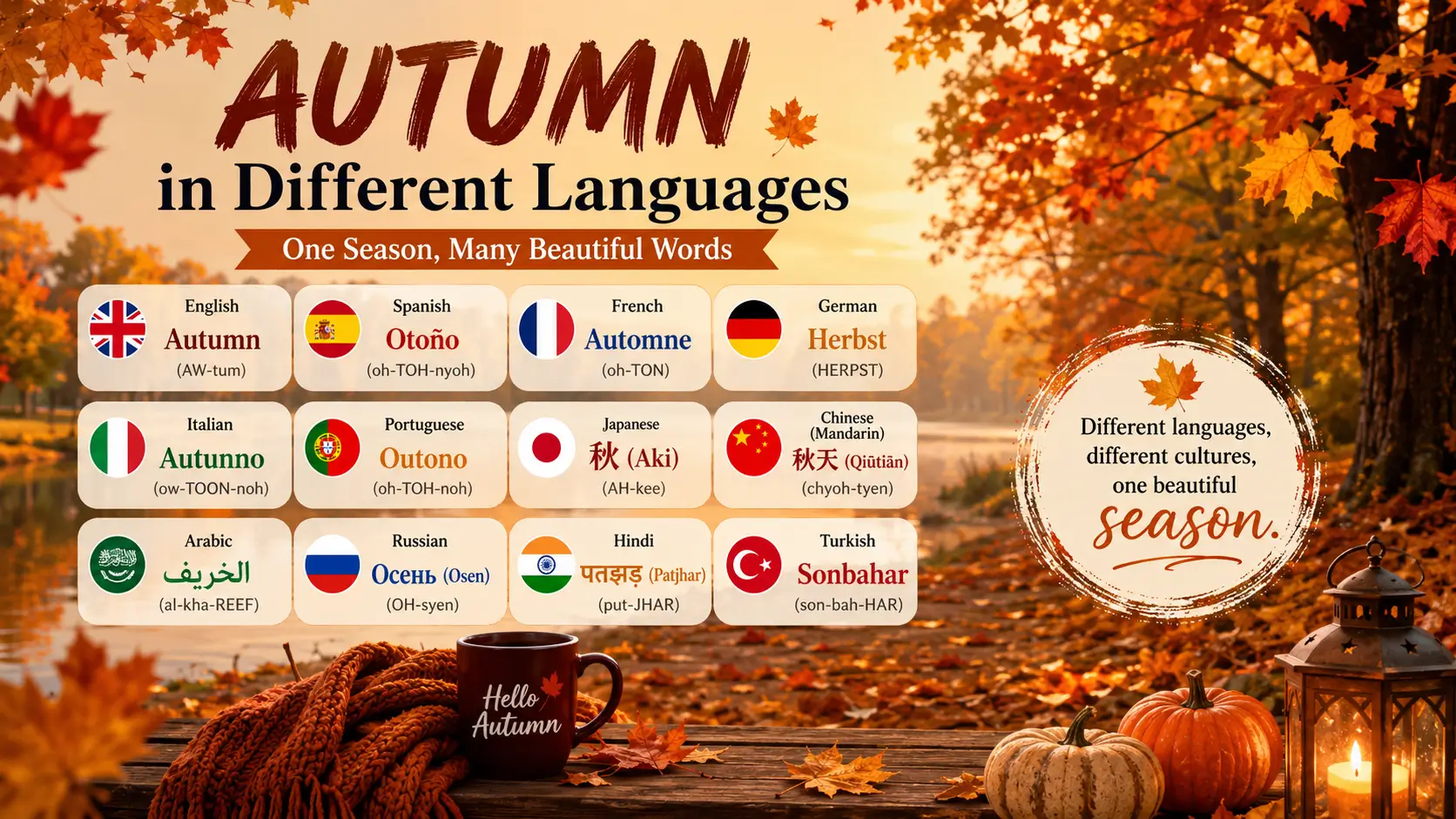
Autumn is one of the most beautiful seasons of the year, known for cooler weather, colorful leaves, shorter days, and cozy traditions. But how do people around the world talk about this season?
If you are searching for autumn in different languages, this guide gives you 70 translations with native phrases, easy English pronunciations, and practical example sentences. You will learn how to say autumn in different languages and discover how the word is used naturally in everyday conversation.
Whether you are learning languages, traveling, writing, studying, or simply curious about autumn translations, this list makes it easy to compare the word autumn around the world.
Autumn in Different Languages: 70 Translations
| # | Language | Autumn | Easy English Pronunciation | Example Sentence | English Meaning |
|---|---|---|---|---|---|
| 1 | English | Autumn | AW-tum | Autumn is my favorite season. | Autumn is my favorite season. |
| 2 | Spanish | Otoño | oh-TOH-nyoh | Me encanta el otoño. | I love autumn. |
| 3 | French | Automne | oh-TON | J’aime l’automne. | I like autumn. |
| 4 | German | Herbst | HERPST | Der Herbst ist schön. | Autumn is beautiful. |
| 5 | Italian | Autunno | ow-TOON-noh | Amo l’autunno. | I love autumn. |
| 6 | Portuguese | Outono | oh-TOH-noh | Eu gosto do outono. | I like autumn. |
| 7 | Dutch | Herfst | HERFST | De herfst is prachtig. | Autumn is beautiful. |
| 8 | Swedish | Höst | HURST | Hösten är vacker. | Autumn is beautiful. |
| 9 | Danish | Efterår | EF-ter-or | Jeg elsker efteråret. | I love autumn. |
| 10 | Norwegian | Høst | HURST | Jeg liker høsten. | I like autumn. |
| 11 | Finnish | Syksy | SUUK-see | Syksy on kaunis. | Autumn is beautiful. |
| 12 | Icelandic | Haust | HOYST | Haustið er fallegt. | Autumn is beautiful. |
| 13 | Irish | Fómhar | FOH-war | Is breá liom an fómhar. | I love autumn. |
| 14 | Scottish Gaelic | Foghar | FOH-ar | Tha am foghar àlainn. | Autumn is beautiful. |
| 15 | Welsh | Hydref | HUH-drev | Mae’r hydref yn brydferth. | Autumn is beautiful. |
| 16 | Polish | Jesień | YEH-shyen | Lubię jesień. | I like autumn. |
| 17 | Czech | Podzim | POHD-zeem | Mám rád podzim. | I like autumn. |
| 18 | Slovak | Jeseň | YEH-sen | Mám rád jeseň. | I like autumn. |
| 19 | Slovenian | Jesen | YEH-sen | Rad imam jesen. | I like autumn. |
| 20 | Croatian | Jesen | YEH-sen | Volim jesen. | I love autumn. |
| 21 | Serbian | Јесен (Jesen) | YEH-sen | Волим јесен. | I love autumn. |
| 22 | Bosnian | Jesen | YEH-sen | Volim jesen. | I love autumn. |
| 23 | Macedonian | Есен (Esen) | EH-sen | Ја сакам есента. | I love autumn. |
| 24 | Bulgarian | Есен (Esen) | EH-sen | Обичам есента. | I love autumn. |
| 25 | Russian | Осень (Osen) | OH-syen | Я люблю осень. | I love autumn. |
| 26 | Ukrainian | Осінь (Osin) | OH-seen | Я люблю осінь. | I love autumn. |
| 27 | Belarusian | Восень (Vosen) | VOH-syen | Я люблю восень. | I love autumn. |
| 28 | Lithuanian | Ruduo | roo-DOH | Man patinka ruduo. | I like autumn. |
| 29 | Latvian | Rudens | ROO-dens | Man patīk rudens. | I like autumn. |
| 30 | Estonian | Sügis | SUU-gis | Mulle meeldib sügis. | I like autumn. |
| 31 | Romanian | Toamnă | TOAM-nuh | Îmi place toamna. | I like autumn. |
| 32 | Hungarian | Ősz | URSH | Szeretem az őszt. | I love autumn. |
| 33 | Albanian | Vjeshtë | VYEH-shtuh | Më pëlqen vjeshta. | I like autumn. |
| 34 | Greek | Φθινόπωρο (Fthinóporo) | fthee-NOH-poh-roh | Μου αρέσει το φθινόπωρο. | I like autumn. |
| 35 | Turkish | Sonbahar | son-bah-HAR | Sonbaharı seviyorum. | I love autumn. |
| 36 | Azerbaijani | Payız | pah-YIZ | Mən payızı sevirəm. | I love autumn. |
| 37 | Armenian | Աշուն (Ashun) | ah-SHOON | Ես սիրում եմ աշունը։ | I love autumn. |
| 38 | Georgian | შემოდგომა (Shemodgoma) | sheh-mod-GOH-mah | მე მიყვარს შემოდგომა. | I love autumn. |
| 39 | Persian | پاییز (Pāyiz) | pah-YEEZ | من پاییز را دوست دارم. | I like autumn. |
| 40 | Kurdish (Kurmanji) | Payîz | pah-YEEZ | Ez payîzê hez dikim. | I love autumn. |
| 41 | Arabic | الخريف (Al-kharīf) | al-kha-REEF | أحب الخريف. | I love autumn. |
| 42 | Hebrew | סתיו (Stav) | STAHV | אני אוהב סתיו. | I love autumn. |
| 43 | Maltese | Ħarifa | ha-REE-fa | Inħobb il-ħarifa. | I love autumn. |
| 44 | Hindi | पतझड़ (Patjhar) | put-JHAR | मुझे पतझड़ पसंद है। | I like autumn. |
| 45 | Urdu | خزاں (Khizaan) | khiz-AAN | مجھے خزاں پسند ہے۔ | I like autumn. |
| 46 | Bengali | শরৎ (Shorot) | SHO-rot | আমার শরৎকাল ভালো লাগে। | I like autumn. |
| 47 | Punjabi | ਪਤਝੜ (Patjhar) | put-JHAR | ਮੈਨੂੰ ਪਤਝੜ ਪਸੰਦ ਹੈ। | I like autumn. |
| 48 | Gujarati | પાનખર (Paanakhar) | paa-na-KHAR | મને પાનખર ગમે છે. | I like autumn. |
| 49 | Marathi | शरद ऋतू (Sharad Ritu) | SHUH-rud RI-too | मला शरद ऋतू आवडतो. | I like autumn. |
| 50 | Nepali | शरद् (Sharad) | SHUH-rud | मलाई शरद् ऋतु मन पर्छ। | I like autumn. |
| 51 | Sanskrit | शरद् (Sharad) | SHUH-rud | शरद् ऋतुः रमणीयः अस्ति। | Autumn is beautiful. |
| 52 | Tamil | இலையுதிர் காலம் (Ilaiyuthir Kaalam) | ee-lai-yoo-thir KAA-lum | எனக்கு இலையுதிர் காலம் பிடிக்கும். | I like autumn. |
| 53 | Telugu | శరదృతువు (Sharadṛtuvu) | sha-ra-DRI-too-voo | నాకు శరదృతువు ఇష్టం. | I like autumn. |
| 54 | Kannada | ಶರತ್ಕಾಲ (Sharatkāla) | sha-rut-KAA-la | ನನಗೆ ಶರತ್ಕಾಲ ಇಷ್ಟ. | I like autumn. |
| 55 | Malayalam | ശരത്കാലം (Sharathkaalam) | sha-ruth-KAA-lum | എനിക്ക് ശരത്കാലം ഇഷ്ടമാണ്. | I like autumn. |
| 56 | Chinese (Mandarin) | 秋天 (Qiūtiān) | chyoh-tyen | 我喜欢秋天。 | I like autumn. |
| 57 | Japanese | 秋 (Aki) | AH-kee | 秋が好きです。 | I like autumn. |
| 58 | Korean | 가을 (Gaeul) | gah-ul | 저는 가을을 좋아해요. | I like autumn. |
| 59 | Vietnamese | Mùa thu | moo-ah too | Tôi thích mùa thu. | I like autumn. |
| 60 | Thai | ฤดูใบไม้ร่วง (Ruedu Bai Mai Ruang) | rue-doo bai-MAI roo-ang | ฉันชอบฤดูใบไม้ร่วง | I like autumn. |
| 61 | Indonesian | Musim gugur | MOO-sim goo-GOOR | Saya suka musim gugur. | I like autumn. |
| 62 | Malay | Musim luruh | MOO-sim loo-ROOH | Saya suka musim luruh. | I like autumn. |
| 63 | Filipino | Taglagas | tag-LAH-gas | Gusto ko ang taglagas. | I like autumn. |
| 64 | Mongolian | Намар (Namar) | nah-MAR | Би намарт дуртай. | I like autumn. |
| 65 | Kazakh | Күз (Küz) | kooz | Мен күзді жақсы көремін. | I love autumn. |
| 66 | Kyrgyz | Күз (Küz) | kooz | Мен күздү жакшы көрөм. | I love autumn. |
| 67 | Uzbek | Kuz | kooz | Men kuzni yaxshi ko’raman. | I love autumn. |
| 68 | Tajik | Тирамоҳ (Tiramoҳ) | tee-rah-MOH | Ман тирамоҳро дӯст медорам. | I love autumn. |
| 69 | Swahili | Vuli | VOO-lee | Ninapenda vuli. | I love autumn. |
| 70 | Afrikaans | Herfs | HERFS | Ek hou van herfs. | I like autumn. |
How to Say Autumn in Different Languages
The word for autumn varies significantly across language families. European languages often have completely different forms, while several Slavic languages use related words derived from older linguistic roots.
For example, autumn is otoño in Spanish, automne in French, autunno in Italian, and Herbst in German. In Japanese, it is aki, while Mandarin Chinese uses qiūtiān. Arabic uses al-kharīf, and Turkish uses sonbahar.
These differences make autumn an interesting word to study when exploring vocabulary in all languages.
Autumn vs. Fall: What Is the Difference?
In English, both autumn and fall refer to the same season.
“Autumn” is especially common in British English and is also widely understood internationally. “Fall” is particularly common in American English.
For example:
- British English: Autumn is my favorite season.
- American English: Fall is my favorite season.
The two words have the same basic meaning, although “fall” has a more distinctly American feel in modern everyday usage.
Autumn Around the World
Autumn does not look the same everywhere.
In countries with four distinct seasons, autumn is often associated with falling leaves, cooler temperatures, harvests, and shorter daylight hours. In other parts of the world, seasonal changes may be less dramatic.
Cultural traditions also vary. Autumn can be connected with harvest celebrations, seasonal foods, festivals, school terms, nature walks, and changes in clothing.
Learning autumn translations therefore gives you more than a vocabulary word. It can also introduce you to different ways cultures describe and experience the changing seasons.
Why Learn Autumn Translations?
Knowing the word for autumn in another language can be useful for travelers, students, language learners, writers, and anyone interested in world cultures.
It can help you:
- Expand your seasonal vocabulary.
- Understand conversations while traveling.
- Describe weather and nature more naturally.
- Recognize seasonal references in foreign media.
- Practice pronunciation and sentence construction.
- Learn how different languages express the same idea.
The examples in the table are intentionally short so they can be used as practical language-learning phrases.
Common Autumn Vocabulary
Once you know how to say autumn, you can expand your vocabulary with related seasonal words.
Useful concepts include:
- Leaves — the colorful leaves associated with the season.
- Cool weather — lower temperatures after summer.
- Harvest — gathering crops at the end of the growing season.
- Rain — common seasonal weather in many regions.
- Wind — often associated with falling leaves.
- October — a month strongly associated with autumn in the Northern Hemisphere.
- September — the beginning of autumn in many places.
- November — a late-autumn month in much of the Northern Hemisphere.
Learning related words alongside autumn in different languages makes it easier to create complete sentences rather than memorizing isolated vocabulary.
Autumn in Different Languages for Travel and Conversation
If you are traveling during autumn, knowing the local word can make simple conversations more natural.
You might use it when talking about the weather, asking about seasonal activities, discussing travel plans, or describing scenery.
For language learners, the easiest approach is to memorize the native word together with a short sentence. This helps you remember not only the translation but also how the word functions in everyday communication.
Frequently Asked Questions
1. How do you say autumn in different languages?
Autumn has many different translations. For example, it is otoño in Spanish, automne in French, Herbst in German, autunno in Italian, 秋 (aki) in Japanese, 秋天 (qiūtiān) in Mandarin Chinese, and خريف (kharīf) in Arabic.
2. What is autumn called in American English?
In American English, fall is the most common everyday term for the season. Autumn is also correct and widely understood.
3. What is autumn called in British English?
Autumn is the standard term in British English. The word refers to the season between summer and winter.
4. What is the most common translation of autumn?
There is no single translation used worldwide. Each language has its own word or expression. Some languages use a single word, while others use a phrase describing the season or falling leaves.
5. Why are autumn translations different across languages?
Languages developed independently across different regions and cultures, so each developed its own vocabulary for seasonal changes. Historical, geographical, and cultural influences have all shaped the words used for autumn.
Conclusion
Learning autumn in different languages is a simple and enjoyable way to expand your vocabulary while discovering how people around the world describe the changing seasons.
From otoño in Spanish and automne in French to aki in Japanese and qiūtiān in Chinese, the translations may sound different, but they all describe the same beautiful time of year.
Use the 70-language table as a quick reference, and practice each word with its example sentence to make the vocabulary easier to remember.

I am Scarlett Wilson, a passionate language writer who loves exploring different languages, words, meanings, translations, and useful phrases. I enjoy making language learning simple, clear, and interesting for everyone.