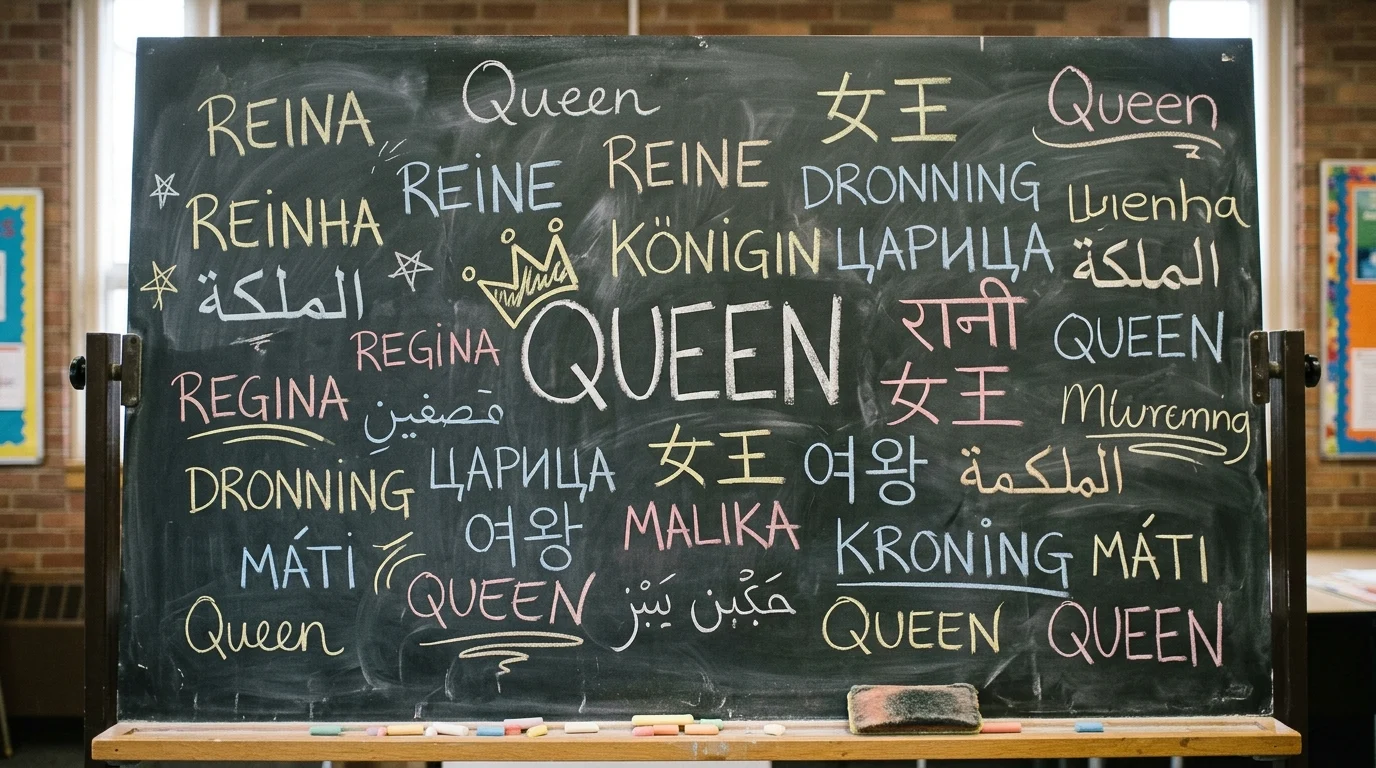
The word queen in different languages reveals how languages express royalty, leadership, and tradition. Whether you are learning a new language, writing a story, exploring royal history, or choosing a meaningful word for a creative project, knowing how to say “queen” around the world can be useful and interesting.
In this guide, you will discover the word for queen in 70 different languages, including native-script spellings, easy English pronunciations, and short example sentences with English translations. You will also learn how the word can change depending on grammar, royal titles, and cultural context.
How Do You Say Queen in Different Languages?
The word “queen” has different forms across languages. Here are eight examples to help you get started.
| Language | Queen | Easy Pronunciation |
|---|---|---|
| Spanish | Reina | RAY-nah |
| French | Reine | REN |
| German | Königin | KUR-nig-in |
| Italian | Regina | reh-JEE-nah |
| Portuguese | Rainha | rah-EEN-yah |
| Arabic | ملكة | MA-li-kah |
| Urdu | ملکہ | MAL-kah |
| Japanese | 女王 | joh-oh |
These words generally refer to a queen, but the precise meaning can depend on whether the speaker means a reigning monarch, a queen consort, or a queen in a game or story.
1. South Asian Languages
South Asia has many languages with rich traditions of royal titles. The words below are used for queens in common contexts, although historical titles can differ.
| Language | Queen in Native Script | Easy Pronunciation | Example Sentence | English Meaning |
|---|---|---|---|---|
| Hindi | रानी | RAA-nee | रानी महल में रहती हैं। | The queen lives in the palace. |
| Urdu | ملکہ | MAL-kah | ملکہ محل میں رہتی ہیں۔ | The queen lives in the palace. |
| Bengali | রানি | RAA-nee | রানি প্রাসাদে থাকেন। | The queen lives in the palace. |
| Punjabi | ਰਾਣੀ | RAA-nee | ਰਾਣੀ ਮਹਿਲ ਵਿੱਚ ਰਹਿੰਦੀ ਹੈ। | The queen lives in the palace. |
| Gujarati | રાણી | RAA-nee | રાણી મહેલમાં રહે છે. | The queen lives in the palace. |
| Marathi | राणी | RAA-nee | राणी राजवाड्यात राहते. | The queen lives in the royal palace. |
| Nepali | रानी | RAA-nee | रानी दरबारमा हुनुहुन्छ। | The queen is in the royal court. |
| Sinhala | රැජින | REH-jin-ah | රැජින මාලිගයේ සිටී। | The queen is in the palace. |
2. East Asian Languages
East Asian languages use different writing systems and expressions for royal titles. In Japanese and Chinese, for example, the characters used for queen are not pronounced like the English word.
| Language | Queen in Native Script | Easy Pronunciation | Example Sentence | English Meaning |
|---|---|---|---|---|
| Chinese (Mandarin) | 女王 | nyoo-wang | 女王住在宫殿里。 | The queen lives in the palace. |
| Japanese | 女王 | joh-oh | 女王は宮殿にいます。 | The queen is in the palace. |
| Korean | 여왕 | yuh-wang | 여왕은 궁전에 있습니다. | The queen is in the palace. |
| Mongolian | хатан хаан | kha-tan khaan | Хатан хаан ордонд байна. | The queen is in the palace. |
| Tibetan | རྒྱལ་མོ་ | gyal-mo | རྒྱལ་མོ་ཕོ་བྲང་ནང་ཡོད། | The queen is in the palace. |
3. Southeast Asian Languages
The languages of Southeast Asia have their own terms for queens and female monarchs. Some expressions are also used in traditional stories and royal settings.
| Language | Queen in Native Script | Easy Pronunciation | Example Sentence | English Meaning |
|---|---|---|---|---|
| Indonesian | Ratu | RAA-too | Ratu tinggal di istana. | The queen lives in the palace. |
| Malay | Ratu | RAA-too | Ratu tinggal di istana. | The queen lives in the palace. |
| Filipino (Tagalog) | Reyna | RAY-nah | Nasa palasyo ang reyna. | The queen is in the palace. |
| Vietnamese | Nữ hoàng | noo hwahng | Nữ hoàng sống trong cung điện. | The queen lives in the palace. |
| Thai | ราชินี | raa-chin-nee | ราชินีประทับอยู่ในพระราชวัง | The queen resides in the royal palace. |
| Burmese | ဘုရင်မ | ba-yin-ma | ဘုရင်မ နန်းတော်မှာ ရှိတယ်။ | The queen is in the palace. |
| Khmer | មហាក្សត្រី | mo-haak-sat-trey | មហាក្សត្រីគង់នៅក្នុងព្រះបរមរាជវាំង។ | The queen resides in the royal palace. |
4. Middle Eastern Languages
In the Middle East, words for queen appear in modern speech, literature, and historical descriptions of monarchies. Arabic, Persian, Hebrew, and Turkish each have their own vocabulary.
| Language | Queen in Native Script | Easy Pronunciation | Example Sentence | English Meaning |
|---|---|---|---|---|
| Arabic | ملكة | MA-li-kah | تعيش الملكة في القصر. | The queen lives in the palace. |
| Persian (Farsi) | ملکه | ma-leh-keh | ملکه در قصر زندگی میکند. | The queen lives in the palace. |
| Hebrew | מלכה | mal-KHAH | המלכה גרה בארמון. | The queen lives in the palace. |
| Turkish | Kraliçe | kra-lee-CHEH | Kraliçe sarayda yaşıyor. | The queen lives in the palace. |
| Kurdish (Kurmanji) | Queen: şahbanû | shah-bah-NOO | Şahbanû di qesrê de dijî. | The queen lives in the palace. |
| Pashto | ملکه | ma-LI-kah | ملکه په ماڼۍ کې ژوند کوي. | The queen lives in the palace. |
5. Western European Languages
Western Europe includes several widely studied languages with distinct words for queen. Some words have historical connections to Latin, while others developed through Germanic linguistic traditions.
| Language | Queen in Native Script | Easy Pronunciation | Example Sentence | English Meaning |
|---|---|---|---|---|
| English | Queen | KWEEN | The queen greeted the visitors. | The queen greeted the visitors. |
| French | Reine | REN | La reine accueille les visiteurs. | The queen welcomes the visitors. |
| German | Königin | KUR-nig-in | Die Königin begrüßt die Gäste. | The queen welcomes the guests. |
| Dutch | Koningin | KOH-ning-in | De koningin begroet de gasten. | The queen greets the guests. |
| Spanish | Reina | RAY-nah | La reina saluda a los invitados. | The queen greets the guests. |
| Portuguese | Rainha | rah-EEN-yah | A rainha recebe os convidados. | The queen welcomes the guests. |
| Catalan | Reina | RAY-nah | La reina saluda els convidats. | The queen greets the guests. |
6. Northern European Languages
Northern Europe includes Scandinavian languages and Finnish. The words may look or sound similar within some language groups, but each language has its own spelling and pronunciation conventions.
| Language | Queen in Native Script | Easy Pronunciation | Example Sentence | English Meaning |
|---|---|---|---|---|
| Swedish | Drottning | DROTT-ning | Drottningen bor i palatset. | The queen lives in the palace. |
| Norwegian | Dronning | DRON-ning | Dronningen bor i slottet. | The queen lives in the castle. |
| Danish | Dronning | DRON-ning | Dronningen bor på slottet. | The queen lives in the castle. |
| Finnish | Kuningatar | KOO-ning-ah-tar | Kuningatar asuu palatsissa. | The queen lives in the palace. |
| Icelandic | Drottning | DROHT-ning | Drottningin býr í höllinni. | The queen lives in the palace. |
| Faroese | Drotning | DROHT-ning | Drotningin býr í slottinum. | The queen lives in the castle. |
7. Southern European Languages
Southern European languages include Italian, Greek, and several languages of the Iberian Peninsula. Their words for queen appear in contemporary speech and historical accounts of royalty.
| Language | Queen in Native Script | Easy Pronunciation | Example Sentence | English Meaning |
|---|---|---|---|---|
| Italian | Regina | reh-JEE-nah | La regina vive nel palazzo. | The queen lives in the palace. |
| Greek | Βασίλισσα | vah-SEE-lee-sah | Η βασίλισσα ζει στο παλάτι. | The queen lives in the palace. |
| Romanian | Regină | reh-JEE-nuh | Regina locuiește în palat. | The queen lives in the palace. |
| Galician | Raíña | rah-EEN-yah | A raíña vive no pazo. | The queen lives in the palace. |
| Basque | Erregina | eh-rreh-GEE-nah | Erregina jauregian bizi da. | The queen lives in the palace. |
| Maltese | Reġina | reh-JEE-nah | Ir-reġina tgħix fil-palazz. | The queen lives in the palace. |
8. Slavic and Eastern European Languages
Many Slavic languages have related vocabulary, but their spellings and pronunciations vary. The exact word can also depend on whether the context concerns a reigning monarch or a queen consort.
| Language | Queen in Native Script | Easy Pronunciation | Example Sentence | English Meaning |
|---|---|---|---|---|
| Russian | Королева | kuh-ruh-LYE-vah | Королева живёт во дворце. | The queen lives in the palace. |
| Ukrainian | Королева | kuh-roh-LEH-vah | Королева живе в палаці. | The queen lives in the palace. |
| Polish | Królowa | kroo-LOH-vah | Królowa mieszka w pałacu. | The queen lives in the palace. |
| Czech | Královna | KRAAL-ov-nah | Královna žije v paláci. | The queen lives in the palace. |
| Slovak | Kráľovná | KRAA-lyov-naa | Kráľovná žije v paláci. | The queen lives in the palace. |
| Bulgarian | Кралица | KRA-lee-tsah | Кралицата живее в двореца. | The queen lives in the palace. |
| Serbian | Краљица | KRA-lyee-tsah | Краљица живи у палати. | The queen lives in the palace. |
| Croatian | Kraljica | KRA-yee-tsah | Kraljica živi u palači. | The queen lives in the palace. |
9. African Languages
Africa is home to thousands of languages. The following examples represent several different language families and regions, illustrating how the word for queen varies across the continent.
| Language | Queen in Native Script | Easy Pronunciation | Example Sentence | English Meaning |
|---|---|---|---|---|
| Swahili | Malkia | mal-KEE-ah | Malkia anaishi katika ikulu. | The queen lives in the palace. |
| Amharic | ንግሥት | nig-ist | ንግሥቷ በቤተ መንግሥት ትኖራለች። | The queen lives in the palace. |
| Somali | Boqorad | boh-koh-RAD | Boqoraddu waxay ku nooshahay qasriga. | The queen lives in the palace. |
| Yoruba | Ayaba | ah-YAH-bah | Ayaba náà ń gbé ní ààfin. | The queen lives in the palace. |
| Igbo | Eze nwanyị | EH-zeh wahn-yin-yah | Eze nwanyị bi n’obí eze. | The queen lives in the royal palace. |
| Zulu | Indlovukazi | in-dloh-voo-KAH-zee | Indlovukazi ihlala esigodlweni. | The queen lives in the palace. |
| Xhosa | Ukumkanikazi | oo-koo-mkah-nee-KAH-zee | Ukumkanikazi uhlala ebhotwe. | The queen lives in the palace. |
| Afrikaans | Koningin | KOH-ning-in | Die koningin woon in die paleis. | The queen lives in the palace. |
10. Central Asian Languages
Central Asia includes Turkic and other language families. Royal vocabulary reflects both local linguistic histories and cultural contact across neighboring regions.
| Language | Queen in Native Script | Easy Pronunciation | Example Sentence | English Meaning |
|---|---|---|---|---|
| Kazakh | Патшайым | pat-sha-YEEM | Патшайым сарайда тұрады. | The queen lives in the palace. |
| Kyrgyz | Ханыша | kha-ny-SHAH | Ханыша сарайда жашайт. | The queen lives in the palace. |
| Uzbek | Malika | mah-LEE-kah | Malika saroyda yashaydi. | The queen lives in the palace. |
| Tajik | Малика | mah-LEE-kah | Малика дар қаср зиндагӣ мекунад. | The queen lives in the palace. |
| Turkmen | Şa aýaly | shah ah-yah-lee | Şa aýaly köşkde ýaşaýar. | The queen lives in the palace. |
11. Other European and Regional Languages
These languages broaden the collection to include the Baltic region and parts of the Caucasus. Their words for queen are useful examples of how royal terminology varies even among neighboring communities.
| Language | Queen in Native Script | Easy Pronunciation | Example Sentence | English Meaning |
|---|---|---|---|---|
| Lithuanian | Karalienė | kah-rah-lee-EH-neh | Karalienė gyvena rūmuose. | The queen lives in the palace. |
| Latvian | Karaliene | kah-rah-lee-EH-neh | Karaliene dzīvo pilī. | The queen lives in the palace. |
| Estonian | Kuninganna | KOO-ning-an-nah | Kuninganna elab lossis. | The queen lives in the castle. |
| Armenian | Թագուհի | tah-goo-HEE | Թագուհին ապրում է պալատում։ | The queen lives in the palace. |
| Georgian | დედოფალი | deh-doh-PAH-lee | დედოფალი სასახლეში ცხოვრობს. | The queen lives in the palace. |
| Albanian | Mbretëreshë | mbreh-tuh-RESH-uh | Mbretëresha jeton në pallat. | The queen lives in the palace. |
12. Additional World Languages
The final group includes languages with global or regional importance in the Americas and the Pacific. These examples show that words for queens are shaped by each language’s own vocabulary and grammar.
| Language | Queen in Native Script | Easy Pronunciation | Example Sentence | English Meaning |
|---|---|---|---|---|
| Haitian Creole | Rèn | REN | Rèn nan rete nan palè a. | The queen lives in the palace. |
| Hawaiian | Mōʻī wahine | moh-EE vah-HEE-neh | Noho ka mōʻī wahine i loko o ka hale aliʻi. | The queen lives in the royal palace. |
| Māori | Kuini | KOO-ee-nee | Kei te whare rangatira te kuini. | The queen is in the royal residence. |
How to Use the Word Queen in Everyday Conversations
The word “queen” is used in conversations about history, royalty, literature, games, and popular culture. In some languages, the word changes depending on its role in a sentence.
Here are a few useful English examples:
- Talking about royalty: The queen welcomed the guests.
- Discussing history: The queen ruled the kingdom for many years.
- Talking about fiction: The queen is an important character in the story.
- Describing a chess position: The queen is the most powerful piece in many common chess strategies.
When speaking another language, learn the word in a complete sentence. This helps you understand how it works with articles, verbs, and grammatical endings.
Formal vs. Informal Ways to Say Queen
Royal titles are usually treated respectfully in formal writing and historical discussion. However, the word itself is not always used as a direct form of address.
For example:
- In English, “the queen” identifies a monarch, while “Your Majesty” is a formal form of address for certain monarchs.
- In Spanish, la reina means “the queen,” while Su Majestad means “Your Majesty.”
- In French, la reine means “the queen,” while Votre Majesté is a formal royal address.
- In Japanese, 女王 (joō) means “queen,” but appropriate forms of address depend on the person, context, and established etiquette.
The safest approach is to distinguish a title from a form of address and follow the conventions of the language and situation.
Why the Word Queen Differs Across Languages
Languages develop their vocabulary through history, social structures, literature, and contact with other communities. Consequently, the word for queen may reflect different ideas about monarchy and royal status.
Some languages use words related to a king or ruler, while others have a distinct term for a female monarch. In addition, the difference between a reigning queen and the wife of a king may not be expressed in exactly the same way in every language.
Grammar also matters. A word may change its ending depending on whether it appears as a subject, object, or possessive expression. Learning the word alongside an example sentence helps make these differences easier to understand.
How to Pronounce Queen in Different Languages
Pronunciation guides written with English letters are approximations. They can help beginners get started, but they cannot represent every sound or accent perfectly.
Use these practical techniques:
- Break the word into syllables. For example, Spanish reina can be practiced as “RAY-nah.”
- Listen to native speakers. Hearing a word in context helps you recognize its rhythm and sounds.
- Pay attention to unfamiliar letters. German Königin and French reine contain sounds that may not match ordinary English spelling.
- Practice complete sentences. This teaches you how the word sounds in natural speech.
- Repeat slowly, then naturally. Begin with clear syllables before practicing at conversational speed.
Remember that regional accents may influence pronunciation, even when the spelling remains the same.
How to Learn and Remember Words in Other Languages
A simple learning routine can help you remember vocabulary more effectively.
- Use flashcards: Put the language on one side and the word, pronunciation, and meaning on the other.
- Practice with spaced repetition: Review words at gradually increasing intervals instead of memorizing everything at once.
- Write short sentences: Use each word in a sentence to learn how it works grammatically.
- Group related vocabulary: Study words such as king, queen, palace, crown, and kingdom together.
- Practice speaking aloud: Repeating words helps you become more comfortable with unfamiliar sounds.
- Review consistently: A few minutes of practice each day can be easier to maintain than a long, occasional study session.
You can also compare words from related languages to notice similarities without assuming that they are always interchangeable.
Is the Word Queen the Same in Every Country?
No. A language is not the same thing as a country, and a single country may have several widely used languages. Likewise, a language may be spoken across many countries.
The word for queen may also vary according to regional usage, historical period, or the kind of royal position being described. Some languages distinguish a reigning female monarch from a queen consort, while others rely on additional words to make the distinction clear.
For accurate communication, consider the language, context, and meaning you intend to express rather than choosing a translation based on a country’s name alone.
Why Learning Words in Other Languages Is Useful
Learning the word for queen in other languages can be useful for several reasons:
- Travel: It can help you recognize royal titles in museums, palaces, and historical displays.
- Language learning: Comparing translations builds vocabulary and reveals differences in grammar.
- Writing: Authors can use accurate titles when creating historical fiction, fantasy, and dialogue.
- Cultural understanding: Learning appropriate terminology helps you discuss people and institutions more respectfully.
- Games and entertainment: Multilingual vocabulary can help you understand books, films, chess discussions, and other cultural references.
The greatest benefit comes from learning not just a translation but also the context in which native speakers use it.
Frequently Asked Questions
1. How do you say queen in different languages?
The word varies by language. Examples include reina in Spanish, reine in French, regina in Italian, Königin in German, rani in Hindi, and 女王 (joō) in Japanese.
2. What is the most common word for queen around the world?
There is no single word used most commonly worldwide. Each language has its own vocabulary, and the most familiar term depends on the language and the people speaking it.
3. How do you say queen in 70 languages?
This article provides a multilingual collection with native-script forms, pronunciation guides, example sentences, and English meanings. The appropriate term depends on the language and context.
4. Are words for queen different across countries and cultures?
Yes. Words can vary between languages, and their meaning may depend on royal traditions, grammar, and whether the person is a reigning monarch or a queen consort.
5. How can I learn to pronounce queen in other languages?
Start with a simple pronunciation guide, listen to native speakers, break words into syllables, and practice short sentences. Repeated listening and speaking can help improve accuracy.
Conclusion
Learning how to say queen in different languages offers a useful introduction to global vocabulary, grammar, and royal terminology. By exploring native spellings, pronunciation guides, and example sentences, you can build your vocabulary while understanding how context affects meaning. For the most accurate usage, consider the language and the specific royal title you want to describe.

I am Scarlett Wilson, a passionate language writer who loves exploring different languages, words, meanings, translations, and useful phrases. I enjoy making language learning simple, clear, and interesting for everyone.