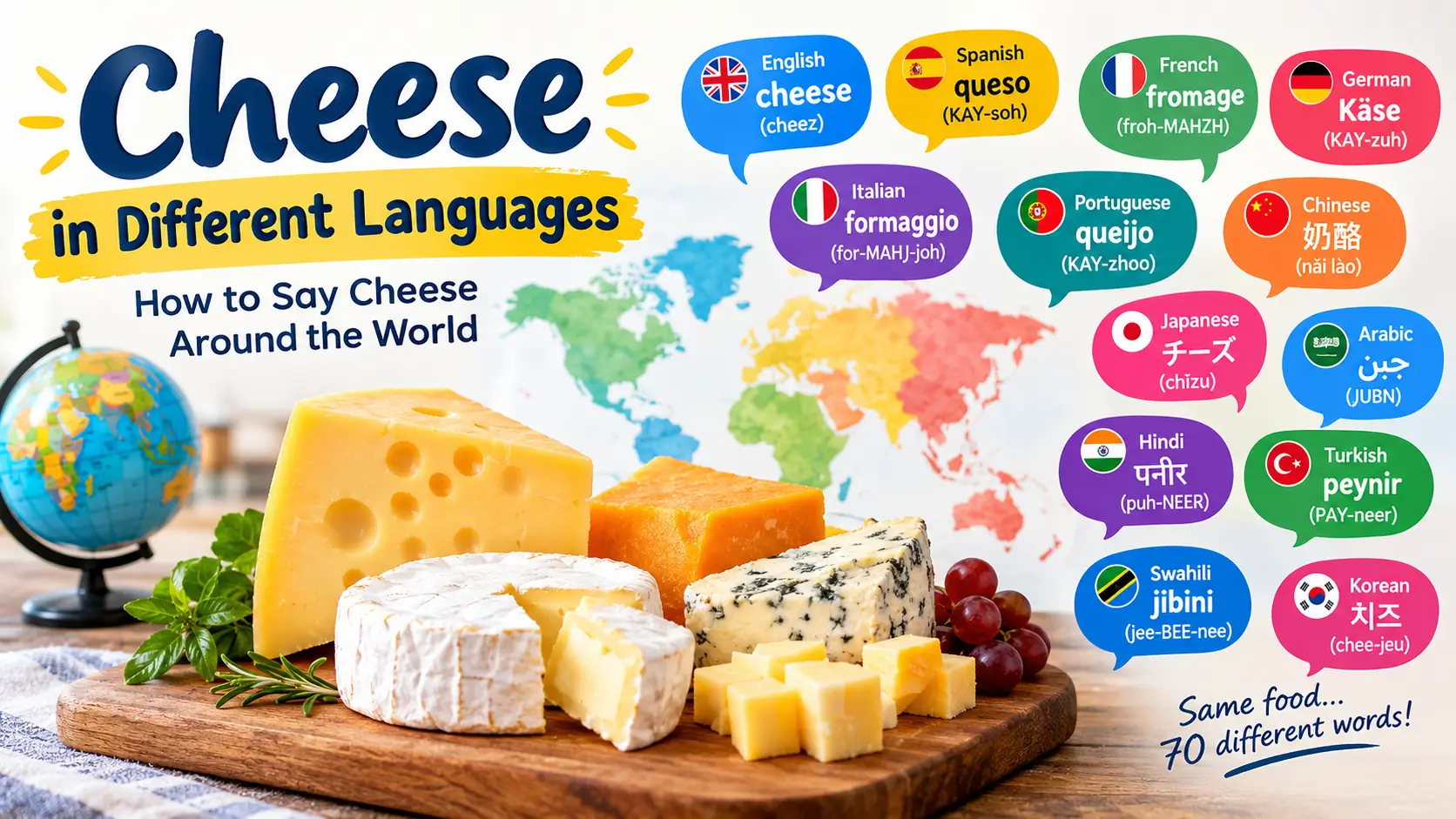
Cheese is one of the world’s most familiar foods, but its name changes from language to language. Learning how to say cheese in different languages is a simple way to explore vocabulary, food culture, and everyday communication around the world.
Whether you are traveling, learning a new language, creating multilingual content, or simply curious about global food words, this guide gives you 70 useful cheese translations in one easy-to-read table.
How to Say Cheese in Different Languages
The word for cheese can vary significantly across languages. Some languages use forms that are historically related to words found in neighboring languages, while others have completely different-looking terms.
The table below shows cheese in all languages with the native expression, an easy English pronunciation, and a short example you can use in everyday conversation.
Cheese in 70 Different Languages
| # | Language | Native phrase | Easy English pronunciation | Example sentence | English meaning |
|---|---|---|---|---|---|
| 1 | English | cheese | cheez | I love cheese on my sandwich. | I love cheese on my sandwich. |
| 2 | Spanish | queso | KAY-soh | Me gusta el queso. | I like cheese. |
| 3 | French | fromage | froh-MAHZH | J’aime le fromage. | I like cheese. |
| 4 | German | Käse | KAY-zuh | Ich mag Käse. | I like cheese. |
| 5 | Italian | formaggio | for-MAHJ-joh | Mi piace il formaggio. | I like cheese. |
| 6 | Portuguese | queijo | KAY-zhoo | Eu gosto de queijo. | I like cheese. |
| 7 | Dutch | kaas | kahs | Ik hou van kaas. | I love cheese. |
| 8 | Swedish | ost | oost | Jag gillar ost. | I like cheese. |
| 9 | Norwegian | ost | oost | Jeg liker ost. | I like cheese. |
| 10 | Danish | ost | ohst | Jeg kan lide ost. | I like cheese. |
| 11 | Finnish | juusto | YOO-stoh | Pidän juustosta. | I like cheese. |
| 12 | Icelandic | ostur | OH-stur | Ég borða ost. | I eat cheese. |
| 13 | Irish | cáis | kaysh | Is maith liom cáis. | I like cheese. |
| 14 | Scottish Gaelic | càise | KAH-shuh | Is toil leam càise. | I like cheese. |
| 15 | Welsh | caws | cows | Rwy’n hoffi caws. | I like cheese. |
| 16 | Polish | ser | sair | Lubię ser. | I like cheese. |
| 17 | Czech | sýr | seer | Mám rád sýr. | I like cheese. |
| 18 | Slovak | syr | seer | Mám rád syr. | I like cheese. |
| 19 | Slovenian | sir | seer | Rad imam sir. | I like cheese. |
| 20 | Croatian | sir | seer | Volim sir. | I love cheese. |
| 21 | Serbian | сир | seer | Волим сир. | I love cheese. |
| 22 | Bosnian | sir | seer | Volim sir. | I love cheese. |
| 23 | Macedonian | сирење | SEE-rehn-yeh | Сакам сирење. | I like cheese. |
| 24 | Bulgarian | сирене | SEE-reh-neh | Обичам сирене. | I love cheese. |
| 25 | Russian | сыр | seer | Я люблю сыр. | I love cheese. |
| 26 | Ukrainian | сир | seer | Я люблю сир. | I love cheese. |
| 27 | Belarusian | сыр | seer | Я люблю сыр. | I love cheese. |
| 28 | Lithuanian | sūris | SOO-ris | Aš mėgstu sūrį. | I like cheese. |
| 29 | Latvian | siers | SEE-ers | Man garšo siers. | I like cheese. |
| 30 | Estonian | juust | YOOST | Mulle meeldib juust. | I like cheese. |
| 31 | Romanian | brânză | BRUN-zuh | Îmi place brânza. | I like cheese. |
| 32 | Hungarian | sajt | shahyt | Szeretem a sajtot. | I like cheese. |
| 33 | Greek | τυρί | tee-REE | Μου αρέσει το τυρί. | I like cheese. |
| 34 | Albanian | djathë | JAH-thuh | Më pëlqen djathi. | I like cheese. |
| 35 | Armenian | պանիր | pah-NEER | Ես սիրում եմ պանիր։ | I love cheese. |
| 36 | Georgian | ყველი | KVEL-ee | მე მიყვარს ყველი. | I love cheese. |
| 37 | Turkish | peynir | PAY-neer | Peyniri seviyorum. | I like cheese. |
| 38 | Azerbaijani | pendir | pen-DEER | Mən pendiri sevirəm. | I like cheese. |
| 39 | Persian | پنیر | pa-NEER | من پنیر دوست دارم. | I like cheese. |
| 40 | Arabic | جبن | JUBN | أنا أحب الجبن. | I love cheese. |
| 41 | Hebrew | גבינה | gvee-NAH | אני אוהב גבינה. | I love cheese. |
| 42 | Hindi | पनीर | puh-NEER | मुझे पनीर पसंद है। | I like paneer/cheese. |
| 43 | Urdu | پنیر | puh-NEER | مجھے پنیر پسند ہے۔ | I like cheese. |
| 44 | Bengali | পনির | poh-NEER | আমি পনির পছন্দ করি। | I like cheese. |
| 45 | Punjabi | ਪਨੀਰ | puh-NEER | ਮੈਨੂੰ ਪਨੀਰ ਪਸੰਦ ਹੈ। | I like cheese. |
| 46 | Gujarati | પનીર | puh-NEER | મને પનીર ગમે છે. | I like cheese. |
| 47 | Marathi | चीज | cheez | मला चीज आवडते. | I like cheese. |
| 48 | Nepali | पनिर | puh-NEER | मलाई पनिर मन पर्छ। | I like cheese. |
| 49 | Tamil | பாலாடைக்கட்டி | paa-laa-dai-KAT-tee | எனக்கு பாலாடைக்கட்டி பிடிக்கும். | I like cheese. |
| 50 | Telugu | చీజ్ | cheez | నాకు చీజ్ ఇష్టం. | I like cheese. |
| 51 | Kannada | ಚೀಸ್ | cheez | ನನಗೆ ಚೀಸ್ ಇಷ್ಟ. | I like cheese. |
| 52 | Malayalam | ചീസ് | cheez | എനിക്ക് ചീസ് ഇഷ്ടമാണ്. | I like cheese. |
| 53 | Sinhala | චීස් | cheez | මම චීස් වලට කැමතියි. | I like cheese. |
| 54 | Chinese (Mandarin) | 奶酪 | nǎi lào | 我喜欢奶酪。 | I like cheese. |
| 55 | Japanese | チーズ | chīzu | 私はチーズが好きです。 | I like cheese. |
| 56 | Korean | 치즈 | chee-jeu | 저는 치즈를 좋아해요. | I like cheese. |
| 57 | Vietnamese | phô mai | foh-my | Tôi thích phô mai. | I like cheese. |
| 58 | Thai | ชีส | cheet | ฉันชอบชีส | I like cheese. |
| 59 | Indonesian | keju | KAY-joo | Saya suka keju. | I like cheese. |
| 60 | Malay | keju | KAY-joo | Saya suka keju. | I like cheese. |
| 61 | Filipino | keso | KEH-soh | Gusto ko ang keso. | I like cheese. |
| 62 | Javanese | keju | KAY-joo | Aku seneng keju. | I like cheese. |
| 63 | Swahili | jibini | jee-BEE-nee | Ninapenda jibini. | I like cheese. |
| 64 | Zulu | ushizi | oo-SHEE-zee | Ngiyawuthanda ushizi. | I like cheese. |
| 65 | Afrikaans | kaas | kahs | Ek hou van kaas. | I love cheese. |
| 66 | Amharic | አይብ | ayb | አይብ እወዳለሁ። | I like cheese. |
| 67 | Somali | farmaajo | far-MAA-joh | Waxaan jeclahay farmaajo. | I like cheese. |
| 68 | Malagasy | fromazy | froh-MAH-zee | Tiako ny fromazy. | I like cheese. |
| 69 | Haitian Creole | fwomaj | fwoh-MAHZH | Mwen renmen fwomaj. | I love cheese. |
| 70 | Esperanto | fromaĝo | froh-MAH-joh | Mi ŝatas fromaĝon. | I like cheese. |
Cheese Translations Around the World
The word for cheese reflects the history and language family of each region. For example, several European languages have related forms, while languages in Asia and Africa often use entirely different vocabulary or borrowed terms.
Some languages also distinguish between different kinds of cheese more specifically. In South Asian languages, for example, words such as paneer commonly refer to a fresh cheese used in cooking.
In everyday conversation, however, the basic word is usually enough to communicate what you mean.
Cheese in European Languages
European languages offer many interesting variations.
French uses fromage, Italian uses formaggio, Spanish uses queso, Portuguese uses queijo, and German uses Käse. Scandinavian languages such as Swedish, Norwegian, and Danish use closely related forms based on ost.
Eastern European languages also have several related forms. Polish uses ser, while Czech and Slovak use sýr/syr. Russian, Ukrainian, and Belarusian use forms based on сыр.
These differences make European cheese vocabulary particularly interesting for language learners.
Cheese in Asian Languages
Asian languages use a wide range of words for cheese.
In Mandarin Chinese, cheese can be called 奶酪, while Japanese uses the borrowed word チーズ and Korean uses 치즈. Vietnamese commonly uses phô mai, while Thai uses ชีส.
South Asian languages have their own vocabulary as well. Hindi, Urdu, Punjabi, Gujarati, and Nepali commonly use forms connected with paneer, while other Indian languages may use borrowed forms such as “cheese” depending on context.
How to Use Cheese in Everyday Sentences
Knowing the translation is useful, but learning a short sentence can make the vocabulary easier to remember.
Useful sentence patterns include:
- I like cheese.
- I love cheese.
- Do you have cheese?
- This cheese is delicious.
- I would like some cheese.
- Where can I buy cheese?
Learning the word together with a practical sentence helps you understand how it functions naturally in conversation.
Common Cheese Vocabulary
When learning cheese translations, it can also help to know related food vocabulary. Words such as milk, bread, butter, pizza, sandwich, dairy, and restaurant frequently appear alongside cheese.
For travelers, food-related vocabulary can be especially useful when ordering meals or asking about ingredients.
Why Learn Cheese in Different Languages?
Learning how to say cheese in different languages can be useful for several reasons:
- Travel: It can make ordering food easier.
- Language learning: Food words are practical everyday vocabulary.
- Cultural learning: Cheese plays different roles in cuisines around the world.
- Communication: A familiar food word can be an easy conversation starter.
- Vocabulary building: Related food terms can be learned together.
The word may look or sound different, but its everyday purpose is easy to understand across cultures.
Frequently Asked Questions
1. How do you say cheese in different languages?
“Cheese” has different names around the world. Examples include queso in Spanish, fromage in French, formaggio in Italian, Käse in German, queijo in Portuguese, keju in Indonesian and Malay, and jibini in Swahili.
2. What is cheese called in Spanish?
Cheese is called queso in Spanish. A simple example is “Me gusta el queso,” meaning “I like cheese.”
3. What is cheese called in French?
Cheese is called fromage in French. For example, “J’aime le fromage” means “I like cheese.”
4. What is cheese called in Hindi and Urdu?
In Hindi, cheese is commonly referred to as पनीर (paneer) when talking about the South Asian fresh cheese, while चीज़ (cheez) is also used for cheese more generally. Urdu commonly uses پنیر (paneer), especially for paneer.
5. What is cheese called in Japanese?
Cheese is チーズ (chīzu) in Japanese. It is a loanword written in katakana and is commonly used for cheese.
Conclusion
Learning cheese in different languages is a simple and enjoyable way to expand your vocabulary while discovering how languages describe familiar foods. From queso and fromage to keju, jibini, チーズ, and 奶酪, the word takes many forms around the world.
Whether you are studying languages, preparing for travel, or simply interested in cheese around the world, these 70 translations provide a useful starting point for everyday communication.

I am Ava Jones, a language enthusiast and author passionate about exploring different languages, sharing useful phrases, explaining meanings, and helping readers communicate confidently across cultures and countries.